Our available controls: Rainier Blinds offers Roman and woven wood shades with motorized operation only. Available controls and power options for other products are confirmed at your consultation.
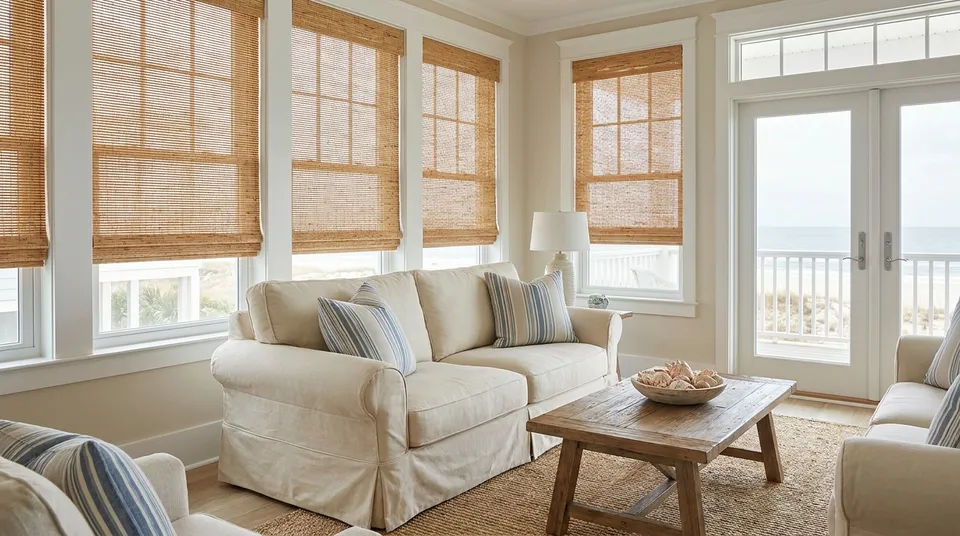
Coastal-style rooms live or die on light: too much glare off the water and the space feels washed out, too much blackout and you lose the airy, sand-and-driftwood mood the style is built on. Woven wood shades solve that balance better than any other window covering for coastal design, and 2026 is a good year to get the weave, liner, and lift mechanism right the first time.
- Driftwood-tone flatweave with a blackout liner is the safe buy for coastal bedrooms and west-facing rooms in 2026.
- Open bamboo weaves without a liner suit covered porches and sunrooms but skip them on unshaded south walls.
- Rainier woven wood shades use motorized operation only. Confirm power and compatible controls and follow the product safety instructions.
- Synthetic woven-look shades mimic the coastal texture at a glance but flatten under close inspection - skip for genuine grasscloth character.
- Motorized woven wood shades handle wide picture windows facing Puget Sound views without a cord to manage.
Why this matters
Coastal design depends on natural texture - reed, bamboo, jute, grasscloth - and most standard roller or cellular shades read as too clean, too synthetic for that look. Woven wood shades bring the texture back without sacrificing function, but the wrong weave openness or the wrong liner choice on a west-facing Seattle-area window turns a design win into a glare problem by July. Rainier Blinds measures and installs woven wood shades across Auburn, Renton, Tacoma, and Bellevue, and the recurring mistake is picking the weave off a showroom sample instead of matching it to the room's actual light exposure.
Who this is for
This guide is for homeowners renovating a beach-house, Cape Cod, or Pacific Northwest coastal-style interior who want the reed and bamboo texture on their windows but aren't sure which weave density, liner, or lift mechanism fits their specific rooms. If you've got a covered porch, a sunroom, or a wide living room window with a view, the picks below map directly to those spaces.
What to look for in woven wood shades for coastal style
Weave openness
A 1/4-inch reed weave blocks more light and glare than a 1/2-inch or 5/8-inch open weave, and that gap matters most on south- and west-facing rooms where Puget Sound afternoon sun hits directly. Tighter weaves also hold their shape better over years of use, which matters in a climate with real humidity swings between winter and summer.
Liner type
A blackout or room-darkening liner turns an airy bamboo shade into a functional bedroom shade without changing the look from outside. Skip the liner on covered patios and porches where you want the texture and dappled light effect - that's the whole point of the material there.
Moisture tolerance
Genuine grasscloth and jute blends can wick moisture in consistently damp rooms, so bathrooms and uncovered outdoor-adjacent spaces need a synthetic-blend weave rated for moisture, not pure natural fiber. This is one of the few spots where a synthetic-look weave beats the real thing on function.
Lift mechanism
Our woven wood shades use motorized operation. Choose the fabric and lining for your room, then we confirm the motor, power option, and controls at your consultation.
Color and tone
Driftwood, sand, and natural bamboo tones read as coastal; dark espresso weaves read more traditional-lodge than beach house. Stick to lighter, warmer tones if the room's palette leans white oak, linen, or weathered blue.
Fade resistance
Direct, unfiltered sun fades natural reed and grasscloth faster than synthetic blends, so a west-facing window with no overhang is the one spot where a synthetic-look woven shade earns its place over the genuine article.
Top picks for coastal-style rooms
Driftwood flatweave with blackout liner - the safe pick. A 1/4-inch flatweave in a driftwood tone with a full blackout liner gives you the coastal texture during the day and full room-darkening at night, which is why it's the most common spec for coastal-style primary bedrooms. Verdict: Buy for bedrooms and media rooms.
Open bamboo weave, no liner - the airy pick. A 5/8-inch open bamboo weave with no liner lets soft, filtered light through and casts the shadow pattern that makes covered porches and sunrooms feel coastal instead of just beige. It only works where there's an overhang or covered structure cutting direct sun. Verdict: Buy for covered porches and sunrooms, Consider for unshaded south walls.
Our woven wood shades use motorized operation. Choose the fabric and lining for your room, then we confirm the motor, power option, and controls at your consultation.
Motorized woven wood shade - the wide-window pick. For a picture window or a wall of glass facing a Sound view, motorized lift covers widths a manual cord or wand can't manage cleanly, and it's controllable by app or wall switch without a visible cord at all. Motorized shades make the most sense on windows over 60 inches wide or anywhere the lift mechanism would otherwise sit behind furniture. Verdict: Buy for wide or hard-to-reach windows.
Synthetic woven-look shade - the budget mimic. These look close to grasscloth in a catalog photo but flatten out and lose the texture depth in person, and they don't take a driftwood stain the same way real reed does. The one place they win is a moisture-prone room where genuine natural fiber shouldn't go anyway. Verdict: Skip for main living spaces, Consider for bathrooms only.
Plan your coastal window treatments
In-home measuring and installation across the Greater Seattle Area.
What to avoid
- Dark espresso or black-tone weaves - they photograph well but shift the room toward lodge or farmhouse style, not coastal.
- No liner on an unshaded west-facing window - the open weave that looks perfect in the showroom will let in enough glare by 4pm to make the room unusable in summer.
- Pure grasscloth in a laundry room or bath - moisture will warp and discolor natural fiber weaves faster than almost any other room in the house.
Before you commit to woven wood over roller or cellular shades, it's worth comparing how each material handles glare and insulation for South King County's specific light and weather pattern - see the roller vs. cellular shade comparison for the tradeoffs.
Verdict comparison
| Pick | Weave openness | Liner | Best room | Verdict |
|---|---|---|---|---|
| Driftwood flatweave | 1/4 inch | Blackout | Bedroom, media room | Buy |
| Open bamboo | 5/8 inch | None | Covered porch, sunroom | Buy / Consider |
| Motorized woven wood | 1/4-1/2 inch | Light-filtering | Family room, kids' room | Buy |
| Motorized woven wood | 1/4-1/2 inch | Blackout or filtering | Wide picture windows | Buy |
| Synthetic woven-look | N/A | Moisture-resistant | Bathroom only | Skip / Consider |
FAQ
What are woven wood shades and why do they suit coastal-style homes?
Woven wood shades are window coverings made from natural materials like bamboo, reed, jute, or grasscloth, and they suit coastal-style homes because the texture and color range - driftwood, sand, natural tan - match the beach-house palette better than smooth vinyl or fabric shades.
Do woven wood shades work in humid coastal climates like the Puget Sound?
Yes, but genuine natural-fiber weaves in consistently damp rooms like bathrooms should get a moisture-resistant synthetic blend instead, since pure grasscloth and jute can warp with repeated humidity exposure.
What's the difference between light-filtering and blackout woven wood shades?
Light-filtering woven wood has no liner and lets soft, dappled light through the weave, while blackout woven wood has a solid liner sewn behind the fabric that blocks nearly all light for bedrooms and media rooms.
Are cordless woven wood shades safe for homes with kids and pets?
Our woven wood shades use motorized operation. Choose the fabric and lining for your room, then we confirm the motor, power option, and controls at your consultation.
Can woven wood shades be motorized?
Yes, motorized woven wood shades are common on wide picture windows and hard-to-reach spots, controlled by wall switch or app instead of a cord or wand.
How much light does a woven wood shade block without a liner?
An open weave without a liner blocks glare and direct sightlines but still lets a soft glow through, which is why unlined weaves work for porches and sunrooms but not bedrooms that need full darkness.
What colors of woven wood shades match a coastal design palette?
Driftwood, sand, and natural bamboo tones match a coastal palette, while dark espresso or black-stained weaves read closer to lodge or farmhouse style.
Do woven wood shades fade in direct sun?
Genuine natural reed and grasscloth fade faster than synthetic-blend weaves under direct, unfiltered sun, so unshaded west-facing windows are the one spot where a synthetic-look weave holds its color longer through 2026 and beyond.
One last thing
Most homeowners over-liner their woven wood shades - a covered porch or a north-facing sunroom almost never needs a blackout backing, and adding one just cancels out the texture and shadow effect that made the coastal weave worth choosing in the first place. Save the blackout liner for the one or two rooms in the house that actually face direct afternoon sun.
Related guides
In-home consultations are free within 60 driving miles of Auburn. Farther projects are considered individually; any consultation fee is quoted before booking and credited toward your order.