
Our available controls: Rainier Blinds offers Roman and woven wood shades with motorized operation only. Available controls and power options for other products are confirmed at your consultation.
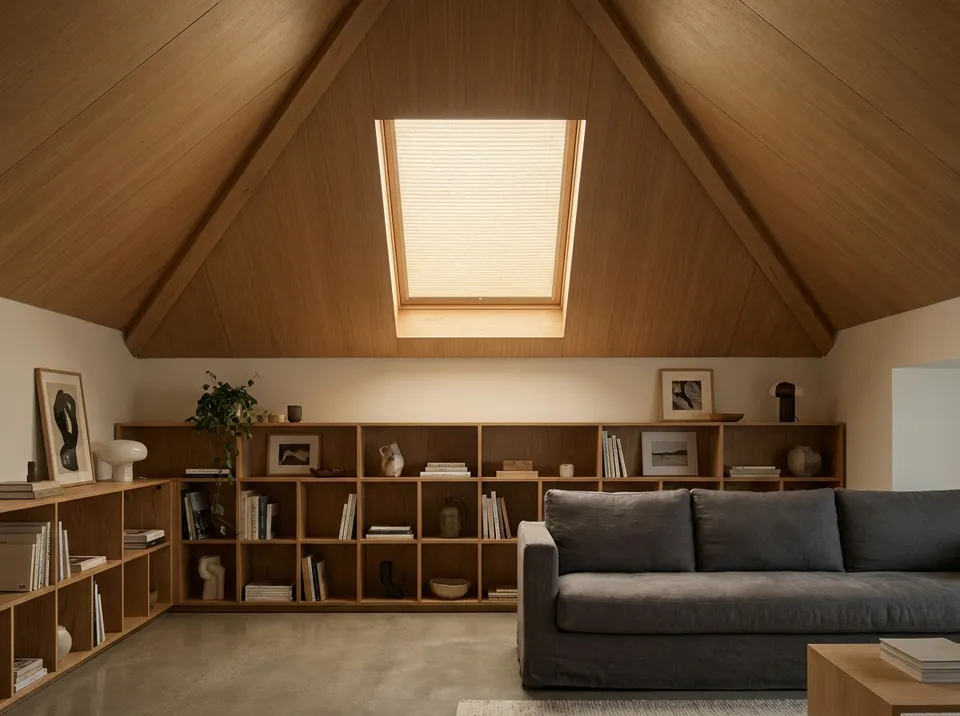
Skylight shades in Auburn, WA solve a specific problem: roof glass brings heat and glare into rooms that are hard to reach. This 2026 guide compares blackout, light-filtering, sunscreen, cellular, and motorized options, then shows how local measuring, custom fabrication, and installation should work. For homes in Lea Hill, Lakeland Hills, West Auburn, and nearby South King County, start with the Auburn service area page when the opening needs an on-site plan rather than a stock size.
TL;DR
- Skylight shades Auburn WA homes need when vaulted or roof glass overheats a room.
- Motorized blackout cellular shades win for sleeping spaces; light-filtering shades win for living areas.
- Custom measuring beats stock sizing on angled, sloped, recessed, and specialty-shaped openings.
- Rainier Blinds measures, has shades custom-made to your exact measurements, and installs with its own crew.
Why this matters
Skylights and angled windows do not behave like vertical windows. The glass faces the sky, the opening may sit in a vaulted ceiling, and the shade can be above a stairwell or a double-height room. A treatment that looks right on a sample window can bind, leave bright edges, or become impossible to operate when the final opening is sloped.
Auburn homes range from older West Auburn and Auburn Highlands houses with added roof glass to newer Lakeland Hills builds with vaulted great rooms. Summer daylight arrives early, and west-facing skylights can keep a room hot late. South King County\u2019s gray winter does not eliminate glare; low sun still lands on a screen, sofa, or dining table.
Buying in 2026 starts with the room\u2019s job: sleep, glare, heat, privacy, or view. Rainier Blinds\u2019 custom window treatments page lists skylight shades plus roller, cellular, zebra, Roman, woven wood, day/night, dual, and drapery options for the rest of the room. Use the skylight\u2019s actual shape and reach to narrow that list.
Who this is for
This guide is for Auburn homeowners with skylights, roof windows, vaulted-ceiling glass, or angled openings who want reliable light control without climbing a ladder every morning. It fits bedrooms, home offices, stairwells, great rooms, and additions where the window is too high, too steep, or too awkward for a normal manual lift.
It is also for homeowners comparing a local measured-and-installed project with a stock kit. If the opening is reachable, square, and rarely used, manual operation can be enough. If the opening sits over a stair, bed, or double-height room, the right motor and mounting plan matter more than choosing a color from a sample book.
What to look for in skylight shades for Auburn homes
1. Shape, angle, and depth before fabric
Start with the opening, not the shade style. A measuring crew should check width and height at three points, record the slope, note casing depth, and identify obstructions such as trim, handles, screens, or a ceiling beam. A quarter-inch gap at an edge can turn a blackout selection into a bright morning outline.
Trapezoid and arched openings need their own plan; a standard rectangle does not belong on an angled frame. Ask whether the shade covers the full opening, the rectangular section below an arch, or only the operable portion. That answer changes the hardware, fabric shape, and price.
2. Opacity matched to the room
Choose the fabric by the failure you need to stop.
- Blackout blocks the strongest daylight and is the right starting point for bedrooms, nurseries, and rooms used for daytime sleep.
- Light-filtering softens direct sun while keeping the room usable for living, reading, and video calls.
- Sunscreen cuts glare and keeps more of the outdoor view, but it is not the same as nighttime privacy when the room lights are on.
Auburn homeowners often make the 2026 mistake of specifying one opacity for every skylight. A blackout bedroom and a light-filtering great room can share a hardware family while doing different jobs. Decide what the room should feel like at 8 a.m., 2 p.m., and after dark before choosing.
3. Heat and insulation, not just brightness
Roof glass receives direct solar load differently from a wall window. If the problem is a hot room, a light-filtering fabric may soften the glare without reducing enough heat. Cellular construction traps air and is the better insulation-first choice when the skylight sits over a bedroom or older room that already runs cold in winter.
Sunscreen roller fabric suits a room where the view and glare control matter more than full dark. Blackout fabric suits sleep and media use. For a large vaulted room, compare the heat job and the light job separately; one fabric rarely wins both without a trade-off.
4. Motorization and power access
Motorization is the practical choice for a skylight above a stairwell, a tall great room, or any opening that would require a ladder. Battery, solar, hardwired, and Power over Ethernet options are available across the package range; the correct choice depends on roof access, wiring, shade weight, and how often the shade moves.
Manual operation still makes sense for a low-slope opening you can reach safely. Do not pay for automation where the shade is opened twice a year. Do motorize the opening you will otherwise leave closed because reaching it is inconvenient. Set the control method before the shade is custom-made so the headrail, power path, and travel limits are planned together.
5. Edge coverage, service, and warranty
A skylight shade can have the right fabric and still fail at the edges. Ask how the side rails, bottom rail, cassette, and mounting position control light gaps. Inside mount keeps the hardware visually contained when depth allows it; outside mount gives more room to cover an irregular opening. The installer should show the fully lowered position from the bed, desk, or seating area that actually uses the room.
Rainier Blinds measures the opening, has the shade custom-made to your exact measurements, and returns with its own crew to install it. Manufacturing is handled for your home, not in-house. The services page lists package warranties up to 5 years; confirm the product and labor coverage that applies to the selected skylight shade before you decide.
Top picks for Auburn and South King County
The sleep pick: motorized blackout cellular skylight shades
Buy. Motorized blackout cellular shades are the strongest fit for bedrooms, lofts, and rooms where the skylight wakes people before the alarm. The cellular structure adds an insulating layer while blackout fabric handles the primary light problem. Motorization removes the ladder from the daily routine and lets you set a repeatable morning opening.
This choice earns the extra hardware when the shade is high, the room is used every day, or the sleeper needs daytime darkness. Confirm the bottom stop and side coverage at installation. A motor solves reach; it does not fix a poor measure.
The living-room pick: light-filtering cellular skylight shades
Buy. Light-filtering cellular shades soften overhead sun in Auburn great rooms without turning the ceiling into a dark panel. They suit reading areas, kitchens, and open living spaces where the room still needs daytime brightness. Choose manual operation only when the opening is safely reachable; choose motorization when the ceiling height makes adjustment unrealistic.
Cellular is the better first conversation when the room loses heat through older roof glass. If glare is the only issue and the view matters more than insulation, compare a sunscreen roller before you commit.
The view pick: sunscreen roller skylight shades
Consider. Sunscreen roller shades are the clean choice for offices and living rooms that need glare control while preserving a connection to the sky. They reduce the harsh patch of light on a monitor or floor without forcing the room to full blackout during the day. The trade-off is clear: sunscreen is a daytime comfort fabric, not a complete night-privacy solution.
Pair it with an appropriate treatment on the room\u2019s vertical windows if neighbors can see in after dark. The shade should be judged from the desk or sofa, not only from the floor beneath the skylight.
The two-job pick: day/night or dual skylight shades
Buy when both jobs are real. A day/night shade combines sheer and blackout layers; a dual shade pairs sunscreen and blackout fabrics on one system. Both are useful when the room needs filtered daylight during work hours and deeper dark for movies or sleep. The second layer adds depth and hardware, so verify the recess before choosing it for a shallow or irregular opening.
Do not buy a dual system simply because the catalog offers two fabrics. Buy it when changing the fabric during the day is part of the room\u2019s routine. Otherwise, one well-matched opacity is simpler and easier to service.
What to avoid
Stock sizing on an angled or recessed opening
A stock rectangle assumes a stock opening. Skylights rarely cooperate. A shade that is slightly narrow leaves a bright edge; one that is too wide binds against the frame or track. Let the measure account for the actual slope, recess, and obstructions before the fabric is finalized.
One opacity for every skylight
Blackout above a living room can make the space feel closed during the day. Sunscreen above a bedroom can leave the sleeper fighting dawn. Assign each skylight a job, then choose the fabric that solves that job instead of copying the first selection across the house.
Motorizing without a service plan
A hard-to-reach shade needs a clear path for battery access, solar exposure, wiring, and future adjustment. Ask who will set the travel limits and what happens if the motor needs service. A remote on the wall is not a complete plan if the shade cannot be reached for a reset or recharge.
Verdict comparison
| Option | Best for | Main strength | Verdict |
|---|---|---|---|
| Motorized blackout cellular | Bedrooms and daytime sleep | Dark plus insulation | Buy |
| Light-filtering cellular | Great rooms and kitchens | Soft daylight plus insulation | Buy |
| Sunscreen roller | Offices and view-focused rooms | Glare control with view | Consider |
| Day/night or dual shade | Rooms with two light jobs | Two fabrics in one system | Buy when needed |
| Stock rectangle kit | Angled or recessed openings | Low upfront effort | Skip |
How local measure, custom fabrication, and install works
Rainier Blinds follows a straightforward four-step process for Auburn skylight shades:
- Consult: Identify which rooms need blackout, glare control, insulation, privacy, or a view. Bring up the opening shape and how often the shade will move.
- Measure: The crew checks the frame, slope, depth, access, and obstacles in person. Three readings at the opening are more useful than one measurement from the floor.
- Our team measures the openings, arranges the custom order, and installs the selected treatments. We confirm the production and installation schedule for your project; motor setup and operation checks are included where applicable.
- Install: The same local crew returns to mount the shade, set the travel limits, test the control, and show the lowered position from the room\u2019s real use points.
That is the difference between a skylight project and an online cart. The shades are custom-made for your home. Rainier Blinds handles the local measure, coordination, and installation with its own crew. Homeowners in South King County can also review the Federal Way service area when the project includes more than one city.
Request a skylight shade quote with the room count, approximate opening sizes, ceiling height, and the main problem in each room. Clear inputs make the on-site conversation faster and keep the quote tied to how the rooms are used.
FAQ
What are the best skylight shades for Auburn WA homes in 2026?
Can skylight shades be motorized?
How much do skylight shades cost in Auburn, WA?
Are blackout skylight shades worth it for bedrooms?
What is the best skylight shade for a vaulted living room?
How long does it take to install custom skylight shades?
Does Rainier Blinds manufacture skylight shades in-house?
One last thing
The detail most Auburn homeowners miss in 2026 is the final lower stop. A skylight shade can look correct while raised and still leave a strip of sun across a bed, desk, or television when lowered. Have the installer demonstrate the fully closed position from the room\u2019s actual seating and sleeping points before the crew leaves.