Our available controls: Rainier Blinds offers Roman and woven wood shades with motorized operation only. Available controls and power options for other products are confirmed at your consultation.
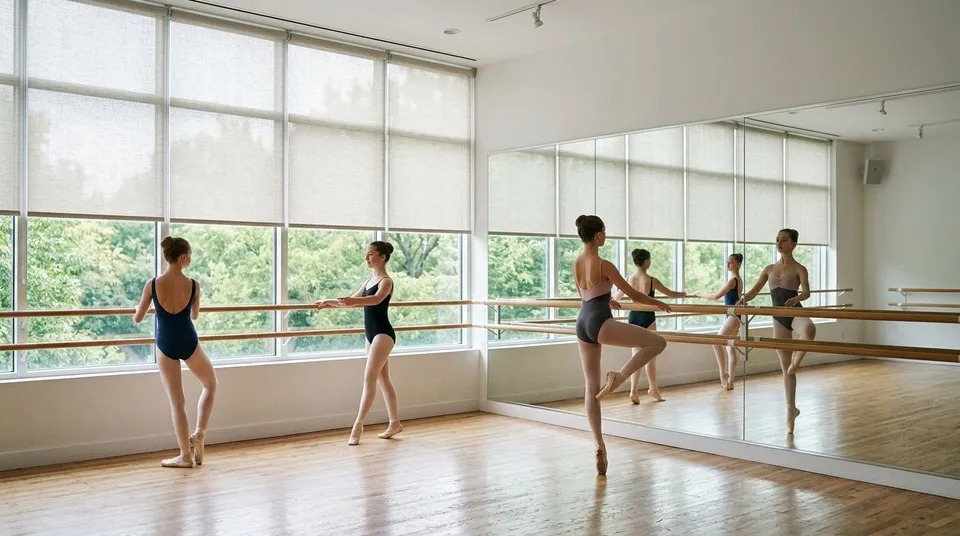
Dance and ballet studios need shades that solve three problems at once: mirror glare, privacy from street-level glass, and safety around barres where kids and adults move fast. Cordless roller shades, zebra shades, and motorized options solve most studio window problems without blocking the natural light instructors rely on for warm-ups.
- Cordless roller and zebra shades are the safest, lowest-profile choice for shades for dance studios with barres near windows.
- Full blackout kills the daylight most studios want for warm-up hours, so light filtering or dual day/night shades work better for most rooms.
- Storefront glass studios need privacy control that doesn't require a full room blackout every time class starts.
- Motorized shades solve the access problem on clerestory windows above mirror walls that nobody can reach with a wand.
- Fabric choice matters more in a studio than a living room because sweat and humidity break down the wrong material fast.
Why this matters
A dance studio isn't a living room with more mirrors. Windows sit behind mirror walls, above barres, or across storefront glass that faces a parking lot, and every one of those conditions changes what shade actually works. Get the wrong fabric or the wrong operation type and you're replacing shades within a year or dealing with a safety complaint from a parent.
Studios in the Puyallup, Auburn, and South King County area also deal with long gray stretches where natural light matters for morning classes, then harsh low-angle sun in late afternoon that blows out mirrors. A studio owner who treats every window the same way ends up over-blacking-out rooms that need daylight, or under-controlling glare in rooms that need it.
Why shades matter for dance and ballet studios
The two biggest complaints from studio owners are glare on mirrors during afternoon classes and street-level visibility into rooms where kids are changing or stretching near the front window. Both are solvable with the right shade type, and neither requires blocking every window in the building.
Studios with floor-to-ceiling storefront glass also face a third issue: passersby watching class through the window creates a distraction for younger students and a privacy concern for parents. Shades for fitness studios and yoga spaces face a similar set of constraints, though dance studios add the mirror-wall problem that yoga rooms usually don't have.
Measure and map every window against your mirror walls
Before picking a shade type, walk the room and note where windows sit relative to mirrors. A window directly across from a mirror wall throws glare straight into dancers' sightlines during barre work, which is a different problem than a window beside the mirror that just needs privacy.
- Mark which windows face mirror walls directly versus at an angle
- Note ceiling height at each window, since clerestory glass above 9 feet usually needs motorization
- Check for barres mounted on or near the window wall
- Flag any skylights or transom windows separately from standard wall windows
- Record which windows face the parking lot or street versus an interior courtyard
Choose blackout or light filtering based on class type
Most studios don't need full blackout across the board. Ballet and jazz classes running in daylight hours want natural light for warm-ups, while competition teams reviewing video or studios livestreaming recitals need a room that can go fully dark on demand.
- Light filtering fabric for rooms used mainly for morning and midday classes
- Blackout shades for any room doubling as a video review or recording space
- Dual day/night shades where one room serves both purposes at different hours
- Zebra shades for rooms that need adjustable opacity without swapping shade types
A studio that records competition footage or streams classes has more in common with a content studio setup than a typical retail space. Blackout shades for streaming and content creator studios covers the same light-control logic that applies to a recital room used for video capture.
Pick cordless or motorized operation for safety
A studio full of kids running drills near a window with a dangling cord is a liability problem waiting to happen. Cordless operation isn't optional in a room where children under 10 are training near the glass.
- Cordless roller or cellular shades for any window within reach of a barre or open floor space
- Motorized shades for windows above 8 feet or behind fixed mirror panels nobody can reach with a pole
- Smart-tier shades with app or group scheduling for studios running back-to-back classes with different light needs
- Battery-powered motorized units for retrofit windows where running wiring isn't practical
Verdict: cordless is the baseline, not the upgrade, for any studio with children on the floor.
Match fabric to humidity and sweat exposure
A dance studio runs warmer and more humid than a typical commercial space, especially during peak class hours with 20-plus bodies moving. Fabric that's fine in an office window can warp or discolor faster in a studio.
- Vinyl-backed or moisture-resistant roller fabric for rooms with heavy activity
- Avoid fabrics prone to sagging or stretching under humidity swings
- Cellular shades in high-traffic rooms hold shape better than lightweight roman fabrics
- Wipe-down fabric surfaces matter more here than in a residential install
Control street-level privacy without full blackout
Studios in strip-mall storefronts or ground-floor spaces deal with foot traffic and street sightlines all day. The fix isn't blacking out the whole window, it's controlling how much a passerby can see without cutting off the light instructors want.
- Zebra shades let you dial opacity up during class and open it fully between sessions
- Outdoor-style privacy fabric on street-facing glass reduces glare and eyes-in without going dark
- Choosing shade opacity for privacy and natural light walks through the opacity range between sheer and full blackout in more detail
- Frosted-effect light filtering fabric works well for changing areas adjacent to the main floor
Handle skylights and clerestory windows separately
Many converted retail and warehouse spaces used for dance studios have skylights or high clerestory glass that a standard wand or crank can't reach. These need their own plan, not an afterthought.
- Motorized skylight shades for any overhead glass above a mirror wall
- Trapezoid or arched shade tracks for angled architectural windows common in converted spaces
- Group these on a separate remote or scheduling zone from the standard wall windows
Comparison: shade options for dance and ballet studios
| Option | Best for | Key limitation |
|---|---|---|
| Cordless roller shades | Windows near barres and open floor space | Manual raise/lower on very tall windows |
| Zebra shades | Storefront glass needing adjustable privacy | Not full blackout even at max close |
| Cellular shades | Rooms with heavy humidity and sweat exposure | Higher cost than basic roller fabric |
| Motorized shades | Clerestory glass and mirror-topped windows | Needs power access or battery unit |
| Skylight shades | Converted spaces with overhead glass | Install access can be tighter than wall windows |
Verdict: zebra or cordless roller shades handle 80 percent of a typical studio's windows, with motorized units reserved for the windows nobody can physically reach.
Get a studio window consult
In-home or on-site measure with real pricing, no online guesswork.
Common mistakes dance studios make
- Blacking out every window by default. Full blackout kills the daylight morning and midday classes rely on, when light filtering or a dual shade would have worked.
- Installing corded shades near barres. A cord within reach of a stretching or falling dancer is a safety issue that cordless operation avoids entirely.
- Ignoring fabric durability for sweat exposure. Standard light fabric sags or discolors faster in a room running warmer and more humid than a typical commercial space.
- Skipping motorization on clerestory glass. A shade nobody can reach with a wand stays open or closed permanently, which defeats the purpose of installing it.
- Treating storefront glass as an all-or-nothing privacy problem. Zebra shades solve the passerby issue without cutting light between classes.
FAQ
What's the best shade for a dance studio with mirror walls?
Cordless roller shades or zebra shades work best across from mirror walls because they control glare without eliminating the daylight instructors use during warm-ups. Motorized versions handle any window mounted above the mirror line that a wand can't reach.
Do dance studios need full blackout shades?
Only in rooms used for video recording, competition review, or livestreaming, where consistent light matters more than daylight. Most class floors do better with light filtering or dual day/night shades that keep natural light available during regular hours.
Is motorized better than manual for a studio with high windows?
Yes, for any window above roughly 8 feet or mounted over a fixed mirror panel where a wand or crank can't reach. Manual shades work fine on standard wall-height windows within arm's reach.
How do you handle privacy for a studio with storefront glass?
Zebra shades give you adjustable opacity so passersby can't see in during class without blocking light entirely between sessions. Full blackout is overkill for most storefront studios and cuts natural light the rest of the day.
What fabric holds up best in a humid, high-activity studio room?
Vinyl-backed roller fabric and cellular shades hold shape better under humidity swings than lightweight roman shade fabric. Studios running 20-plus dancers per class generate more heat and moisture than a typical commercial room.
Are cordless shades required for studios with young children?
Cordless operation isn't a legal requirement everywhere, but any window within reach of a barre or open floor used by children under 10 should be cordless as a safety baseline. A dangling cord near active floor space is an avoidable liability.
Can shades be grouped so different studio rooms open on a schedule?
Smart-tier motorized shades support app or scheduling controls that raise or lower groups of shades by room or by class block. That's useful in studios running back-to-back classes with different light needs across multiple rooms.
One last thing
A studio that only fixes glare on the window directly across from the mirror and ignores the windows beside it still gets afternoon flare bouncing off the glass at an angle. Map the whole wall, not just the window that's obviously a problem, before you order anything for 2026.