
Our available controls: Rainier Blinds offers Roman and woven wood shades with motorized operation only. All other shade styles are available with manual, motorized, or smart control. Your consultation confirms the controls and power options for your product.
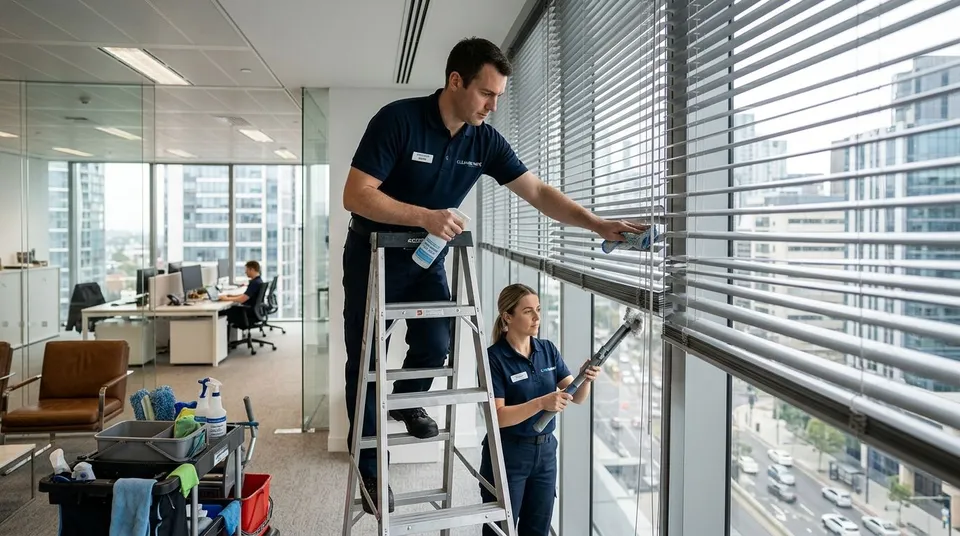
Commercial blind cleaning services keep window coverings in offices, retail stores, medical suites, and multi-family common areas dust-free and fully functional, with the goal of protecting the investment a property owner already made in window treatments. What separates commercial cleaning needs from a homeowner's is scale and liability: dozens or hundreds of units, tenant complaints when a cord jams, and a facilities budget that has to account for wear on high-traffic glass.
- Commercial blind cleaning services in 2026 keep offices, retail floors, and medical suites presentable, but dusting alone won't fix cracked slats or dead motors.
- Rainier Blinds measures and installs replacement roller, cellular, and zebra shades for commercial spaces that need less upkeep than traditional slat blinds.
- A written maintenance contract should spell out cleaning frequency, method by material, and who handles repair versus full replacement.
- Skip DIY work on motorized commercial shades; unsupervised cleaning voids warranty coverage on the wiring and motor.
Why blind cleaning and maintenance matter for commercial buildings
A lobby, exam room, or retail storefront with grimy or sagging window coverings signals neglect faster than almost anything else in the space. Property managers in South King County and the Greater Seattle Area deal with this constantly: tenants notice broken slats and stuck cords before they notice anything else about the unit.
Commercial spaces also see faster wear than homes. Higher foot traffic, more direct sun exposure through storefront glass, and constant HVAC cycling all shorten the working life of window coverings. Facilities teams that skip a cleaning and inspection schedule end up paying for full replacements years earlier than they should have.
Rainier Blinds regularly gets called into commercial window treatments for retail storefronts after a business owner tried to patch a failing blind system rather than replace it, and the repair cost more in labor than a new set of shades would have.
Audit what you're maintaining
Before any cleaning schedule gets written down, someone needs to know what's actually on the windows.
Walk every window covering in the building
- Note the material at each window: fabric roller shade, cellular honeycomb, vinyl slat blind, zebra dual-layer, or drapery panel.
- Flag units with visible fading, sagging, or broken slats.
- Record whether each unit is manual, motorized, or smart-controlled.
- Mark high-traffic zones (entryways, conference rooms, exam rooms) that need more frequent attention.
- Photograph anything already damaged for the maintenance file.
Match the cleaning method to the material
Not every window covering in a commercial building gets cleaned the same way, and using the wrong method shortens the life of the fabric or the mechanism.
- Fabric roller and roman shades: vacuum with a brush attachment, spot clean with a mild solution.
- Cellular shades: compressed air or a soft brush in the honeycomb folds; never soak.
- Zebra and dual-layer shades: wipe the sheer sections with a dry microfiber cloth, avoid pulling on the alternating bands.
- Vinyl or aluminum slats: damp cloth wipe-down, slat by slat, closed position first.
- Outdoor steel wire and zipper track shades: hose off debris, check the track for grit buildup that strains the motor.
Set a cleaning frequency by zone
- Lobbies and entryways: monthly, given foot traffic and dust.
- Private offices and back-of-house rooms: quarterly.
- Medical and dental exam rooms: monthly, tied to infection-control standards the practice already follows.
- Storage and low-use rooms: twice a year is usually enough.
- Outdoor and patio shades: seasonal, before and after the wet Pacific Northwest months.
Decide who actually does the cleaning
Most buildings split this between in-house janitorial staff and a specialty vendor, and getting that split wrong is where budgets blow up.
- In-house staff can handle routine dusting and light vacuuming on manual shades.
- A janitorial contract can absorb cleaning into an existing scope if the crew is trained on fabric care.
- A specialty blind and shade vendor should handle anything motorized, since unsupervised cleaning around wiring risks the warranty.
- Facilities teams juggling multiple properties often standardize on one vendor across all locations to keep the paper trail simple.
- Whoever cleans should also log damage they spot, so small problems get flagged before they become full outages.
Budget for repair and replacement, not just cleaning
A cleaning contract only maintains what's already there. At some point, slats crack, cords fray, or a motor stops responding, and cleaning can't fix any of that.
This is where a lot of commercial buildings quietly overspend: they keep paying a cleaning vendor to service window coverings that are past the point of being worth maintaining. Rainier Blinds measures and installs replacement roller, cellular, zebra, and outdoor shades for commercial properties across Auburn, Bellevue, Tacoma, and the rest of the Greater Seattle Area, using its own measure and install crew rather than a subcontractor. Swapping worn slat blinds for cellular or roller shades in high-traffic zones often cuts the ongoing maintenance load significantly, since fewer moving parts mean less that can jam or crack.
Put the maintenance contract in writing
- Specify cleaning frequency by room type, not a blanket "monthly" for the whole building.
- List the material-specific method the vendor is contracted to use.
- Define what counts as "repair" versus "replacement" and who approves the spend.
- Require a damage log after every visit, not just a service confirmation.
- Set a review date, at least annually, to reassess whether shades in high-wear zones need replacing rather than continued servicing.
Plan for end-of-life replacement before it's an emergency
- Track install dates so nothing gets forgotten for a decade.
- Budget replacement in phases by zone rather than all at once.
- Prioritize public-facing rooms (lobbies, conference rooms, exam rooms) for upgrades first.
- Loop in a measure-and-install crew, like the one at Rainier Blinds, before a failure forces an emergency order.
“If a window covering costs more in cleaning labor than a replacement shade would cost to install, it's not a maintenance problem anymore, it's a replacement decision.”
Comparison: who handles commercial blind cleaning and maintenance
| Option | Best for | Key limitation |
|---|---|---|
| In-house janitorial staff | Routine dusting on manual shades in low-traffic rooms | Not trained for motorized units or fabric-specific care |
| Existing janitorial contract, expanded scope | Buildings that already have a cleaning vendor on site | Vendor may not know material-specific handling, risking fabric wear |
| Specialty blind and shade vendor | Motorized shades, high-traffic zones, warranty-sensitive equipment | Adds a separate line item to the facilities budget |
| Measure-and-install crew for replacement | Units past the point cleaning can fix | Doesn't cover ongoing cleaning, only repair and replacement |
Verdict: for offices and retail spaces running slat blinds past their working life, replacing them with roller, cellular, or zebra shades from a crew like Rainier Blinds' own measure and install team cuts the long-term maintenance burden more than any cleaning contract can. Buy the replacement conversation before the cleaning contract renewal, not after.
Common mistakes commercial property managers make
- Treating cleaning and repair as the same line item. A cleaning vendor dusting a cracked slat blind every month doesn't fix the crack; it just delays the decision.
- Skipping the material audit. Buildings with mixed window coverings (some vinyl slats, some fabric shades, some motorized) often get one cleaning method applied to all of them, which damages the fabric ones.
- Letting janitorial staff touch motorized units. Untrained cleaning around a motorized shade's wiring is one of the fastest ways to void a warranty.
- No damage log. Without a written record after each cleaning visit, small issues like a fraying cord go unnoticed until the unit fails completely.
- Waiting for total failure before budgeting replacement. Reactive replacement always costs more than a phased upgrade planned around a lease renewal or annual budget cycle.
Get a commercial shade consultation
Rainier Blinds measures and installs commercial shades across the Greater Seattle Area.
FAQ
What's included in a commercial blind cleaning service?
A commercial blind cleaning service typically covers dusting, vacuuming, or spot cleaning of window coverings on a set schedule, plus a visual check for cord and slat damage. It does not typically cover motor repair or fabric replacement, which usually falls to a separate vendor.
How often should commercial blinds be cleaned?
High-traffic zones like lobbies and entryways need monthly attention in 2026, while private offices and storage rooms can go quarterly or twice a year. Medical and dental exam rooms usually align cleaning frequency with the practice's existing infection-control schedule.
Should in-house staff clean motorized commercial shades?
No. Cleaning around a motorized shade's wiring without training risks the warranty and can damage the motor housing. A specialty vendor or the original install crew should handle motorized units.
Is it better to repair or replace worn commercial blinds?
If a unit needs repair more than once a year, replacement usually costs less over time than continued repair labor. Rooms with heavy foot traffic or direct sun exposure tend to hit that threshold fastest.
What should a commercial maintenance contract specify?
It should list cleaning frequency by room type, the material-specific method to be used, who approves repair versus replacement spending, and a requirement for a damage log after every visit.
Do cellular or roller shades need less maintenance than slat blinds?
Yes, generally. Fewer moving parts and no individual slats to bend or crack means roller, cellular, and zebra shades typically need less frequent repair intervention than traditional slat blinds in commercial settings.
Can Rainier Blinds replace commercial window coverings, not just clean them?
Rainier Blinds measures and installs replacement shades, including roller, cellular, zebra, and outdoor options, for commercial properties across Auburn, Bellevue, Tacoma, and the Greater Seattle Area using its own crew.
What's the biggest mistake in commercial blind maintenance contracts?
Treating every window covering the same regardless of material. Vinyl slats, fabric shades, and motorized units each need a different cleaning method, and applying one blanket approach damages the more delicate materials fastest.
One last thing
The cleaning contract renewal is usually the moment a facilities budget quietly locks in another year of servicing window coverings that should have been replaced already. Before signing, walk the building and flag which units are being cleaned versus which ones are being propped up. In 2026, a five-minute audit at renewal time saves more than a year of line-item cleaning fees on hardware that's already past its working life.