
Our available controls: Rainier Blinds offers Roman and woven wood shades with motorized operation only. Available controls and power options for other products are confirmed at your consultation.
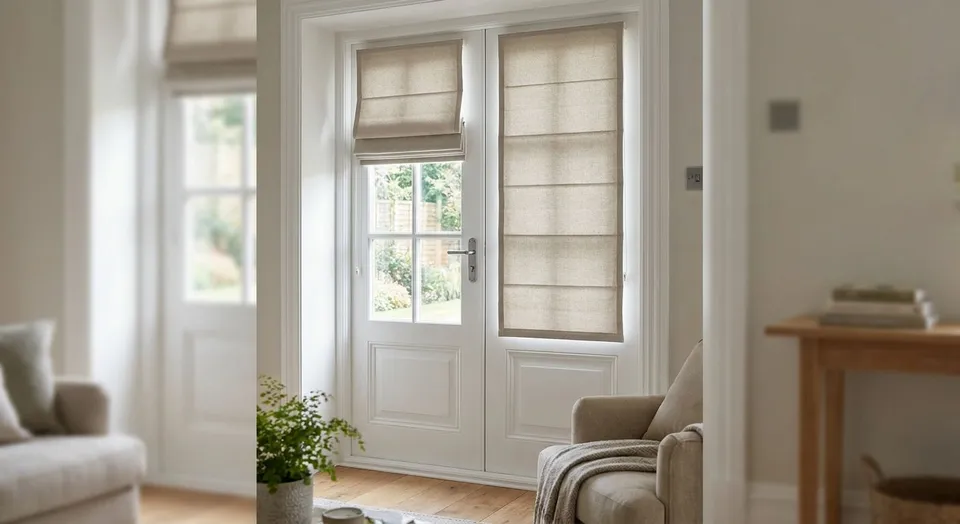
Searching for blinds for French doors usually turns up products that don't actually fit French doors, venetian slats and vertical blinds catch on door handles, jam mid-swing, and rattle every time the door closes. The window coverings that work on French doors in 2026 are shades: cellular, roller, zebra, or a tailored drapery panel, chosen to clear the door hardware and operate without a cord snagging on the handle.
- For blinds for French doors, cellular shades in a top-down-bottom-up build clear door handles without rattling. Buy.
- Motorized shades solve the reach problem on tall French door panels and cost more upfront but skip cords entirely.
- Skip anything with an outside-mount valance over 3 inches deep. It blocks the door from opening flush.
- Zebra shades work for single French doors with clear sightlines but struggle on paired doors that meet in the middle.
Why this matters
French doors have less usable depth than a standard window. Most frames give you 1 to 1.5 inches before hitting the door handle or hinge hardware. A shade built for a wide living room window will not fit that clearance, and a corded shade near a door that gets opened 10+ times a day is a strangulation risk with kids or pets in the house. Getting the mount type, the fabric, and the operating system right on the first order matters more here than on almost any other window in the house, because French doors get used constantly and re-measuring after a bad fit costs you twice.
Who this is for
This guide is for homeowners in Auburn, Bellevue, Tacoma, or anywhere in the Greater Seattle Area with French doors leading to a patio, deck, or backyard, and who need privacy and light control without losing the ability to open the door fully. It applies whether you have a single French door, a paired set that meets in the center, or French doors paired with sidelights. If you're covering a sliding glass door instead, the clearance problem is nearly identical, and most of the picks below apply there too.
What to look for in shades for French doors
Clearance for the door handle and hinge
Measure the depth from the glass to the interior door handle before picking a mount type, most French door handles sit 2 to 3 inches proud of the glass. An inside-mount shade needs at least 1.25 inches of clear frame depth to avoid contact with the handle when the door swings; if your frame is shallower than that, outside mount is the only option that won't jam.
Cordless or motorized operation
Check that door-mounted shades clear the handle and swing without catching. Choose a suitable cordless or motorized product to avoid an exposed operating pull cord. Follow all product safety instructions and keep cribs, beds, and climbable furniture away from windows.
Light control that still lets the door open
Top-down-bottom-up shades let you drop privacy from the top while keeping the bottom half of the glass clear, which matters on a door because you still need to see the threshold and step when you're opening it at night. A shade that only operates bottom-up blocks that sightline entirely once it's raised for privacy.
Fabric that survives condensation and temperature swings
Pacific Northwest French doors run cold glass against warm room air for months at a time, and fabric mounted tight against that glass picks up moisture. Cellular shades with a honeycomb structure hold a pocket of insulating air between the fabric and the glass, which cuts down on the condensation contact that warps softer fabrics like woven wood.
Symmetry across paired doors
A pair of French doors that meet in the center needs two shades that stack identically. Mismatched fabric runs or uneven header heights show immediately on a door in a way they don't on a wide single window. Order both panels from the same fabric dye lot and confirm the header depth matches on both sides before installation.
Hardware that won't interfere with the door lock
Brackets and headrails need to sit clear of any deadbolt or multi-point lock mechanism built into the door stile. This is the single most common measuring mistake on French door orders, a bracket that looks fine on paper conflicts with the lock throw once the shade is actually mounted.
Top picks for French door shades
Vertical cellular shades, the clearance pick. Built specifically for door-height openings, vertical cellular shades stack to the side rather than lifting up, which keeps the shade fully clear of the door handle at every position. They hold up well against the condensation that collects on Pacific Northwest glass in the winter months. Vertical cellular shades for sliding glass doors covers the same clearance logic that applies to French doors. Buy if your frame depth is under 1.5 inches.
Motorized roller shades can make a door panel easier to adjust. Confirm the shade’s clearance from the handle and door swing, as well as the motor, power, and controls. Battery power can avoid a new power cable at the window when the selected product supports it. Confirm the motor, approved charger or batteries, charging access, and any wired-power requirements before ordering. Battery life and charging time vary by model, shade size, and use.
Top-down-bottom-up cellular shades. The privacy pick. This build lets you drop the top for privacy while keeping the bottom clear so you can still see the threshold when opening the door. It's the closest thing to a universal answer for anyone asking about blinds for French doors who wants privacy without losing sightlines. Full logic on this operating style is in top-down-bottom-up shades for privacy and light control. Buy for street-facing or neighbor-facing French doors.
Zebra shades. The light-control pick. Alternating sheer and solid bands let you dial light in without going fully dark, which works well on a single French door with a clean view. On paired doors that meet in the center, the banding pattern has to line up across both panels or the mismatch is obvious. Consider for single doors, Skip for tight-clearance paired doors unless you order both from the same run.
Drapery panels. The traditional pick. A tailored drapery panel on a rod set above the door frame gives you a softer look and works well paired with a functional shade underneath for actual light control. Panels alone don't block light or offer real privacy on their own, so they're a layering choice, not a standalone fix. Consider as a second layer, not the primary shade.
Get exact measurements for your French doors
On-site measure and a quote for your selected options, no subcontractors.
What to avoid
- Outside-mount valances deeper than 3 inches. They look finished in a showroom photo but block the door from swinging fully open once installed on-site.
- Standard corded lift systems near door handles. The cord runs directly across the path a hand reaches for the handle, and it's the first thing that snaps or tangles on a door used daily.
- Fabric shades without a moisture-resistant liner. Regular fabric mounted tight against cold French door glass in a Pacific Northwest winter picks up condensation and can warp or mildew within a season.
Verdict comparison
| Shade type | Best for | Clearance needed | Verdict |
|---|---|---|---|
| Vertical cellular | Tight-frame French doors | Under 1.5 in | Buy |
| Motorized roller | High-traffic doors | 1.5-2 in | Buy |
| Top-down-bottom-up cellular | Privacy without losing sightline | 1.25-2 in | Buy |
| Zebra shades | Single doors, clear view | 1.5-2 in | Consider |
| Drapery panels | Layered look, secondary light control | N/A (rod-mounted) | Consider |
FAQ
What's the best window covering for French doors?
Vertical cellular shades or motorized roller shades work best for French doors in 2026 because they clear the door handle and hinge hardware without a cord in the way. Traditional venetian or aluminum blinds tend to rattle and snag on door hardware, which is why shades are the standard recommendation.
Do you put blinds or shades on French doors?
Shades, not traditional blinds, are the right fit for nearly every French door because most frames only have 1 to 1.5 inches of clearance before hitting the door handle. Cellular, roller, and zebra shades are all built to work within that tight depth.
How much does it cost to cover French doors in 2026?
Cost depends on the fabric, size, and whether you choose manual or motorized operation, so get an on-site measure for exact pricing on your specific doors. A local consult also flags any hardware clearance issues before you order.
Can you motorize shades for French doors?
Yes, motorized shades are a common choice for French doors because they remove the need to reach across the door swing to operate a cord. Most 2026 motorized systems run on rechargeable batteries and can pair with a smart home hub.
Are cordless shades required for French doors near kids?
Cordless or motorized shades are the safer standard for any door-mounted shade, since a hanging cord sits directly in the path of a hand reaching for the door handle. This matters most on doors that get opened multiple times a day by kids or pets.
What is the best mount type for French door shades?
Inside mount works if your frame has at least 1.25 inches of clear depth before the handle or hinge; outside mount is the fallback for shallower frames. Measuring the exact depth before ordering avoids a shade that jams against the hardware.
Are cellular shades good for insulating French doors in the Pacific Northwest?
Cellular shades hold a pocket of air between the fabric and the glass, which cuts down on the condensation that collects on cold French door glass through a Pacific Northwest winter. That same air pocket adds a layer of insulation against heat loss.
Can zebra shades work on paired French doors?
Zebra shades work on paired French doors only if both panels are ordered from the same fabric run so the sheer and solid banding lines up across the center meeting point. Mismatched banding is the most common complaint on paired-door zebra shade orders.
One last thing
The detail that gets missed most on French door orders isn't the fabric. It's the deadbolt. A bracket that clears the door handle can still land directly over a multi-point lock mechanism built into the stile, and that's not something you catch by eyeballing the door from across the room. Measure with the lock hardware in mind before you order, not after the shade arrives.
Related guides
In-home consultations are free within 60 driving miles of Auburn. Farther projects are considered individually; any consultation fee is quoted before booking and credited toward your order.