
Our available controls: Rainier Blinds offers Roman and woven wood shades with motorized operation only. Available controls and power options for other products are confirmed at your consultation.
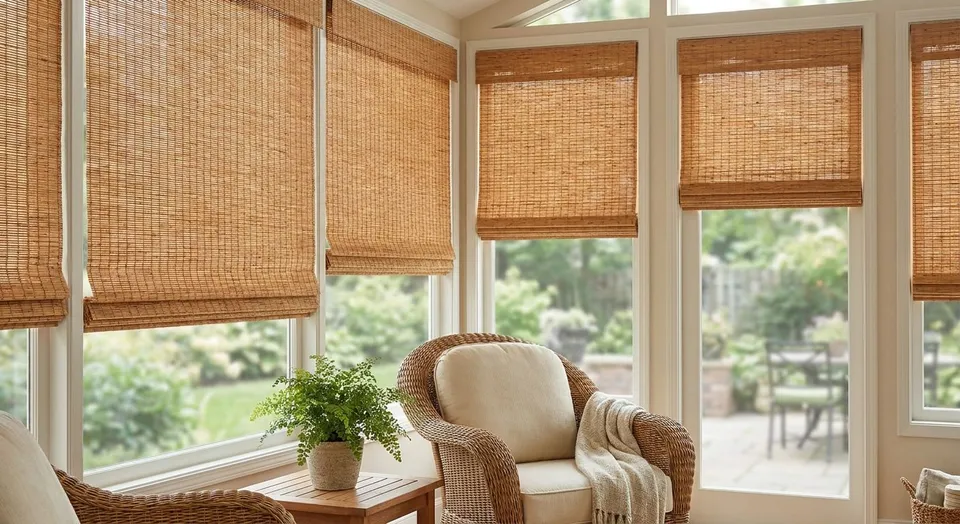
An enclosed porch turns into a greenhouse in July and a cold box in January unless the glass gets the right shade behind it. This guide breaks down which custom blinds for enclosed porch windows actually hold up in a Pacific Northwest three-season room.
- Solar shades win for enclosed porches with south or west glass. Buy 5-10% openness fabric for glare without losing the view.
- Cellular shades are the pick when the porch swings more than 20-30 degrees between day and night.
- Woven wood roman shades suit a sunroom aesthetic but skip them on porches with high humidity or direct rain spray.
- Custom blinds for enclosed porch windows in 2026 should be cordless or motorized. Porch sills are usually too deep to reach a wand.
Why this matters
Enclosed porches aren't regular rooms. Glass usually runs floor to near-ceiling on two or three walls, which means more UV exposure, more temperature swing, and more condensation than a standard bedroom window. A porch converted from a screened space still behaves like one in the shoulder seasons, cold glass, warm room, moisture on the inside pane by morning.
Standard mini blinds sag and warp in that environment. Solar shades for sunroom windows are built for exactly this kind of glass load, which is why they're the default recommendation for most enclosed porches across South King County in 2026. The right fabric holds its shape through a Seattle winter and doesn't yellow by year three.
Who this is for
This guide is for homeowners who've enclosed a porch, converted a three-season room, or are finishing a sunroom addition and need window coverings that handle direct sun, temperature swings, and privacy from the street or neighbors, without turning the space into a cave. If the porch gets used year-round as a reading nook, home office, or plant room, the shade choice changes what the room feels like every single day.
What to look for in blinds for enclosed porch windows
Moisture and mildew resistance
Condensation forms on enclosed porch glass more than on interior windows because the glass sits closer to outdoor temperatures. Fabric and vinyl-coated shades resist mildew far better than untreated wood or paper-backed materials, which is one reason wood and faux wood options aren't part of a serious recommendation here.
UV and fade protection
A porch with unobstructed south or west glass gets more direct sun exposure over a day than almost any other room in the house. Fabric with a UV rating or a tighter weave protects flooring and furniture from fading. This matters most in rooms with hardwood, rugs, or upholstered furniture near the glass.
Insulation against temperature swing
Enclosed porches lose and gain heat faster than framed rooms because there's more glass relative to wall. A honeycomb-structured shade traps a layer of air against the pane, which cuts down on that swing better than a flat fabric roller shade.
Mount type for oversized or angled glass
Porch windows run long, run in series across a wall, or sit at an angle where the roofline meets the glass. Outside-mount and top-down/bottom-up configurations solve for uneven trim and let you keep the top of the window open for light while covering the bottom for privacy.
Cordless or motorized operation
Many enclosed porches have windows set behind furniture, planters, or a low sill that makes a pull cord awkward to reach. Cordless lift or a motorized option removes that problem entirely, and it's the safer choice in any porch used by kids or pets.
Light control range
A porch used as a plant room needs different light than one used as a media nook. Sheer or light-filtering fabric keeps the greenhouse function intact; blackout fabric turns the same room into a screening room after dark.
Top picks for enclosed porch windows
Solar Shades. The year-round pick. A 5-10% openness fabric cuts glare and UV load while keeping the porch view intact, which is the single biggest reason this category tops the list for enclosed porches in 2026. Verdict: Buy for any porch with unobstructed south or west glass.
Cellular Shades, the temperature control pick. A honeycomb cell traps a pocket of air against the glass, which matters most on porches where the daily swing runs 20 degrees or more between morning and afternoon. See the full comparison in roller shades vs cellular shades before deciding between the two fabric structures. Verdict: Buy for porches used as three-season rooms through winter.
Woven Wood Roman Shades, the sunroom aesthetic pick. These bring texture and warmth that flat roller fabric can't match, and they read well against exposed beam or shiplap porch ceilings. Check the full breakdown in woven wood shades for coastal-style homes. The tradeoff: natural fiber weaves hold moisture longer than vinyl-coated fabric. Verdict: Consider for a dry, covered porch; Skip for one with direct rain exposure or high humidity.
Zebra Shades. The privacy-toggle pick. Alternating sheer and solid bands let you shift from full view to full privacy without swapping shades, useful on a porch that faces a street or a neighbor's yard. Verdict: Consider for porches doubling as a home office or a space with street-facing glass.
An exterior-rated shade can help with sun and glare. Select the exact system for the opening, mounting structure, and exposure. Follow its documented wind limits and retraction instructions; neither cable guides nor zipper tracks guarantee protection from wind, rain, or storms.
What to avoid
- Faux wood or real wood blinds: they warp and crack faster in a room with more humidity and temperature swing than a standard interior window, and the slats don't hold up to porch-level condensation.
- Corded lift systems near play areas: enclosed porches often double as a kid or pet space, and a dangling cord is the wrong call regardless of fabric choice.
- Fully opaque blackout fabric on a plant or greenhouse porch. It solves privacy but kills the reason the porch was enclosed with glass in the first place.
Get a quote for your porch windows
In-house measure and install across the Greater Seattle Area, no subcontractors.
Verdict comparison
| Product | Best for | Insulation | Light control | Verdict |
|---|---|---|---|---|
| Solar Shades | South/west facing glass | Moderate | Glare-cut, view intact | Buy |
| Cellular Shades | Wide temperature swing | High | Light-filtering to room-darkening | Buy |
| Woven Wood Romans | Dry, covered porches | Low-moderate | Light-filtering | Consider |
| Zebra Shades | Street-facing privacy needs | Low | Sheer to opaque toggle | Consider |
| Outdoor Zipper Shades | Partly open, covered porches | Confirm the selected system’s exposure limits | Solar to blackout options | Buy (situational) |
FAQ
What are the best custom blinds for enclosed porch windows?
Solar shades in a 5-10% openness fabric are the best default for enclosed porch windows in 2026 because they cut UV and glare without blocking the view. Cellular shades are the better call when the porch swings more than 20 degrees between day and night.
Are faux wood blinds good for an enclosed porch?
No, faux wood and real wood blinds warp and crack faster on enclosed porches because the glass runs closer to outdoor temperatures and humidity than a standard interior window. Fabric-based shades hold their shape far longer in that environment.
Do enclosed porches need blackout shades?
Only if the porch is used as a media room or bedroom at night. Most enclosed porches do better with light-filtering or solar fabric that keeps the daytime function of the glass intact.
Should porch windows have cordless or motorized shades?
Cordless or motorized is the safer and more practical choice, since porch windows often sit behind furniture or a deep sill that makes a pull cord hard to reach. It's also the standard recommendation for any porch used by kids or pets.
How much do custom shades for an enclosed porch cost in 2026?
Cost depends on the number of windows, fabric, and whether the shades are motorized, and it varies by supplier. A measure-and-quote visit gives an exact number for the specific window count and configuration.
Can outdoor shades work on an enclosed porch?
An exterior-rated shade can help with sun and glare. Select the exact system for the opening, mounting structure, and exposure. Follow its documented wind limits and retraction instructions; neither cable guides nor zipper tracks guarantee protection from wind, rain, or storms.
Do cellular shades help with porch temperature swings?
Yes, the honeycomb cell structure traps a layer of air against the glass, which reduces heat loss in winter and heat gain in summer better than a flat roller fabric.
Are woven wood shades a good fit for a humid porch?
Not usually. Natural fiber weaves hold moisture longer than vinyl-coated fabric, so a woven wood roman shade works better on a dry, covered porch than one exposed to rain or heavy condensation.
One last thing
The detail most homeowners miss on an enclosed porch: measure for outside mount, not inside mount, if the porch trim isn't perfectly square. And it rarely is on a converted space. An outside-mounted shade covers the gap and blocks more light leak at the edges than an inside mount ever will on uneven porch framing.