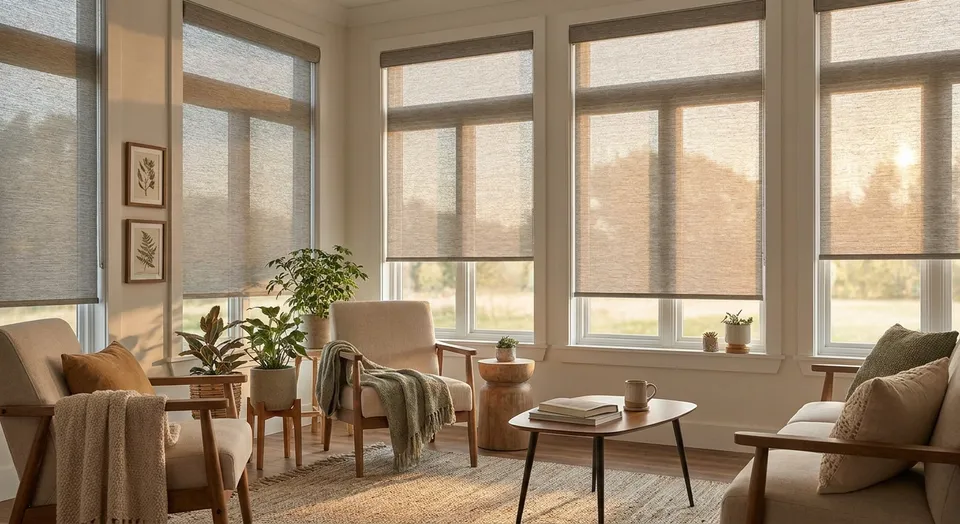
Sunrooms take more direct, low-angle sun than any other room in a Puget Sound house, and the wrong shade turns a bright addition into a greenhouse by 2pm. This guide ranks the best solar shades sunroom windows in Auburn, Bellevue, Tacoma, and Seattle actually need in 2026, from openness percentage to motorization, so the purchase happens once.
- 3% openness solar screens are the best solar shades sunroom windows with south or west glass need for glare control. Buy.
- 5% openness fabric is the all-around pick when a sunroom needs both shade and a view. Buy.
- Motorized solar shades solve the transom-window problem no wand or cord can reach. Buy.
- Skip uncoated mesh screens sold cheap online for sunrooms. They sag and fade within two Pacific Northwest summers. Skip.
Why this matters
A sunroom isn't a normal room with one exposure. It's usually glass on three sides, sometimes four, with a low roofline that traps heat. Regular drapery blocks the sun but kills the reason the room exists. Solar shades filter light instead of blocking it, so the space stays usable at noon in July and still lets in a view at 8am in January.
Compare screen fabrics in the actual sunroom light. The right balance depends on the opening, exposure, fabric color and construction, and how much view or glare reduction you want.
How these picks were ranked
Ranking here comes from install patterns across sunrooms in Auburn, Bellevue, Tacoma, Renton, and Seattle, not lab testing. The criteria: heat block (tied directly to openness rating), UV protection, how much view the fabric preserves, glare control at the low winter sun angle Western Washington gets from October through February, and whether the window height and shape even allows for motorization.
Sunroom windows run bigger and taller than standard rooms, often with a transom band up top, so a fabric that works in a living room doesn't automatically work here. 2026 sunroom installs lean heavily toward 3-5% openness because that band handles both the July glare and the February low-angle sun without swapping shades seasonally.
The ranked list
1. 1-3% openness solar screen: the glare killer
Solar fabric can reduce glare and UV exposure while preserving some daytime view. Compare the exact fabric’s openness, color, visible-light and solar performance data in the room; openness alone is not a UV-blocking or heat-rejection rating. Solar shades do not guarantee nighttime privacy or prevent all fading.
The tradeoff is view clarity. Outward vision gets hazier, especially after dark when interior lights are on. For a sunroom with a west or south wall that gets direct sun most of the day in 2026's summer months, this is still the right call. Buy for any wall that faces west or south with no tree cover.
2. 5% openness fabric: the all-rounder
This is the most common install across Rainier Blinds' sunroom jobs because it splits the difference: enough glare control to sit comfortably at noon, enough openness to still see the yard. Fabric at this rating blocks a large share of solar heat gain while keeping the room from feeling closed off.
It works on east-facing walls that get a hard morning sun and on partially shaded exposures where a 1-3% screen would be overkill. Buy for mixed-exposure sunrooms. This is the default recommendation for most Puget Sound layouts.
3. 10% openness fabric: the view keeper
More daylight, more visual connection to the yard, and noticeably less heat block than the tighter weaves. This rating belongs on north-facing sunroom walls where direct sun is rare and the priority is keeping the space bright, not blocking glare.
Put it on a south or west wall and the room still overheats by afternoon. Consider for north-facing walls only, skip it everywhere else in a sunroom.
4. Motorized solar shades: the convenience pick
Motorized controls can help with high sunroom windows. Battery power can avoid a new power cable at the window when the selected product supports it. Confirm the motor, approved charger or batteries, charging access, and any wired-power requirements before ordering. Battery life and charging time vary by model, shade size, and use. Compatibility, hub requirements, and available controls depend on the selected motor and your home setup. We confirm those details before ordering.
For a wall of connected sunroom windows, one motor group can raise all of them together on a timer tied to sun position. The motorized shades guide breaks down how these systems handle multi-window walls in Kent-area homes, which maps directly onto sunroom layouts. Buy for any sunroom with glass above 7 feet.
5. Dual shade day/night system: the wildcard
This pairs a solar screen with a room-darkening or blackout shade on the same headrail, so one control raises the solar screen during the day and drops a second, tighter fabric for privacy or movie nights. It adds cost and a second fabric to maintain, but it solves the sunroom-as-guest-room or sunroom-as-media-room problem in one install.
Consider if the room doubles as sleeping space or a screen room after dark. Otherwise it's an unnecessary layer.
6. Reflective or silver-backed fabric: the heat blocker
An aluminized or reflective coating on the back of the fabric bounces radiant heat before it transfers into the room, which matters more in a sunroom than almost any other space in the house. This is the fabric to reach for on a west-facing wall in Tacoma or Auburn that gets full sun from 3pm to sunset in July.
The coating adds a slight sheen visible from outside, which some homeowners don't love on a street-facing elevation. Buy for west walls with heavy afternoon exposure; skip it on street-visible sides if the sheen bothers you.
7. Uncoated mesh screen: the one to skip
Cheap mesh sold online without a UV coating looks identical to a proper solar screen in a photo and behaves completely differently in a real sunroom. No coating means faster fading, and Western Washington humidity causes these fabrics to sag out of their track within two summers.
There's no version of this that belongs in a sunroom that gets real sun exposure. Skip.
If both glare and winter comfort matter, compare the selected screen fabric’s solar data with the cellular product’s thermal data. The entire product and its installation determine performance.
Comparison table
| Fabric / type | Openness % | UV block | View retention | Best for | Verdict |
|---|---|---|---|---|---|
| Tight weave | 1-3% | Product-specific | Low | South/west walls, full sun | Buy |
| Standard weave | 5% | High | Moderate | Mixed exposure | Buy |
| Open weave | 10% | Moderate | High | North walls only | Consider |
| Motorized (any %) | 3-5% typical | High | Moderate | Windows above 7 ft | Buy |
| Day/night dual | 3-5% + blackout | High | Moderate | Media room or guest sunroom | Consider |
| Reflective-backed | 3-5% | High | Moderate | West walls, heavy afternoon sun | Buy |
| Uncoated mesh | Varies | Low | Varies | Nothing in a real sunroom | Skip |
Where to buy
- Get custom measurements, not stock sizes. Sunroom windows run odd widths, and transom bands rarely match standard blind dimensions.
- See the fabric swatch in the actual room before ordering. An openness percentage reads differently on paper than it does on a west wall at 4pm in July.
- Confirm who installs it. A sunroom's framing shifts more than a standard room over a few seasons, and a crew that also measured the space catches fit issues an online order can't.
Get a sunroom shade quote
Request a quote for your selected shades, measured and installed by Rainier Blinds' own crew.
FAQ
What's the best solar shade openness for a sunroom?
5% openness is the most common fit for sunrooms with mixed sun exposure in 2026, balancing glare control with a usable view. South or west walls with full direct sun do better with 1-3% openness fabric instead.
Is 5% or 10% openness better for a sunroom?
Openness and color both affect the view and glare. Compare physical samples and the selected fabric’s measured solar, visible-light, and UV data at your window; an openness percentage alone is not a heat or UV rating. Solar screen does not guarantee nighttime privacy or prevent all fading.
Do solar shades actually block heat in a sunroom?
Solar fabric can reduce glare and UV exposure while preserving some daytime view. Compare the exact fabric’s openness, color, visible-light and solar performance data in the room; openness alone is not a UV-blocking or heat-rejection rating. Solar shades do not guarantee nighttime privacy or prevent all fading.
Are motorized solar shades worth it for sunrooms?
Motorized solar shades are worth it whenever a sunroom has windows above 7 feet, since manual wands and cords can't reach transom or clerestory glass. They also let a whole wall of connected windows raise and lower together on one schedule.
How much do solar shades cost for sunroom windows in 2026?
Cost depends on window size, fabric openness, and whether the shade is motorized, so it varies job to job. A local installer can give exact pricing after measuring the actual windows.
Can solar shades stop sunroom furniture from fading?
Solar fabric can reduce glare and UV exposure while preserving some daytime view. Compare the exact fabric’s openness, color, visible-light and solar performance data in the room; openness alone is not a UV-blocking or heat-rejection rating. Solar shades do not guarantee nighttime privacy or prevent all fading.
What's the difference between solar shades and cellular shades for a sunroom?
Solar shades filter light and reduce glare while keeping some view, while cellular shades trap air in honeycomb pockets for winter insulation. Sunrooms with heavy winter heat loss sometimes need both, on different windows.
Do solar shades work on transom or clerestory sunroom windows?
Yes, and motorized versions are the practical way to operate them since transom windows usually sit 7 to 10 feet up. Manual chain or cord operation on windows that high is awkward and often unsafe on a stepladder.
One last thing
Openness and color both affect the view and glare. Compare physical samples and the selected fabric’s measured solar, visible-light, and UV data at your window; an openness percentage alone is not a heat or UV rating. Solar screen does not guarantee nighttime privacy or prevent all fading.