
Our available controls: Rainier Blinds offers Roman and woven wood shades with motorized operation only. Available controls and power options for other products are confirmed at your consultation.
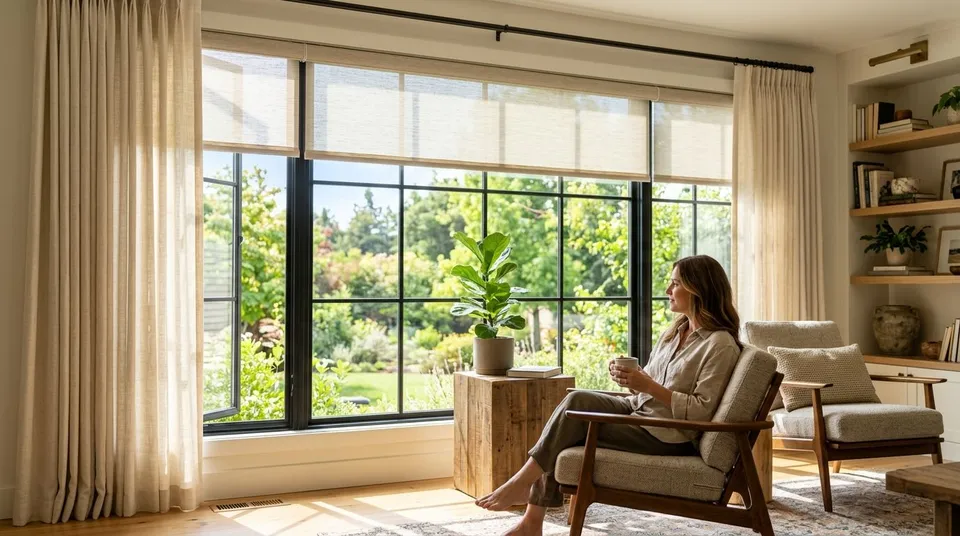
South-facing windows in the Puget Sound area take more direct sun than any other exposure in the house, and picking the wrong shade means squinting through afternoon glare or replacing sun-faded furniture inside a year or two. Solar roller shades are the best window treatments for south-facing windows in 2026 for most rooms, with cellular shades, zebra shades, woven wood roman shades, layered drapery, and outdoor shades each solving a narrower problem.
- Solar roller shades are the best window treatments for south-facing windows in 2026 for heat and glare control.
- Cellular shades cut energy loss best when a south-facing room swings hard between summer and winter.
- Zebra shades give adjustable light control without giving up the view out a sunny room.
- Woven wood roman shades add texture and moderate sun filtering for south-facing living rooms.
- Layering drapery over a shade handles the harshest afternoon sun and finishes the room.
Why this matters
Best overall: solar roller shades. Best for energy efficiency: cellular shades. Best for light control with a view: zebra shades. Best for texture and warmth: woven wood roman shades. Best for a finished, layered look: drapery over shades. Best for decks and patios: outdoor shades.
South-facing glass gets direct sun for most of the daylight hours, year-round, more than any other orientation. In the Greater Seattle Area, that sun still hits hard from spring through early fall even with the region's reputation for clouds, and a south-facing room usually runs into three problems at once: fabric and flooring that fades within a couple of years, a cooling bill that spikes every summer, and glare that makes an afternoon video call impossible. The right shade solves all three. The wrong one solves none of them, and a room that gets re-treated in 2026 because the first pick ignored fabric openness or insulation value is a common repeat job for Rainier Blinds crews across Auburn, Bellevue, and Tacoma.
What makes the best window treatment for south-facing windows
- UV and heat block: fabric that stops solar heat gain before it gets through the glass
- Glare control: enough light diffusion to see a screen at 2pm without closing the room off
- Insulation value: the same window treatment should cut heat loss in December, not just heat gain in July
- Fade resistance: fabric and hardware rated to hold color under years of direct UV exposure
- Operation tier: manual, motorized, or smart control, since south-facing rooms benefit most from shades that adjust on a schedule
- Room fit: a kitchen, a living room, and a home office all use south sun differently, and the shade has to match the room
Shade options for south-facing windows at a glance
| Shade Type | Best For | Standout Feature | Key Limitation |
|---|---|---|---|
| Solar roller shades | Overall south-facing rooms | Low-openness fabric blocks glare and heat while keeping a partial view | Not a true blackout option on its own |
| Cellular shades | Energy efficiency | Honeycomb pockets trap air against heat gain and heat loss | Less view-through than roller or zebra styles |
| Zebra shades | Light control with a view | Alternating sheer and solid bands adjust light in steps, not all or nothing | Horizontal seams show more wear on very wide windows |
| Woven wood roman shades | Texture and warmth | Natural material filters harsh light instead of just blocking it | Blocks less UV than a dedicated solar fabric |
| Drapery layered over shades | Finished, layered rooms | Lined panels add a true blackout layer on top of a shade | Requires two products instead of one |
| Outdoor shades | Patios and decks | Steel wire or zipper track models hold up to wind and direct exposure | Built for outdoor use, not interior windows |
1. Solar roller shades: best window treatment for south-facing windows overall
Solar roller shades use a tightly woven fabric, often in a 1% to 5% openness range, that blocks direct sun before it turns into heat inside the room. That fabric cuts glare enough to work at a laptop or watch TV at 3pm in a south-facing living room, and it still lets you see the yard through the weave. Rainier Blinds measures and installs solar shades across kitchens, living rooms, and home offices that take direct afternoon sun, and the fabric pairs well with solar shades built to slow fade damage on furniture and flooring sitting in that direct light.
Solar roller shades pros:
- Blocks glare and heat before it hits the glass
- Keeps a view-through during daylight hours
- Comes in manual, motorized, or smart control tiers
- Handles daily use in high-traffic rooms without extra hardware
Solar roller shades cons:
- Not a blackout solution by itself
- Openness percentage has to match the room's actual sun exposure to work well
Best for: living rooms, kitchens, and home offices with direct south sun for most of the day.
Verdict: Buy.
2. Cellular shades: best for energy efficiency in south-facing rooms
Cellular shades trap air inside honeycomb-shaped pockets that sit against the glass, which slows heat gain in summer and heat loss in winter through the same window. That two-way insulation makes cellular shades the strongest pick for a south-facing room where the utility bill swings hard between seasons, and cellular shades built for energy savings tend to earn their keep fastest in rooms with older single-pane or aging double-pane glass.
Cellular shades pros:
- Cuts heat gain and heat loss through the same window
- Comes in light-filtering and blackout fabric options
- Available in cordless and motorized versions for households with kids or pets
- Handles noise dampening better than a flat fabric shade
Cellular shades cons:
- Less view-through than a roller or zebra shade
- Blackout cellular fabric blocks the view entirely when closed
Best for: south-facing bedrooms and home offices where the room temperature swings between seasons.
Verdict: Buy.
3. Zebra shades: best for light control without losing the view
Zebra shades, also called dual-layer shades, alternate sheer and solid fabric bands on one roll, so sliding the layers adjusts light in small steps instead of an all-or-nothing choice. In a south-facing room that gets harsh sun at noon and softer light by evening, that adjustability matters more than in a north- or east-facing room with steadier light.
Zebra shades pros:
- Adjusts light in fine increments instead of open or closed
- Keeps a partial view even when the sheer layer is engaged
- Works well in living rooms and dining rooms with sightlines to a yard
- Available motorized for rooms with hard-to-reach windows
Zebra shades cons:
- Horizontal seams show more wear on very wide south-facing windows
- Sheer layer alone doesn't stop UV fade the way a solar fabric does
Best for: living rooms and dining rooms where the household wants to dial in light throughout the day.
Verdict: Buy.
4. Woven wood roman shades: best for texture and warmth
Woven wood roman shades use natural materials like bamboo, jute, or grass folded into a roman shape, filtering sun instead of blocking it outright. That gives a south-facing room texture that plain fabric doesn't have, though it comes at the cost of UV block compared to a dedicated solar fabric.
Woven wood roman shades pros:
- Adds natural texture that pairs well with wood floors and warm interiors
- Filters harsh light into a softer glow instead of full glare
- Works as a light-filtering layer under drapery in a south-facing room
Woven wood roman shades cons:
- Blocks less UV than solar fabric, so fade protection is weaker
- Not built for rooms that need real energy savings
Best for: south-facing rooms where the priority is style and light filtering over maximum heat block.
Verdict: Hold, and pair it with a solar shade behind it if the room takes all-day direct sun.
5. Drapery layered over shades: best for a finished, near-blackout look
Lined drapery panels added over a solar or cellular shade block sun a single shade can't stop on its own, and give a south-facing bedroom or media room a finished, layered look instead of bare glass.
Drapery layered over shades pros:
- Adds a real blackout layer on top of a light-filtering shade
- Softens a room visually in a way a shade alone doesn't
- Works over roller, cellular, or zebra shades without conflicting
Drapery layered over shades cons:
- Requires buying and installing two products, not one
- Heavy lined panels need sturdy hardware on a wide south-facing window
Best for: bedrooms and media rooms that need real darkness during peak south sun hours.
Verdict: Buy for bedrooms, Hold for everyday living rooms that don't need full blackout.
6. Outdoor shades: best for patios and decks with full south exposure
Steel wire and zipper track outdoor shades handle wind and direct exposure on a south-facing deck or patio, extending usable outdoor time through summer afternoons that would otherwise be too hot or too bright to sit in. Rainier Blinds' outdoor roller shades for decks and patios hold up outside in a way an interior fabric shade never would.
Outdoor shades pros:
- Built for wind and direct weather exposure, not just indoor light
- Extends usable patio and deck time during peak south sun
- Zipper track models resist billowing in gusty conditions
Outdoor shades cons:
- Built for exterior use only, not a substitute for an interior window treatment
- Steel wire models need a track mounted to the structure
Best for: south-facing patios, decks, and covered outdoor living spaces.
Verdict: Buy for outdoor spaces, Skip for interior windows.
How we ranked
Each shade is scored against the six criteria above: UV and heat block, glare control, insulation value, fade resistance, operation tier options, and room fit. Solar roller shades score highest across the most criteria for a typical south-facing window, which is why it's the overall pick, but a room built for outdoor living or full blackout does better with a different option from this list.
Which window treatment should you choose for south-facing windows?
Solar roller shades handle 2026's toughest south sun with the least tradeoff, and they're the right default for most Greater Seattle Area homes. If the concern is the utility bill, go with cellular shades instead. If the room needs flexible light throughout the day, pick zebra shades. If it's an outdoor living space, outdoor shades are the only real fit. If a bedroom needs true darkness during peak afternoon sun, layer drapery over a shade rather than relying on either alone. Every option above is measured and installed by Rainier Blinds' own crew, not a subcontractor, across Auburn, Bellevue, Tacoma, and the rest of the Greater Seattle Area.
Get a free in-home consultation
Rainier Blinds measures and quotes south-facing windows on the spot.
FAQ
What are the best window treatments for south-facing windows?
Solar roller shades are the best window treatments for south-facing windows in 2026 for most rooms, since low-openness fabric blocks heat and glare while keeping a partial view. Cellular shades, zebra shades, and outdoor shades each fit a narrower need.
Are cellular shades good for south-facing windows?
Yes, cellular shades are one of the strongest options for a south-facing room because the honeycomb pockets slow heat gain in summer and heat loss in winter through the same window. They work best in bedrooms and home offices with big seasonal temperature swings.
Do solar shades block heat as well as blackout shades?
Solar shades block heat and glare while staying view-through, but they don't create full darkness the way a blackout cellular shade or lined drapery does. For a room that needs both heat control and total darkness, layer drapery over a solar or cellular shade.
Is drapery alone enough for a south-facing bedroom?
Drapery alone can darken a room, but it doesn't block heat gain the way a solar or cellular shade does underneath it. Layering lined drapery over a shade handles both the light and the heat coming through a south-facing window.
Do zebra shades fade in direct south sun?
Zebra shades hold up reasonably well but block less UV than a dedicated solar fabric, so a south-facing room with all-day direct sun will see more fabric wear over time. Rooms with partial or afternoon-only sun are a better fit for zebra shades.
What openness percentage works best for a south-facing living room?
A 1% to 5% openness solar fabric blocks the most heat and glare for a south-facing living room, while fabrics closer to 10% openness trade some heat block for a clearer view. The right number depends on how much direct sun the room gets each day.
Can motorized shades handle strong afternoon sun on their own?
Motorized shades can run on a schedule that closes automatically during peak south sun hours and opens again in the evening. That scheduling is one of the biggest advantages of choosing a motorized or smart operation tier for a south-facing window in 2026.
One last thing
A south-facing room can lose more heat through the window overnight in January than it gains during the day in July, which is why cellular shades earn their keep in winter as much as summer. Homeowners tend to shop for south-facing window treatments in June for the glare and forget the same window is working just as hard against them in the cold months of 2026 and 2027.