
Our available controls: Rainier Blinds offers Roman and woven wood shades with motorized operation only. Available controls and power options for other products are confirmed at your consultation.
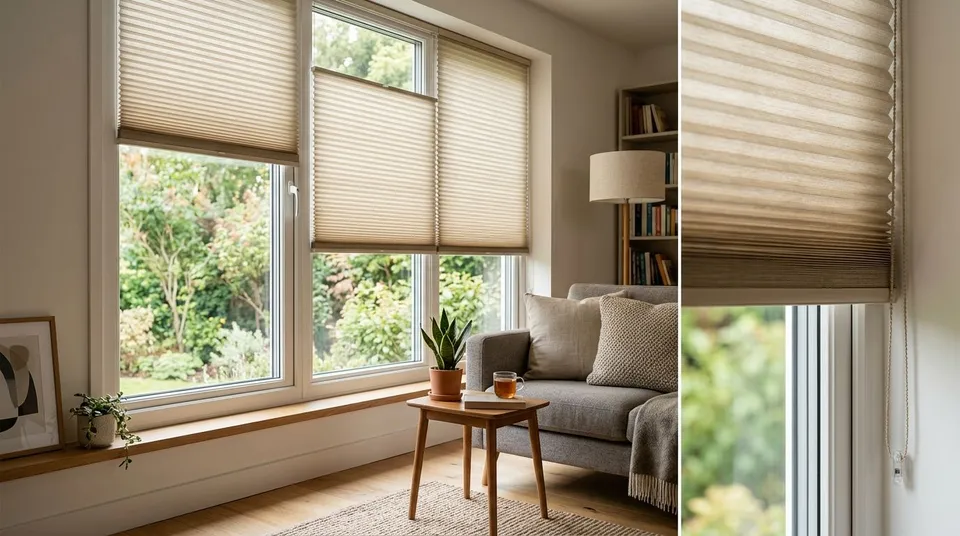
Triple-pane windows already cut heat loss better than double-pane or single-pane glass, but the covering you put over them decides whether that efficiency actually shows up on your energy bill. Best overall for triple-pane windows in 2026: cellular shades. Best for light control without losing insulation: zebra shades. Best for bedrooms and light-sensitive rooms: blackout shades.
- Cellular shades are the best blinds for triple-pane windows in 2026 because the honeycomb structure adds a second air barrier behind the glass.
- Zebra shades let you adjust daylight without opening the window covering fully, keeping the insulating layer mostly closed.
- Blackout shades combine full light block with the densest fabric layer on this list, best for bedrooms and nurseries.
- Slatted blinds, including aluminum and wood, leave gaps between slats that undercut what triple-pane glass is doing.
- Layering a shade with drapery adds the most combined insulating value for large or west-facing triple-pane windows.
Why this matters
If you searched "best blinds for triple-pane windows," here is the honest answer: slatted blinds are not the right tool for the job. Aluminum and wood blinds hang with gaps between each slat, and those gaps let conditioned air leak past the glass no matter how good the window itself is. Fabric shades close against the frame in one continuous panel, which is why they pair better with triple-pane construction.
Rainier Blinds measures and installs cellular shades for energy savings across South King County homes where triple-pane windows are already doing most of the work. The shade's job in 2026 is to stop the remaining heat transfer at night and during winter storms, not to replace what the glass already handles during the day.
Homeowners in the Greater Seattle Area tend to ask this question after a window replacement, when a contractor has just installed triple-pane glass and the old blinds do not fit the new frame depth. That is the right moment to switch categories entirely instead of rehanging the same slatted blinds.
What makes the best shade for triple-pane windows
- Insulating value: does the shade add an air gap or dense fabric layer beyond what the glass provides
- Mount fit for triple-pane frames: deep-set sashes often need an inside mount with enough frame depth
- Light control range: from sheer daytime filtering to full blackout
- Maintenance: cording, cleaning, and motorization needs over years of daily use
- Room fit: bedroom, living room, or office use case, since no single shade wins every room
At a glance: shades for triple-pane windows
| Shade type | Best for | Standout feature | Key limitation |
|---|---|---|---|
| Cellular shades | Whole-house energy performance | Honeycomb cells trap an air layer against the glass | Single-cell versions insulate less than double-cell |
| Zebra shades | Flexible daylight control | Sliding sheer and opaque bands in one shade | Insulates less than a sealed honeycomb design |
| Roman shades | Formal living and dining rooms | Tailored fabric folds fit deep-set frames | Stacks bulk at the top when raised |
| Blackout shades | Bedrooms and nurseries | Near-total light block plus a dense fabric layer | Not built for rooms that want daytime light |
| Shade plus drapery | Large or west-facing window walls | Two insulating layers stacked at one window | Needs wall space and more hardware to maintain |
1. Cellular shades: best shade for triple-pane window insulation
Cellular shades fold into honeycomb-shaped cells that trap a pocket of air directly against the glass, giving a triple-pane window a second insulating layer on top of the low-E coating and gas fill already built into the sash. Double-cell versions do more work than single-cell, and the fabric ranges from sheer to blackout so the shade doubles as light control.
Cellular shades pros:
- Adds measurable insulating value on top of an already efficient window
- Cordless and top-down/bottom-up options give privacy without losing all the daylight
- Fabric and opacity range covers everything from sheer to full blackout
Cellular shades cons:
- Single-cell fabric insulates noticeably less than double-cell
- Pleats collect dust and need periodic cleaning
- Motorized versions add install time to schedule around
Best for: homeowners who want every degree of retained heat a triple-pane window can offer. Verdict: Buy.
2. Zebra shades: best for flexible light control on triple-pane windows
Zebra shades alternate sheer and opaque fabric bands on a single roller. Sliding the bands to overlap blocks the view in, offsetting them lets daylight through, and the shade still closes against the glass the same way a solid roller shade would, keeping drafts out even while you adjust light levels.
Zebra shades pros:
- Adjustable privacy and daylight in seconds without swapping shades
- Clean, contemporary look that fits living rooms and home offices
- Works well in rooms with mixed sun exposure through the day
Zebra shades cons:
- Doesn't seal air as tightly as a honeycomb cellular design
- Horizontal bands can show light gaps at full overlap
- Fewer fabric choices than a standard roller shade
Best for: rooms where you want to see out during the day and full privacy at night. Verdict: Buy.
3. Roman shades: best for a tailored look on deep-set triple-pane frames
Roman shades fold into soft horizontal pleats as they rise, giving a furniture-grade look that suits formal living rooms and dining rooms with deep-set triple-pane frames. Some fabrics come with insulating linings that add a bit of extra barrier at the glass.
Roman shades pros:
- Wide fabric selection, including linings built for insulation
- Fits recessed or deep-set triple-pane frames cleanly
- Pairs naturally with drapery for a layered window treatment
Roman shades cons:
- Stacks in visible folds at the top when raised, covering more glass than a flat shade
- Cord and lift systems need more upkeep than a simple roller
- Not the first choice in high-humidity rooms
Best for: living rooms and dining rooms where the look matters as much as the function. Verdict: Buy for style-forward rooms, Hold if daily light is the priority.
4. Blackout shades: best for bedrooms and light-sensitive rooms
Blackout shades use a room-darkening fabric or an added liner to block nearly all outside light. That dense fabric layer also does more insulating work at the glass than a light-filtering shade, which is why bedrooms with triple-pane windows still benefit from one.
Blackout shades pros:
- Full light block, useful for shift workers, nurseries, and home theaters
- Adds a thick fabric layer that trims heat loss further
- Available in cellular or roller construction depending on the room
Blackout shades cons:
- Wrong choice for rooms that want daytime light
- Dark fabric can show light gaps without a tight, properly measured mount
- Fewer color options than light-filtering fabrics
Best for: bedrooms, nurseries, and home theaters. Verdict: Buy for bedrooms and light-sensitive spaces.
5. Shade plus drapery: best for large or west-facing triple-pane windows
Pairing a cellular or roller shade with drapery on a rod stacks a second air gap and a heavier fabric barrier on top of what the shade alone provides. For large window walls or west-facing rooms with strong afternoon sun, this layered setup does the most combined insulating work of anything on this list.
Shade plus drapery pros:
- Highest combined insulating effect of any option here
- Drapery adds sound dampening on top of the insulation benefit
- Two light-control layers: shade for daytime, drapery for full nighttime block
Shade plus drapery cons:
- Two systems to install instead of one
- Needs wall space beside the window for stack-back
- More hardware and cords to maintain over time
Best for: large windows and window walls or west-facing rooms with heavy afternoon sun. Verdict: Buy for large window walls, Skip if wall space is tight.
How we ranked these
Each shade on this list was weighed against the five criteria above: insulating value, mount fit for triple-pane frames, light control range, maintenance load, and room fit. Cellular shades won on insulating value and versatility. Zebra shades and roman shades won narrower categories where a different priority, light control or looks, mattered more than raw R-value. Blinds with slats, aluminum, faux wood, or real wood, were left off entirely because none of them close against the frame the way a fabric shade does.
“If a shade has visible slats or gaps when closed, it is not doing anything a triple-pane window hasn't already done on its own.”
Get a free in-home consultation
Rainier Blinds measures your triple-pane frames and installs with its own crew.
Which shade should you choose for a triple-pane window?
For most South King County homes in 2026, cellular shades are the default pick: they add the most insulating value with the least maintenance, and they come in enough opacities to cover every room in the house. Pick zebra shades if daylight control matters more than maximum insulation, blackout shades for a bedroom or nursery, roman shades when the room's look is the priority, and a shade-plus-drapery combination for a large or west-facing window wall where you want every layer of protection you can get.
FAQ
What is the best window covering for triple-pane windows?
Cellular shades are the best overall choice for triple-pane windows in 2026 because the honeycomb cells trap an added air layer against the glass. Zebra shades and roman shades are better fits when light control or room design matter more than maximum insulation.
Do cellular shades really add insulation to already efficient windows?
Yes. Double-cell cellular shades commonly carry an R-4 insulating value, and the U.S. Department of Energy notes cellular shades can cut heat loss through a window by up to 40%. That effect still applies on top of a triple-pane sash.
Are aluminum or wood blinds a good match for triple-pane windows?
No. Slatted blinds, including aluminum, faux wood, and real wood, leave gaps between slats even when fully closed, which undercuts the sealing a triple-pane window is built to provide. A fabric shade closes as one continuous panel instead.
Can zebra shades keep a room warm in winter?
Zebra shades help some when fully closed against the glass, but they do not seal air as tightly as a honeycomb cellular shade. Choose zebra shades for daylight flexibility first and insulation second.
What's the best shade for a bedroom with a triple-pane window?
Blackout shades are the best fit for bedrooms and nurseries in 2026. They block nearly all outside light and add a dense fabric layer that trims additional heat loss at the glass.
Should I pair drapery with shades on a triple-pane window?
Pair drapery with a shade when the window is large or faces west with strong afternoon sun. The combination stacks two insulating layers and adds sound dampening that a shade alone does not provide.
How much difference do shades actually make on already efficient glass?
A properly closed cellular shade can reduce heat loss through the window by up to 40%, based on Department of Energy figures on window coverings. That is a meaningful addition even on top of triple-pane construction.
Can shades for triple-pane windows be motorized?
Yes. Cellular, roller, zebra, and roman shades are all available in manual, motorized, or smart operation tiers, so a triple-pane window can get scheduled closing for extra insulation on winter nights.
One last thing
The biggest efficiency mistake homeowners make with triple-pane windows in 2026 is leaving the shades open all night. A closed cellular shade can cut heat loss at the window by up to 40% per Department of Energy figures, and that gain disappears the moment the shade stays open after dark. The glass is already doing its job; closing the shade is what finishes it.