Our available controls: Rainier Blinds offers Roman and woven wood shades with motorized operation only. Available controls and power options for other products are confirmed at your consultation.
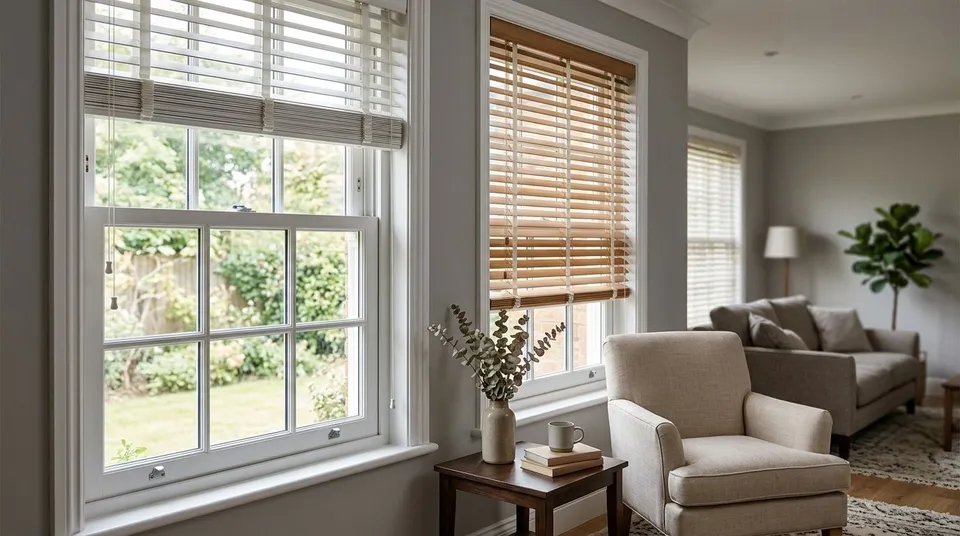
Double-hung windows slide open from the top and the bottom, and that two-sash design is exactly why generic horizontal blinds create problems: slats catch on the lower sash's tilt-in hardware and block half the window from opening cleanly. The best blinds for double-hung windows in 2026 are custom shades, not slatted blinds — cellular shades take the overall win for insulation and sash clearance, top-down/bottom-up styles win for splitting privacy and light, and roller shades win for a flat, minimal profile.
- Cellular shades rank as the best blinds for double-hung windows in 2026 for insulation and sash clearance.
- Top-down/bottom-up shades cover the lower sash for privacy while the upper sash stays open for light.
- Roller shades suit double-hung windows where a flat, minimal profile matters more than insulation.
- Rainier Blinds measures and installs custom shades across the Greater Seattle Area, not slatted blinds.
- Woven wood and zebra shades add texture or graduated light control on sun-exposed double-hung windows.
Why this matters
A double-hung window has an upper sash that lowers from the top and a lower sash that raises from the bottom, both moving along the same tracks. Any window covering mounted inside the frame has to clear that hardware without rubbing, or you end up with a shade that jams the sash or a blind whose slats get bent every time the window opens.
Homes across Auburn, Bellevue, Tacoma, and Seattle built between the 1970s and today still run double-hung windows in bedrooms, dining rooms, and stairwells, and the sash clearance problem shows up the same way in each one. Rainier Blinds measures and installs custom shades for this exact window type, and the list below reflects what actually holds up on a double-hung sash versus what looks fine in a showroom photo.
What makes the best shades for double-hung windows
- Clears the lower sash's tilt-in hardware without rubbing or catching
- Offers separate light control for the top pane and the bottom pane
- Insulates the sash gap, which is where most double-hung windows leak air
- Mounts inside the frame without blocking the counterbalance mechanism
- Comes in cordless or motorized operation so cords aren't a repeat annoyance
- Holds its shape under direct sun without warping or fading unevenly
At a glance: shades for double-hung windows
| Shade type | Best for | Standout feature | Key limitation |
|---|---|---|---|
| Cellular shades | Overall pick, energy efficiency | Honeycomb pockets insulate the sash gap | Costs more than a basic roller shade |
| Top-down/bottom-up shades | Splitting privacy and light | Independent control of the upper and lower sash | Two-way cords need occasional re-tensioning |
| Roller shades | Clean, minimal profile | Flat fabric roll clears sash hardware without bulk | Limited insulation value on its own |
| Zebra shades | Flexible light control | Alternating sheer and opaque bands align to the sash line | Sheer bands still let some light through |
| Roman shades | Traditional, tailored look | Soft fabric folds neatly when raised | Bulkier fabric stack at the top when fully open |
| Woven wood shades | Texture and natural warmth | Natural reed or bamboo weave | Less blackout, small light gaps between reeds |
1. Cellular shades: best overall for double-hung windows
Cellular shades use honeycomb-shaped pockets that trap air against the glass, which matters most on double-hung windows since the sash meeting rail is a common spot for drafts. The shade sits flat against the frame and clears the sash tracks cleanly whether it's raised or lowered.
Cellular shades pros:
- Insulates the sash gap better than any other option on this list
- Fits inside the frame without interfering with the tilt-in hardware
- Available in light-filtering or blackout fabric depending on the room
Cellular shades cons:
- Higher cost than a basic roller shade
- Fabric pleats can trap dust over years of use
Best for: double-hung windows in bedrooms and living rooms where energy savings matter. Verdict: Buy.
2. Top-down/bottom-up shades: best for splitting privacy and light
This operating style, available on cellular and some roller fabrics, lets you drop the top of the shade for privacy while the bottom stays open for light, or the reverse. On a double-hung window, that maps directly onto the two sashes: cover the lower sash for street-level privacy and leave the upper sash exposed for daylight.
Top-down/bottom-up shades pros:
- Matches the two-sash layout of a double-hung window better than any single-direction shade
- Keeps privacy and light control independent of each other
- Works with cordless or motorized lift systems
Top-down/bottom-up shades cons:
- Costs more than a standard single-direction shade
- Dual cord systems occasionally need re-tensioning
Best for: street-facing double-hung windows where privacy and daylight both matter. Verdict: Buy. Read more on top-down/bottom-up shades for privacy and light control.
3. Roller shades: best for a clean, minimal profile
Roller shades roll into a flat tube at the top of the frame and unroll as one continuous piece of fabric. On a double-hung window that means no pleats or folds to catch on the sash, just a flat surface that clears the hardware every time the window opens or closes.
Roller shades pros:
- Lowest-bulk option on this list, minimal stack height
- Wipes clean easily in kitchens and bathrooms
- Available in light-filtering, blackout, or solar fabric
Roller shades cons:
- Less insulation value than a cellular shade
- Single-direction lift, no split privacy control
Best for: double-hung windows in kitchens and modern-style rooms. Verdict: Buy. For a side-by-side breakdown, see roller shades vs. cellular shades.
4. Zebra shades: best for flexible light control
Zebra shades alternate sheer and opaque fabric bands on a single roll. Sliding the bands into or out of alignment adjusts how much light passes through, which gives a double-hung window a middle ground between fully open and fully blacked out.
Zebra shades pros:
- Adjustable light control without swapping fabrics
- Modern, banded look that reads differently from a standard roller shade
- Works well on windows that get strong afternoon sun
Zebra shades cons:
- Sheer bands still let some light and heat through even when "closed"
- Not a blackout option on its own
Best for: double-hung windows facing south or west with strong afternoon sun. Verdict: Buy for sun-facing rooms, Hold for nurseries needing full blackout.
5. Roman shades: best for a traditional, tailored look
Roman shades fold into horizontal pleats as they rise, giving a double-hung window a softer, more furnished look than a roller or cellular shade. They pair well with older or traditionally styled homes where double-hung windows are the standard.
Roman shades pros:
- Tailored, fabric-forward look that suits formal rooms
- Wide range of fabric and pattern choices
- Can be lined for added light control
Roman shades cons:
- Fabric stacks up at the top when fully raised, reducing visible glass
- Not the best insulator compared to cellular shades
Best for: double-hung windows in dining rooms and formal living spaces. Verdict: Buy. More detail in best Roman shades for living rooms.
6. Woven wood shades: best for texture and natural warmth
Woven wood shades use natural reed, jute, or bamboo weaves instead of fabric. On a double-hung window they add texture and a warmer look than a flat roller or cellular shade, without the heaviness of full drapery.
Woven wood shades pros:
- Natural texture that fabric shades can't replicate
- Lightweight, doesn't add bulk to the sash area
- Works well layered with drapery panels
Woven wood shades cons:
- Small gaps between reeds let in some light even when lowered
- Less blackout capability than cellular or lined Roman shades
Best for: double-hung windows in casual living rooms or spaces going for a natural look. Verdict: Buy for texture, Skip if full blackout is the priority.
How we ranked these
Each shade was measured against the six criteria above: sash clearance, split light control, insulation, frame-mount fit, operation options, and sun durability. Cellular shades and top-down/bottom-up styles scored highest because they solve the double-hung window's specific two-sash problem directly, not just window coverage in general.
“If a shade catches on the sash track, it's the wrong style for a double-hung window, no matter how it looks in the showroom.”
Which shade should you choose for double-hung windows?
For most homes in 2026, cellular shades are the default answer if energy savings and clean sash clearance matter most. If the window faces the street and privacy has to coexist with daylight, top-down/bottom-up shades are the better pick. Going for a minimal, modern look points to roller shades, while a more traditional room calls for Roman shades or woven wood.
Whatever the room, the fix for a double-hung window is always a shade measured to the actual sash depth, not a stock blind sized to the rough opening.
Get shades measured for your sash
Rainier Blinds measures and installs custom shades across the Greater Seattle Area.
FAQ
What are the best blinds for double-hung windows in 2026?
Custom shades outperform slatted blinds on double-hung windows in 2026 because they clear the sash hardware without catching. Cellular shades win overall for insulation, and top-down/bottom-up shades win for splitting privacy from light.
Do double-hung windows need a special mount type?
Double-hung windows usually take an inside mount so the shade sits flush against the frame and doesn't interfere with the sash tracks. An outside mount works when the frame depth is too shallow for an inside fit.
Are cellular shades better than roller shades for double-hung windows?
Cellular shades insulate better because of their honeycomb air pockets, while roller shades have a flatter, lower-bulk profile. Choose cellular for energy savings and roller for a minimal look.
Can top-down/bottom-up shades fit any double-hung window?
Top-down/bottom-up shades fit most standard double-hung windows as long as the frame depth accommodates an inside mount. A measurement at the window confirms fit before installation.
Do zebra shades block enough light for a bedroom?
Zebra shades let some light through even in the closed position because of their sheer bands, so they work better in living areas than in rooms needing full blackout. A lined Roman shade or blackout cellular shade is the better bedroom pick.
Why not use regular blinds on a double-hung window?
Slatted blinds can catch on the lower sash's tilt-in hardware, making the window harder to open and close over time. Shades mount flatter against the frame and avoid that interference.
How long does it take to install shades on double-hung windows?
Installation time depends on the number of windows and the shade type, and is confirmed during the in-home measurement. A single double-hung window typically takes a short window within a standard install visit.
Do motorized shades work on double-hung windows?
Yes, motorized lift systems work with cellular, roller, and Roman shades on double-hung windows and remove the need for a pull cord near the sash.
One last thing
The detail most homeowners miss on double-hung windows is the meeting rail, the horizontal bar where the upper and lower sash overlap. A shade that stops short of that rail leaves a light gap right at eye level, so getting the drop measurement to the rail, not just the sill, is what separates a shade that looks finished from one that doesn't.