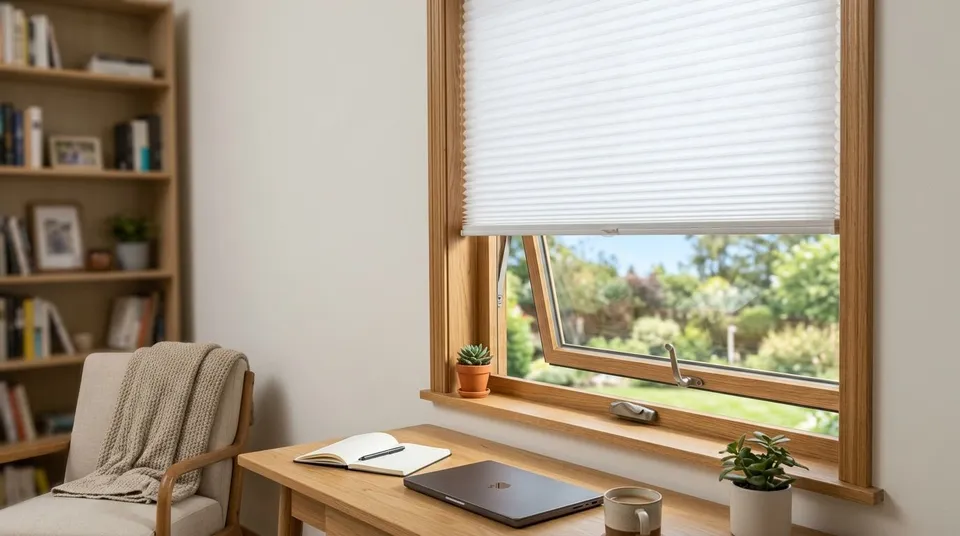
Awning-style crank windows hinge at the top and swing outward, with the crank handle sitting at the bottom of the frame where a standard blind's tilt wand or bottom rail usually lands. That's why most homeowners searching for the best blinds for awning-style crank windows end up with a product that jams against the hardware within the first month. Custom shades, not blinds, solve the clearance problem and that's the real answer for 2026 installs.
- Cordless cellular shades are the best overall pick for awning-style crank windows in 2026.
- Standard blinds with slats or tilt wands frequently hit the crank handle on awning and casement frames.
- Outside-mount roller shades clear the crank arm on wide window banks without adding frame depth.
- Motorized roller shades solve high or hard-to-reach awning windows above sinks, stairwells, and transoms.
- Skylight shades are built for the angled glass on awning-style skylights that flat shades can't fit.
Why this matters
An awning window's crank mechanism sticks out into the room by an inch or more when the window is cranked open. Any window treatment that hangs a cord, wand, or bottom rail directly in that path either gets bent, blocks the crank from turning, or has to be re-adjusted every time you open the window.
That's a hardware clearance problem, not a style problem, and it rules out several products before you even get to color and fabric. Rainier Blinds' casement window shade guide covers the same hinge-and-crank issue on casement frames, which share the identical mounting challenge as awning windows.
What makes the best shades for crank windows
- Clearance from the crank arm at full open, without the shade needing to be raised first
- Cordless or top-down-bottom-up operation so no cord loop dangles near the handle
- Outside-mount or frame-adjacent bracket options for windows with shallow inset depth
- Motorized or smart control for windows placed above sinks, stairwells, or other hard-to-reach spots
- Fabric that holds shape in a room with regular temperature swings near an operable window
- Manual, motorized, and smart tiers available on the same shade so the choice isn't locked in at install
At a glance: shades for awning-style crank windows in 2026
| Shade type | Best for | Standout feature | Key limitation |
|---|---|---|---|
| Cordless cellular shades | Everyday awning and casement windows | Full crank clearance, no dangling cord | Fewer opacity levels than a roller shade |
| Outside-mount roller shades | Wide banks of awning windows | Clears the crank arm without added frame depth | Needs wall or trim space outside the opening |
| Top-down-bottom-up cellular shades | Privacy without blocking the crank | Light in from the top, privacy from the bottom | Two-way control means a slightly higher unit cost |
| Motorized roller shades | High or hard-to-reach awning windows | Remote or app control clears the reach problem entirely | Needs power or a battery-charge routine |
| Skylight shades | Angled awning-style skylights | Built to track glass that isn't set at 90 degrees | Requires professional-grade mounting hardware |
1. Cordless cellular shades: best overall for crank windows
Cellular shades use a honeycomb-shaped fabric structure that operates on a spring or cordless lift system, which keeps every moving part away from the crank handle at the bottom of the frame. On an awning window, that means the shade goes up and down cleanly no matter where the crank is turned to.
Cordless cellular shades pros:
- No cord loop to catch on the crank arm
- Insulating air pockets cut heat loss through the glass, a real factor in Pacific Northwest homes
- Available in manual, motorized, or smart-hub-compatible operation
Cordless cellular shades cons:
- Fewer opacity choices than a roller shade fabric
- Honeycomb structure shows more wear in high-humidity rooms over time
Cordless cellular shades pricing: Rainier Blinds prices every cellular shade at the in-home consultation, since fabric, mount type, and control tier all factor into the quote.
Best for: homeowners who want one shade that works on every awning or casement window in the house without a second thought about the crank.
Verdict: Buy. This is the default recommendation for 2026 unless a specific room needs a different feature.
2. Outside-mount roller shades: best for wide crank window banks
Roller shades mounted outside the window frame, on the wall or trim, sit far enough forward that the crank handle never touches the shade even when the window is cranked fully open. That makes them the strongest option for a row of two or three awning windows set side by side, a common layout in newer South King County builds.
Outside-mount roller shades pros:
- Clears the crank arm regardless of how wide the window bank is
- Flat fabric profile reads cleaner across multiple windows than individual cellular units
- Works in manual or motorized tiers, including a mount type guide worth reading before ordering
Outside-mount roller shades cons:
- Needs enough wall or trim depth around the opening to hold the bracket
- Light gaps at the sides are more noticeable than an inside-mount shade
Best for: wide sets of awning windows where an inside mount would still land too close to the crank hardware.
Verdict: Buy for multi-window banks; Skip if you only have a single narrow awning opening, since an inside-mount cellular shade will look cleaner.
3. Top-down-bottom-up cellular shades: best for privacy without blocking the crank
A top-down-bottom-up cellular shade lowers from the top or raises from the bottom independently, which lets you keep the lower half covered for privacy while leaving the top open for light, all without a cord or rail sitting near the crank. On an awning window mounted at eye level, that's the difference between a shade you fight with daily and one you forget is there.
Top-down-bottom-up cellular shades pros:
- Bottom section stays clear of the crank handle at all times
- Privacy and daylight controlled independently on the same shade
- Pairs with the same cordless lift discussed in Rainier Blinds' top-down-bottom-up shades guide
Top-down-bottom-up cellular shades cons:
- Two-way lift mechanism costs more than a single-direction cellular shade
- Slightly more moving parts to service over the shade's life
Best for: bathrooms, home offices, and street-facing rooms where an awning window sits at eye level and privacy matters more than a clear view.
Verdict: Buy for eye-level installs; Hold for windows placed high on a wall where privacy isn't a factor.
4. Motorized roller shades: best for high or hard-to-reach awning windows
Awning windows placed above a kitchen sink, over a stairwell, or near a vaulted ceiling put the crank handle out of easy reach in the first place. A motorized roller shade solves the reach problem and the clearance problem in one move, since there's no manual wand or cord to manage near the crank at all.
Motorized roller shades pros:
- Remote or app control removes the reach problem entirely
- No manual mechanism anywhere near the crank arm
- Programmable schedules covered in Rainier Blinds' guide on how to program motorized window shades
Motorized roller shades cons:
- Needs either a power run or a regular battery-charge routine
- Higher unit cost than a manual roller shade of the same fabric
Best for: awning windows placed above sinks, stairwells, or vaulted ceilings where a step stool is the only other option.
Verdict: Buy for hard-to-reach placements; Wait if your awning window is within easy arm's reach, since manual cellular shades cover the same clearance need for less money.
5. Skylight shades: best for angled awning-style skylights
Some awning-style crank windows are actually roof or wall skylights set at an angle rather than vertical. A flat roller or cellular shade built for a 90-degree opening won't track correctly on angled glass, which is why skylight shades use a dedicated guide system built for that geometry.
Skylight shades pros:
- Built specifically to track angled or vaulted glass
- Available in motorized tiers for skylights out of arm's reach
- Blocks glare and heat gain on south- and west-facing roof glass
Skylight shades cons:
- Requires professional-grade mounting hardware, not a DIY install
- Fewer fabric and color options than a standard roller or cellular shade
Best for: angled awning-style skylights where a standard flat shade physically won't fit the frame.
Verdict: Buy if your crank window is a skylight; Skip for standard vertical awning windows, where a flat shade is the simpler and cheaper route.
“If a shade needs the crank handle moved out of the way to operate, it's the wrong shade for that window.”
How we ranked these
Every shade on this list was judged against the same six criteria: crank clearance, cord-free or top-down-bottom-up operation, mount flexibility, motorized or smart availability, fabric durability near an operable window, and how the shade performs on a wide bank versus a single opening. Cordless cellular shades ranked first because they clear every criterion without a caveat; the other four each win one specific scenario the top pick doesn't cover as well.
Which shade should you choose for your crank window?
For a single awning or casement window with no special reach or privacy issue, cordless cellular shades are the right call in 2026. If you're covering a wide bank of awning windows, move to outside-mount roller shades. If the window sits above a sink or stairwell, go motorized. If it's an actual skylight, skip the flat shades entirely and go straight to a skylight-specific shade.
Rainier Blinds measures and installs every one of these shade types across the Greater Seattle Area, including Bellevue, Tacoma, and Seattle, with its own install crew rather than a subcontractor.
Get a free in-home shade consultation
Real measurements and real pricing on the spot, no online guesswork.
FAQ
What's the best shade for an awning-style crank window?
Cordless cellular shades are the best overall pick for awning-style crank windows in 2026 because the lift mechanism stays clear of the crank handle at the bottom of the frame. Motorized roller shades and top-down-bottom-up cellular shades cover specific placement or privacy needs the cordless cellular shade doesn't.
Why don't regular blinds work well on crank windows?
Slatted blinds hang a tilt wand or bottom rail directly in the path of the crank arm, which can jam the mechanism or bend the hardware within weeks. Shades without a rigid bottom rail, like cellular or roller shades, clear that path instead.
Can you put motorized shades on an awning window?
Yes, motorized roller and cellular shades both work on awning-style crank windows and remove the reach problem on windows placed above sinks, stairwells, or vaulted spaces. Power runs or battery-charge routines are the main tradeoff.
Do skylight windows count as awning-style crank windows?
Some skylights use the same crank-operated hinge as a vertical awning window, just set on an angle. Those need skylight-specific shades built to track angled glass, not a standard flat roller or cellular shade.
Is an inside mount or outside mount better for a crank window?
Outside mount is better for wide banks of awning windows since it clears the crank arm without needing extra depth inside the frame. Inside mount works fine for a single narrow awning opening.
Are cordless shades safer than corded shades on crank windows?
Cordless shades remove any loose cord near the crank handle, which cuts the chance of the cord catching on the mechanism during operation. That's a mechanical clearance benefit on top of the usual child-safety reason for going cordless.
How do you measure a crank window for custom shades?
Measure the frame with the window fully closed and note how far the crank handle projects into the room when open, since that projection determines whether an inside or outside mount will clear it. A professional measurement at an in-home consultation catches this before the shade is ordered.
One last thing
The detail most homeowners miss: measure the crank handle's projection with the window fully open, not closed. A shade that clears the frame at rest can still catch the handle mid-swing, and that's the single most common reason a newly installed shade gets sent back for a remount.