
Our available controls: Rainier Blinds offers Roman and woven wood shades with motorized operation only. All other shade styles are available with manual, motorized, or smart control. Your consultation confirms the controls and power options for your product.
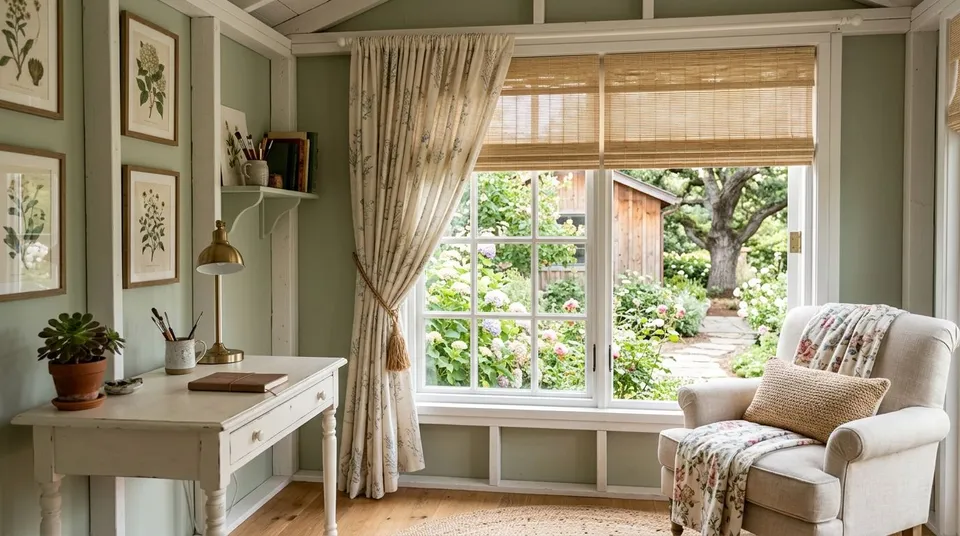
A she-shed or backyard studio needs window treatments that manage direct sun, protect privacy from close neighbors, and hold up in a structure with less insulation than the main house. Custom roller, cellular, and zebra shades solve all three problems in one visit, and outdoor-rated shades cover sliding glass doors and covered porches attached to the studio.
- Cellular shades are the top pick for window treatments for she sheds because they add insulation a detached structure usually lacks.
- Zebra shades work best for craft, sewing, or art studios that need adjustable light without full blackout.
- Outdoor roller shades cover sliding doors and covered porches attached to a she-shed or studio.
- Battery-powered motorized shades solve the no-outlet problem common in backyard structures built without full electrical runs.
- Blackout roller shades are the right call for recording studios or video-editing sheds where screen glare is the main complaint.
Why window treatments matter for she-sheds and backyard studios
A she-shed or backyard studio is usually a single-pane or double-pane structure with no attic insulation and one or two exposures that get sun most of the day. That means heat gain and glare are worse than in the main house, and privacy is a bigger issue because the structure often sits closer to a property line or a neighbor's second-story window.
Most of these builds also skip a full electrical run to a switch box, which changes which motorized options actually work. A window treatment plan for an accessory dwelling unit faces the same wiring and insulation constraints, and the fixes overlap directly with what a she-shed needs.
Update your glare and heat control first
Before picking fabric or color, deal with the physical problem: how much direct sun hits the window and for how many hours.
- Track sun exposure for one full day, morning and afternoon, before ordering anything
- Note which walls have no overhang or awning shading the glass
- Flag any window facing west, since afternoon heat gain is the worst offender in the Pacific Northwest
- Check for single-pane glass, which loses and gains heat twice as fast as double-pane
Choose insulation over decoration for uninsulated walls
A she-shed with thin walls and no attic space loses conditioned air through the glass faster than the walls. Cellular shades are the strongest single upgrade for this problem because the honeycomb pockets trap air against the pane.
- Single-cell honeycomb shades for a light insulation boost on a budget
- Double-cell honeycomb shades for studios used year-round, including winter workspace
- Top-down bottom-up cellular shades to keep the top open for light while blocking the sightline at eye level
- Light-filtering cellular fabric for daytime studios that still want soft natural light
- Blackout cellular fabric for a studio also used as a guest sleeping space
The same logic applies to insulated cellular shades in garage conversions, which face nearly identical heat-loss problems in a converted, uninsulated structure.
Add privacy without losing the natural light that makes a studio usable
Most she-sheds sit close to a fence line or a neighbor's yard, and blackout everything defeats the point of a daylight studio.
- Light-filtering roller shades for daytime privacy that still lets in usable light
- Zebra shades with alternating sheer and solid bands, adjustable to the exact privacy level needed
- Frosted or opaque roller fabric for windows facing a shared fence line
- Sheer roman shades for a softer look in a studio doubling as a guest space
For a full breakdown of opacity levels, how to choose shade opacity for privacy and natural light covers the tradeoffs between light-filtering and blackout in more depth than a single product page can.
Protect fabric, supplies, and equipment from sun fade
A craft room, sewing studio, or art studio stores fabric, paint, paper, and canvas that fade or degrade with direct UV exposure over a season or two.
- Solar shades with a tight weave factor to cut UV without blocking the view entirely
- Roller shades in a UV-blocking fabric for storage walls that face direct afternoon sun
- Blackout shades for any wall storing paper stock, dyed fabric, or finished artwork
- Rotating stock away from the sunniest wall as a no-cost interim fix while shades are on order
Custom sewing and craft room treatments walk through fabric choices built specifically around fade protection for stored materials.
Solve the power problem before choosing motorized
Detached structures built without a full electrical permit often lack a dedicated outlet near every window, which rules out plug-in motorized shades on some walls.
- Manual cordless shades for any wall with no nearby outlet
- Battery-powered motorized shades for windows out of reach where manual cords aren't practical
- Solar-charged motorized shades for a south- or west-facing wall that gets steady daily sun
- Hardwired motorized shades only where an electrician already ran power to that wall
A battery-powered motorized shade is the right call for most she-shed installs in 2026, since it skips the wiring problem entirely without giving up remote or app control.
Match the treatment to how the studio actually gets used
A yoga studio, a recording booth, and a home office shed all need different light control even though they're the same size structure.
- Full blackout roller or cellular shades for recording booths and video-editing sheds where screen glare and outside noise both matter
- Light-filtering zebra shades for yoga or fitness studios that want soft, even daylight
- Roman shades or drapery for a she-shed styled as a guest reading room or sitting space
- Cellular shades for a shed doubling as a home office needing glare control on a monitor
Blinds and shades for fitness studios and yoga spaces breaks down light control specifically for movement studios, which shares a lot with a backyard yoga shed.
Cover the outdoor side too
Many she-sheds have a small covered porch, patio slider, or attached deck that needs its own shade separate from the interior windows.
- Outdoor roller shades in steel wire mesh for a covered porch attached to the studio
- Zipper-track outdoor shades for a fully enclosed patio space next to the shed
- Solar mesh fabric that cuts glare on the porch without blocking the view into the yard
Outdoor roller shades for decks and patios covers mesh density and mounting options for exactly this kind of attached outdoor space.
“If a she-shed window gets more than four hours of direct afternoon sun, skip light-filtering and go straight to blackout or a tight-weave solar fabric.”
Comparison: shade options for she-sheds and backyard studios
| Option | Best for | Key limitation |
|---|---|---|
| Cellular shades | Year-round insulation, temperature swings | Adds bulk to very shallow window frames |
| Zebra shades | Adjustable privacy with kept daylight | Not full blackout even at tightest setting |
| Roller shades (solar or blackout) | Fade protection, glare control, budget builds | Single light level per shade, no gradual adjustment |
| Outdoor roller shades | Attached porches, patios, sliders | Not rated for full interior use |
| Roman or drapery | Guest-space or sitting-room styled sheds | Least practical for full blackout or heavy sun |
Rainier Blinds measures and installs every option on this table in the Greater Seattle area, and a free in-home consultation is the only way to get an exact quote for a she-shed or studio, since window sizes on these structures are rarely standard.
Common mistakes she-shed and studio owners make
- Buying stock-size blinds off a shelf. She-shed windows are frequently non-standard sizes, and a stock blind that's even a half-inch off leaves light gaps at the edges.
- Skipping insulation shades because the structure feels temporary. A studio used through a Pacific Northwest winter needs the same thermal handling as a spare bedroom, not less.
- Choosing full blackout for a daytime craft or art studio. Blocking all light defeats the reason for windows in a workspace; light-filtering or zebra shades solve privacy without killing usable daylight.
- Assuming motorized shades need a full electrical run. Battery-powered motorized shades solve most detached-structure power problems without an electrician.
- Ignoring the attached porch or slider. Interior shades alone don't stop glare on a covered porch; that side needs its own outdoor-rated shade.
Get a free she-shed consultation
Rainier Blinds measures and installs shades for backyard studios across South King County.
FAQ
What are the best window treatments for she sheds in 2026?
Cellular shades are the best all-around window treatment for she sheds in 2026 because they add insulation to a detached structure that usually has none. Zebra shades are the better pick for studios that need adjustable privacy without losing daylight.
Do backyard studios need blackout shades?
Only if the studio is used for recording, video editing, or sleeping; a daytime craft or art studio does better with light-filtering or zebra shades. Full blackout blocks the natural light most studios are built to capture.
Can motorized shades work in a she-shed with no outlet?
Yes, battery-powered motorized shades work without a dedicated outlet or new wiring. Solar-charged versions extend battery life further on south- or west-facing windows that get steady sun.
How do I stop fabric and craft supplies from fading in a sunny studio?
Solar or blackout roller shades with a tight-weave or UV-blocking fabric protect stored fabric, paper, and paint from sun fade. Positioning storage away from the sunniest wall helps as a short-term fix while shades are being measured and installed.
Are outdoor shades different from interior shades for a she-shed porch?
Yes, outdoor roller shades use steel wire mesh or zipper-track fabric rated for exterior exposure, which interior shade fabric isn't built for. A covered porch or slider attached to the studio needs its own outdoor-rated shade.
What's the most common window treatment mistake in backyard studios?
Buying stock-size blinds for non-standard shed windows, which leaves light gaps at the frame edges. Custom measuring solves this and matches the shade exactly to the opening.
Do cellular shades really help with temperature in an uninsulated shed?
Yes, the honeycomb pockets in cellular shades trap air against the glass, cutting heat loss and heat gain more than a flat roller shade does. Double-cell versions add more of this effect than single-cell.
Is drapery a good option for a she-shed?
Drapery works well for a she-shed styled as a guest sitting room or reading space, but it's the weakest option on the table for full blackout or heavy sun control. Roman shades or roller shades handle those jobs better.
One last thing
The detail most owners miss until installation day: a she-shed's window trim is often thinner than a standard house wall, which limits mount depth for certain headrail styles. Getting an exact measurement before ordering, rather than guessing off a tape measure at the hardware store, is the single biggest reason DIY shade orders come back wrong in 2026.