
Our available controls: Rainier Blinds offers Roman and woven wood shades with motorized operation only. All other shade styles are available with manual, motorized, or smart control. Your consultation confirms the controls and power options for your product.
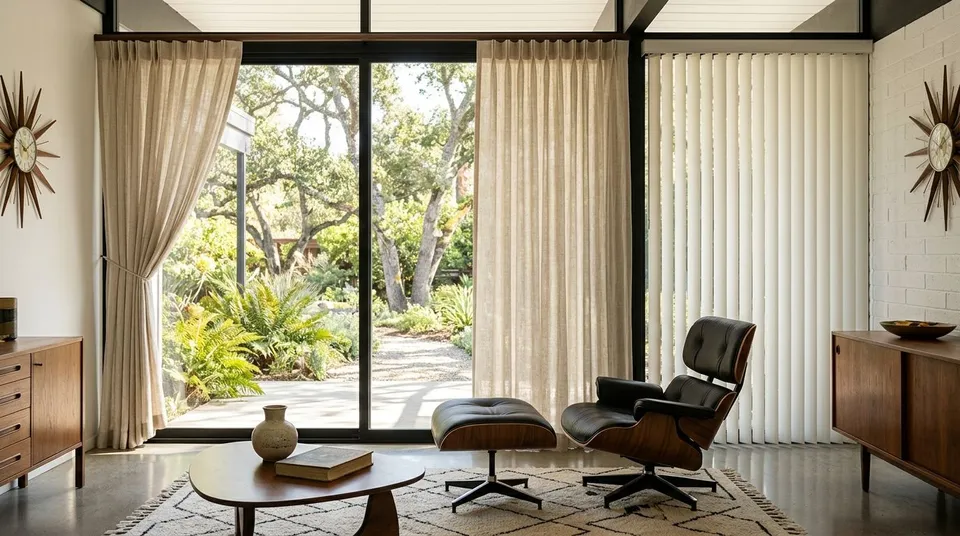
Window treatments for mid-century modern homes have one job the style won't compromise on: control light and privacy without hiding the glass walls, clerestory windows, and low rooflines that make the architecture recognizable in the first place. That rules out heavy drapery, ruffled valances, and anything with a busy print, and it points straight at flat, low-profile shades instead.
- Window treatments for mid-century modern homes work best as flat, low-profile shades, not heavy drapery.
- Roller shades and zebra shades match the clean horizontal lines the architecture is built around.
- Motorized options solve the clerestory and high-window access problem common in mid-century floor plans.
- Cellular shades add insulation value to the single-pane glass many original mid-century homes still carry in 2026.
Why window treatments matter for mid-century modern homes
A mid-century modern home is designed around glass. Floor-to-ceiling windows, clerestory strips above eye level, and wide sliding glass doors are structural features, not add-ons, so a shade that blocks or bulks up that glass fights the house instead of finishing it. Anything mounted like an afterthought, a scalloped valance or a stacked drapery panel, reads as out of period the moment you step back and look at the roofline.
Most of these homes in the Seattle, Bellevue, and Tacoma area were built between the 1950s and 1970s, and a large share still carry the original single-pane, aluminum-frame glass. That means heat loss through the window wall is a real cost problem in 2026, not just a decorating detail, and it changes what "the right window treatment" actually means for this segment compared to a newer build with double-pane glass.
Measure every wall of glass before you shop
Start with the openings, not the fabric swatches. A mid-century home rarely has a single standard-size window, so measuring wrong here costs you the whole project.
- Decide inside mount versus outside mount on full-height glass walls before anything else, since the headrail depth changes the answer
- Note any clerestory or transom windows above eight feet that will need a pole system or motorized control
- Measure the stack clearance on sliding glass doors so the shade never blocks the track
- Check oversized picture windows for non-standard widths; many original mid-century sashes don't match modern stock sizes
- Flag any windows with visible mounting hardware from a prior remodel that needs to come out first
Pick a flat profile that respects the roofline
Mid-century architecture reads as a series of horizontal lines. A shade that sits flat against the glass keeps that line intact; a valance or a bunched drapery panel breaks it.
- Roller shades disappear into a slim headrail and leave the glass wall visually uninterrupted
- Cellular shades hold the same flat profile while adding a layer of insulation
- Roman shades in a flat-fold style bring texture without the stacked bulk of a traditional gather
- Skip scalloped valances, box pleats, and ornate cornices; they visually fight a low, flat roofline
Motorized shades on oversized picture windows solve a specific mid-century problem: a manual chain or wand on a nine-foot pane is awkward to operate daily, and most homeowners stop using it within a year. Rainier Blinds sets up motorized shades for large picture windows so the glass wall stays the focal point instead of the hardware.
Choose fabric and color for the wood before you choose it for the wall
Mid-century interiors are built around exposed wood, teak, walnut, cedar paneling, and the shade color has to sit next to that wood, not compete with the paint.
- Woven wood shades pair naturally with exposed wood trim and read as period-correct without looking staged
- Warm-toned zebra shades in olive, rust, or warm gray complement wood tones better than stark white or cool gray
- A fabric with too much white or blue undertone washes out the warmth mid-century wood finishes are known for
- Solid neutrals outperform patterns here; mid-century rooms rely on line and material, not print
Fabric choice on roman shades is where most homeowners get this wrong first, since the same fabric that reads as "warm" in a swatch book can look cold once it's hanging against a full wall of glass. Rainier Blinds walks through this exact tradeoff in its guide on how to choose fabric for custom roman shades.
Solve glare and heat on west-facing glass
A lot of mid-century great rooms were oriented to catch afternoon sun, which means solar heat gain and glare are functional problems, not decorating footnotes.
- Light-filtering shades cut glare during peak afternoon hours without blacking out the room midday
- Dual shades let you switch between sheer and opaque fabric bands in the same headrail
- Cellular shades add a dead-air pocket that reduces heat transfer through single-pane glass
- Outdoor shades on an adjacent patio or deck cut heat before it reaches the glass at all
Handle sliding glass doors separately from windows
A sliding glass door in a mid-century home usually anchors the main living space, so the shade covering it has to get out of the way completely when the door is in use.
- Choose a shade that stacks fully clear of the door track, not one that has to be raised every time someone walks through
- Vertical cellular shades or a wide roller panel on a low-profile mount keep the door fully operable
- Motorized control matters more here than on a standard window, since a shade you have to hand-crank next to a heavy door gets ignored
Rainier Blinds covers mount and stack options in detail in its guide to motorized shades for sliding glass doors, which is worth reading before you settle on a headrail style for a glass wall opening.
Automate anything above reach
Clerestory strips and high transom glass are common in split-level mid-century floor plans, and they're the windows most likely to sit bare because a pole system is a hassle to use daily. Motorized shades on these openings get adjusted; manual ones mostly get left alone, which defeats the point of installing a shade there in the first place.
Layer drapery only where the room asks for it
Bedrooms and formal dining rooms in a mid-century floor plan can take a drapery panel alongside a shade for warmth and blackout. An open living room with a glass wall almost always looks better with the shade alone; a drapery panel there just adds bulk the room's sightlines don't need.
Get a measure for your mid-century windows
A free in-home consultation covers fabric, mount type, and motorization options.
Comparison: shade options for mid-century modern homes
| Option | Best for | Key limitation |
|---|---|---|
| Roller shades | Large glass walls and sliding doors needing a flat, minimal profile | Limited insulation value on their own |
| Cellular shades | Single-pane windows where heat loss is a real cost issue | Bulkier stack than a roller on very wide openings |
| Zebra shades | Rooms wanting alternating light control without a bulky headrail | Horizontal banding can compete with strong wood grain patterns |
| Woven wood shades | Rooms with exposed wood trim, wanting texture that reads as period-correct | Less blackout capability than cellular or roller |
| Roman shades (flat-fold) | Windows wanting fabric texture without a stacked drapery look | Slower operation than a roller unless motorized |
| Drapery panels | Bedrooms and dining rooms wanting warmth alongside a shade | Adds visual bulk if used alone on a full glass wall |
Common mistakes mid-century modern homeowners make
- Buying heavy drapery for a wide picture window, which blocks the daylight the room was designed around
- Choosing an ornate valance or cornice, adding visual weight a flat roofline can't support
- Leaving clerestory or transom windows manual, then never actually adjusting them because the pole is out of reach
- Ignoring single-pane heat loss and picking a purely decorative shade with no insulating value
- Mixing multiple accent colors across open sightlines, breaking the continuous horizontal line mid-century design relies on
FAQ
What's the best window treatment for a mid-century modern home?
Flat, low-profile shades such as roller, cellular, or zebra shades work best for mid-century modern homes because they preserve the horizontal lines and glass walls the architecture is built around. Heavy drapery and ornate valances tend to fight the flat roofline instead of complementing it.
Should I use drapery or shades in a mid-century modern living room?
Shades alone usually work better in an open mid-century living room with a glass wall, since drapery panels add bulk the sightlines don't need. Drapery is a better fit in bedrooms and dining rooms where a warmer, layered look makes sense.
How do I cover clerestory windows in a mid-century home?
Motorized shades are the practical answer for clerestory and high transom windows, since a manual pole system above eight feet rarely gets used consistently. Motorization means the shade actually gets adjusted instead of left bare.
Do cellular shades help with single-pane windows in older mid-century homes?
Yes, cellular shades add a layer of insulation that single-pane glass never had, which matters for homes built in the 1950s through 1970s that still carry original aluminum-frame windows. The insulating cell reduces heat transfer through the glass.
What color shades work with mid-century wood trim?
Warm-toned neutrals such as olive, rust, and warm gray complement exposed teak, walnut, and cedar trim better than stark white or cool-toned fabrics. Too much white or blue undertone washes out the warmth mid-century wood finishes are known for.
Are patterned shades appropriate for mid-century modern interiors?
Solid neutrals generally outperform patterns in mid-century interiors, since the style relies on clean lines and material contrast rather than print. A strong pattern can compete with the wood grain and architectural lines instead of supporting them.
What's the best shade for a sliding glass door in a mid-century home?
A shade that stacks fully clear of the door track, such as a wide roller panel or vertical cellular shade on a low-profile mount, is the best fit for sliding glass doors. The shade should never interfere with the door's daily operation.
How do I stop glare on west-facing mid-century windows?
Light-filtering or dual shades cut glare during peak afternoon hours without fully blacking out the room, which fits mid-century great rooms oriented to catch afternoon sun. Cellular shades add the extra benefit of reducing solar heat gain through the glass.
One last thing
A lot of original mid-century homes in the Puget Sound area still run single-pane, aluminum-frame glass from the 1950s through 1970s, which means the insulation gap is the part homeowners underestimate most going into 2026. A cellular shade closes more of that gap than a roller or roman shade of the same size, so if the house has original glass, that's the deciding factor before fabric or color even enter the conversation.