
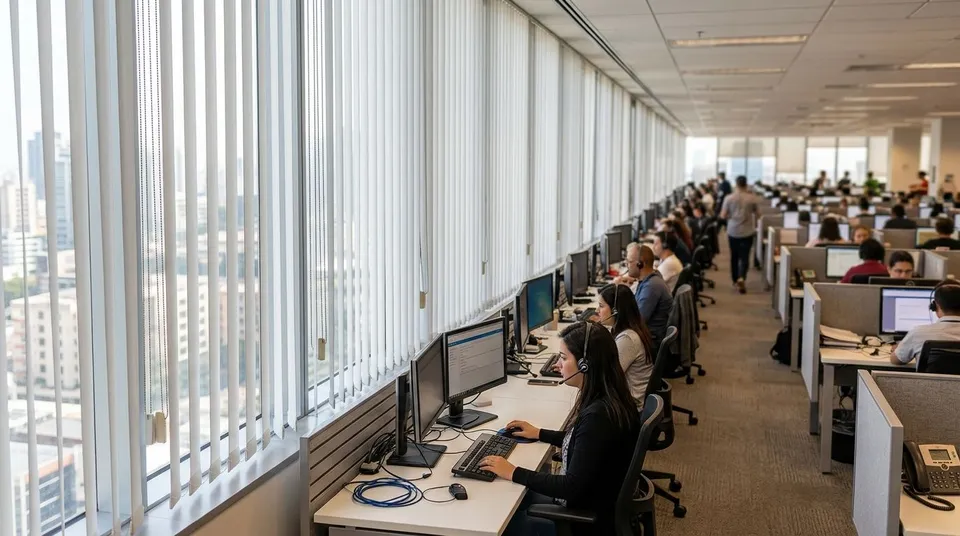
Vertical blinds for call centers is a search a lot of facility managers type into Google in 2026, but Rainier Blinds does not install vertical blinds on any floor, open-plan or otherwise, because the vane tracks jam under the kind of daily traffic a call center floor generates. The good news is the actual problems people are trying to solve, glare on monitor banks and privacy on glass-walled supervisor offices, get solved better by shades built for continuous commercial use.
- Rainier Blinds does not install vertical blinds; light-filtering roller shades and zebra shades solve the same glare and privacy problems on open-plan call center floors in 2026.
- Motorized shades let a facilities team raise an entire window wall on one schedule instead of assigning staff to adjust blinds by hand every shift.
- Zebra shades handle glass-walled supervisor offices by switching between open sightlines and full privacy using one shade.
- Cellular shades add insulation value for call center floors along exterior walls in older Puget Sound office buildings.
Why window treatments matter on an open-plan call center floor
A call center floor runs differently than a normal office. Shifts overlap, monitors sit in long rows facing whatever window wall the building has, and supervisors usually work behind glass so they can watch the floor without a closed door. That combination creates two problems at once: glare that fights with overhead lighting, and privacy that has to be adjustable rather than permanent.
Vertical blinds get searched for this use case because they are the old default for wide glass runs and sliding doors in commercial spaces. The vanes rotate and stack to one side, which sounds useful on paper. In practice, on a floor that gets touched dozens of times a day, the vanes chip, the chain mechanism jams, and dust collects on both sides of every slat where cleaning crews rarely reach. Light-filtering shades built for open-plan office windows skip that mechanism entirely and cut glare with one continuous piece of fabric instead of dozens of moving vanes.
The direct answer for open-plan call center floors in 2026: light-filtering roller shades or zebra shades, motorized where the window run is wide, cellular shades where insulation matters more than sightlines.
“Vertical blinds jam on a floor that gets touched a hundred times a day; roller and zebra shades have no track to jam.”
Update your window audit before picking a shade
Start with what the floor actually has, not what a catalog shows you. The right shade depends on orientation, glass type, and how many desks sit within ten feet of a window.
- Note which walls face west or south, since those get the worst afternoon glare
- Count how many monitor rows face a window directly versus at an angle
- Mark every glass partition wall separately from exterior windows
- Check ceiling height and mount depth for headrail clearance
- Confirm whether power access exists near windows for motorized options
Match shade type to the sightline problem
Not every window on the floor needs the same treatment. A supervisor glass office has a different job than a 40-foot window wall behind a bank of agent desks.
- Light-filtering roller shades for desk rows that need glare cut without going dark mid-shift
- Zebra shades for glass-walled supervisor offices that flip between open and private
- Cellular shades for exterior-wall zones where draft and heat loss are the bigger complaint
- Blackout shades only for training rooms or media rooms running screen presentations
Choose manual, motorized, or smart controls for shift-based staffing
This is where most call centers get it wrong. A manual shade on a 40-foot window wall means someone walks the floor and adjusts ten shades by hand every time the sun moves, and on a rotating shift schedule that job belongs to nobody. Motorized shades group by zone so a whole wall raises or lowers on one schedule, and that is usually the faster path once the floor has more than a handful of windows.
- Manual: lowest ongoing cost, fine for a single office or a small break room
- Motorized: batches multiple shades on one wall to run on a fixed schedule
- Smart: adds app or voice control on top of motorized, useful for teams managing more than one floor
- Zone control: separate the window-wall zone from the glass-partition zone so they run on different schedules
Rainier Blinds measures and installs every one of these tiers with its own crew rather than a subcontractor, which matters on a commercial floor where install has to happen after hours without disrupting shifts. Every quote happens at a free on-site consultation.
Book a free on-site consultation
Rainier Blinds measures and installs commercial shades with its own crew across the Greater Seattle Area.
Plan mount type for commercial glazing
Commercial window frames vary more than residential ones, and mount type decides whether the install goes smoothly or turns into a change order.
- Inside mount for storefront-depth glass frames
- Outside mount for shallow or recessed frames that cannot hold an inside bracket
- Continuous headrail across a window wall so multiple shades read as one line
- Ceiling mount for glass partition walls with no window frame to attach to
Test glare control at desk height, not at the window
A shade that looks fine standing at the window can still leave a glare stripe across a monitor eight feet away. Test at the point that actually matters.
- Check screen reflection sitting at the desk, not standing at the sill
- Test at midday and again in late afternoon, since the sun angle changes
- Verify supervisor office privacy separately from the open floor light level
Set a cleaning and maintenance routine for continuous-use floors
A shade that runs eight, ten, or sixteen hours a day needs a maintenance plan, not an install-and-forget approach.
- Wipe light-filtering fabric shades monthly with a dry microfiber cloth
- Vacuum cellular honeycomb shades with a brush attachment to avoid crushing the cells
- Check motor batteries or hardwired connections quarterly on motorized units
- Re-test smart shade schedules after any daylight saving time change
Comparison: shade options for open-plan call center floors
| Option | Best for | Key limitation |
|---|---|---|
| Light-filtering roller shades | Even glare control across long desk rows | Less privacy at night once interior lights are on |
| Zebra shades | Glass-walled supervisor offices needing open and closed flexibility | Horizontal banding collects dust and needs regular cleaning |
| Cellular shades | Exterior-wall zones needing insulation against drafts | Bulkier profile, less ideal on a continuous window wall |
| Motorized tier, any shade type | Floors with rotating shifts and no staff assigned to adjust shades | More setup involved and needs power access at each window |
| Vertical blinds | Wide sliding glass runs in some settings | Vanes jam and collect dust under heavy daily use; not installed by Rainier Blinds |
Verdict: skip vertical blinds for a call center floor. The vane mechanism is not built for that traffic level, and Rainier Blinds does not carry it for that reason. Zebra shades for conference rooms and shared workspaces covers the same privacy logic that applies to a supervisor glass office.
Common mistakes call centers make with window treatments
- Buying residential-grade shades rated for a bedroom window instead of a floor that runs eight to sixteen hours a day
- Testing glare only at the window instead of at desk height where the agent actually sits
- Treating the supervisor glass office like the open floor when it needs its own privacy control
- Choosing manual shades for a floor with rotating shifts where nobody owns the job of adjusting them
- Skipping the power access check before ordering motorized shades, then finding no power near the window wall
FAQ
What is the best window treatment for a call center floor?
Light-filtering roller shades or zebra shades fit most open-plan call center floors in 2026 because they cut monitor glare without the jamming issues of vaned track systems. Motorized versions work best on wider window walls where staff cannot adjust every shade by hand.
Are vertical blinds good for call centers?
No. Vertical blind vanes jam and collect dust under the heavy daily traffic of an open-plan floor, and Rainier Blinds does not install them for that reason. Roller or zebra shades cover the same glare and wide-glass problem without a moving track.
Do zebra shades work for glass-walled supervisor offices?
Yes, zebra shades switch between an open sightline and full privacy using one shade. That makes them a better fit for a supervisor glass office than a fixed drape.
Can shades be motorized for a whole floor at once?
Yes, motorized shades group into zones so an entire window wall raises or lowers on one schedule. That removes the need for staff to adjust each shade during shift changes.
How do you stop glare on monitors from window light?
Test glare control at desk height rather than at the window, since the angle that matters is where the agent eyes meet the screen. Light-filtering roller shades cut that glare across a full row of desks without going fully dark.
What shade type holds up best in a high-traffic commercial space?
Light-filtering roller shades and zebra shades hold up better than vaned blinds on continuous-use floors because there is no track mechanism to jam. Cellular shades work well along exterior walls that need insulation.
Is manual or motorized better for a call center?
Manual shades involve less setup but require someone to adjust them by hand every shift, which rarely works on a rotating schedule. Motorized shades run on a fixed schedule with no staff time involved, so the shift pattern decides the answer.
How do you clean shades in a commercial office?
Light-filtering fabric shades need a monthly wipe with a dry microfiber cloth, and cellular honeycomb shades should be vacuumed with a brush attachment so the cells are not crushed. Motorized units also need a quarterly check on batteries or wiring.
One last thing
The detail most facilities managers miss until install day: a continuous headrail across a 40-foot window wall reads as one clean line instead of ten separate shades with visible gaps, and that is a mount decision made before ordering, not after. Get it wrong once and the whole wall looks patched together for as long as those shades stay up, in 2026 or any year after.