
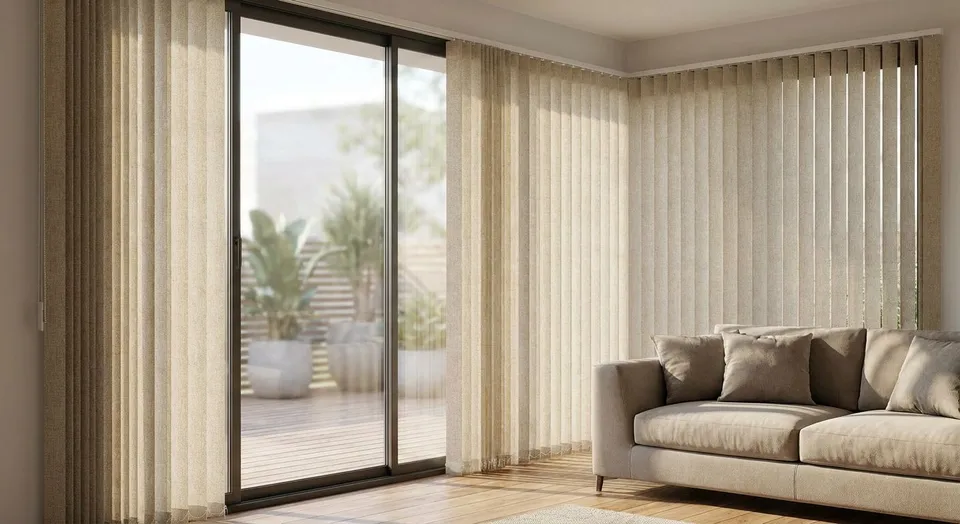
Homeowners typing "vertical blinds for sliding glass doors" into Google in 2026 usually want one thing: something that won't jam or snap on a wide track. Rainier Blinds doesn't install vertical blinds. On a 6- to 12-foot slider the treatment we actually recommend is custom drapery, and this guide explains why it beats both vertical blinds and the shades usually pitched as their replacement.
- Traditional vertical blinds for sliding glass doors are a skip in 2026. PVC vanes crack and chain tracks bind on wide spans.
- Custom drapery on a rod or track is the pick for a slider. It pushes fully clear of the door and there's no hardware in the traffic path. Buy.
- Shades on a door you use daily are a hassle: something has to be raised or moved every time you walk through. Skip for high-traffic sliders.
- Motorized shades remove the cord problem but not the raise-it-every-time problem. Consider only for sliders you rarely open.
- Outdoor roller shades extend coverage to the patio side of a slider. Consider when the door opens onto a deck.
Why this matters
Vertical blinds were built for office glass walls, not for a homeowner's patio slider that gets opened forty times a day by kids, dogs, and grocery bags. The chain-and-tilt mechanism is the failure point: one snagged vane and the whole stack stops tracking straight.
Pacific Northwest sun makes it worse. West-facing sliders in Bellevue, Tacoma, and Auburn take direct afternoon light for months, and PVC vanes yellow and warp faster than most homeowners expect. By the time a slider is due for new coverings, the smarter move in 2026 is a system built for the width and the weather, not a 1990s office holdover.
Custom window treatments for sliding glass doors fixed for the exact opening solve both problems at once, no gap at the header, no vane rattling against the glass in a draft.
Who this is for
This guide is for homeowners with a sliding glass door 6 feet or wider, patio doors, French-style sliders, and floor-to-ceiling glass common in newer South King County builds. If your current vertical blinds are chipped, snapped, or stuck half-open, or you're replacing a rental's stock blinds before move-in, the criteria below apply directly to you.
What to look for in a sliding-door window treatment
Stack width and clearance
The shade has to gather fully to one side without blocking the track the door slides on. A treatment that eats 8 inches of clearance on a 6-foot door defeats the point of a slider.
Weight and mount rated for wide spans
A headrail engineered for a 30-inch window sags and binds when it's stretched across 9 or 12 feet. Wide sliders need a reinforced headrail or a routed track built for the span, not a standard mini-blind bracket pushed to its limit.
Cordless or motorized lift
Cordless controls avoid exposed operating pull cords. Follow the product safety instructions and keep beds, furniture, and other climbing objects away from windows. At a doorway, also check that the treatment clears normal traffic and the door hardware.
Sun and moisture tolerance
West- and south-facing sliders in the Puget Sound area take direct sun for hours in summer and condensation in winter. Fabric and vinyl need to hold color and shape through both without curling at the edges.
Indoor-outdoor coordination
If the slider opens onto a deck or patio, the interior shade is only half the job. An exterior shade on the same opening blocks heat before it ever hits the glass.
Top picks for large sliding glass doors
Custom drapery: what we actually recommend
On a door you walk through every day, drapery is the treatment that stays out of your way. Panels slide fully clear of the opening on a rod or track, there's no headrail to duck and no lift mechanism sitting in the traffic path, and a wide span is no harder to cover than a narrow one. Fabric also handles the two things sliders are worst for, glare off a big pane of glass and heat loss at the door in winter. Buy. This is our recommendation for most sliding glass doors. See custom drapery for sliding glass doors.
Vertical cellular shades: the closest like-for-like swap
These stack to one side the way a vertical blind does, and the honeycomb fabric fold replaces brittle PVC vanes. They're engineered for wide openings. 6, 8, and 12-foot sliders are standard architectural widths, and a routed vertical cellular track handles all three without a center seam. Consider if you specifically want the vertical-stack look, but understand you're still moving a treatment every time you use the door. See vertical cellular shades for sliding glass doors.
Motorized shades: only for sliders you rarely open
Remote or app control removes the cord and the wand, which are the parts most likely to break from repeated use. What it doesn't remove is the shade itself: on a door you open several times a day, something still has to travel up and down before you can walk through. Consider for a slider that mostly stays shut, Skip for the door you use to get to the deck. Details at motorized shades for sliding glass doors.
Custom blinds for sliding glass doors: the full lineup
If you have decided against drapery and want a shade anyway, this is where to compare fabrics and lift systems, roller, cellular, and zebra options sized specifically for slider dimensions rather than standard window widths. Consider as your first stop before narrowing down a specific system. Browse the category at custom blinds for sliding glass doors.
Zebra shades on a slider-rated track: the light-control hybrid
Alternating sheer and opaque bands let you dial in privacy without going full blackout, which works well on a slider that's also a primary light source for a living room or kitchen. Consider if you want adjustable privacy rather than an all-or-nothing shade.
Outdoor roller shades: the patio-side companion
When the slider opens onto a deck or patio, an exterior shade stops heat and glare before it reaches the glass, which takes real load off whatever's covering the inside. Consider pairing this with an interior pick if your slider faces west or gets full afternoon sun.
Get a quote for your sliding door
Rainier Blinds measures and installs on-site across the Seattle area.
What to avoid
- Traditional vertical blinds. The chain-and-tilt mechanism is the most common failure point on wide sliders, one snagged vane throws off the whole track. Skip in 2026.
- Standard aluminum mini blinds mounted horizontally on a slider. They're not rated for the width and sag in the center past about 6 feet. Skip.
- Stock vinyl accordion shades sized for regular windows. They don't have the drop length for the floor-to-ceiling sliders common in newer Bellevue and Tacoma construction. Skip.
"The chain-and-tilt mechanism is the single point of failure on vertical blinds, swap to a cordless cellular or roller system and it disappears entirely."
Verdict comparison
| Option | Stack Clearance | Cordless/Motorized | PNW Sun & Moisture | Best For | Verdict |
|---|---|---|---|---|---|
| Custom drapery | Pushes fully clear of the door | Manual or motorized track | High | Any slider you use daily | Buy |
| Vertical cellular shades | Full stack to one side | Yes, motorized available | High | Wide sliders, 6-12 ft | Consider |
| Motorized shades | Full clearance, no cords | Yes | High | Sliders you rarely open | Consider |
| Zebra shades (slider track) | Stacks to one side | Cordless standard | Moderate | Adjustable privacy | Consider |
| Outdoor roller shades | N/A, exterior mounted | Yes | Built for exposure | Patio-facing sliders | Consider |
| Traditional vertical blinds | Binds on wide tracks | Manual chain only | Poor, vanes warp/yellow | Not recommended in 2026 | Skip |
FAQ
What's the best window treatment for large sliding glass doors in 2026?
Vertical cellular shades or motorized cellular and roller shades are the best options for large sliding glass doors in 2026. Both stack fully to one side and skip the chain-and-tilt mechanism that fails on traditional vertical blinds.
Are vertical blinds still a good option for sliding doors?
No. Vertical blinds are a skip for sliding doors in 2026 because the vanes crack and the chain track binds on wide spans. A vertical cellular shade covers the same stack pattern without those failure points.
How much does it cost to replace vertical blinds with shades?
Cost depends on the door's width, the fabric, and whether you add motorization. Rainier Blinds gives real pricing on-site during a measure, rather than an online estimate that changes once someone measures the actual opening.
Can one shade cover a 9-foot slider without a center seam?
Yes, when the shade is built on a routed track sized to the opening rather than assembled from two standard-width panels. Vertical cellular shades and motorized roller systems are both available in continuous widths that match common slider sizes.
Do motorized shades work on tall sliding glass doors?
Yes. Motorized lift systems handle floor-to-ceiling drop lengths without the extra pull force a manual chain needs on a tall door. This matters most on newer builds with 8-foot or taller glass.
What's better for a sliding door: cellular shades or roller shades?
Cellular shades add insulation and stack more compactly, while roller shades give a cleaner flat look and simpler mechanism. Either works on a slider; the choice usually comes down to whether energy efficiency or a minimal profile matters more.
Are vertical blinds hard to maintain?
Yes, individual vanes crack, chains stretch or snap, and PVC yellows with sun exposure, all of which require part replacement rather than a simple fix. That maintenance burden is the main reason vertical blinds are being phased out in favor of cellular and roller systems.
Do outdoor shades work on a slider that leads to a patio?
Yes. An outdoor roller shade mounted on the exterior side of the slider blocks heat and glare before it reaches the glass, which reduces the load on whatever covers the interior. It's a common pairing for west-facing patio doors in the Seattle area.
One last thing
The part homeowners don't expect: the failure isn't usually the fabric or the vane material, it's the mechanism. Swap a chain-and-tilt vertical blind for a cordless cellular or motorized system and the single moving part most likely to break is gone. Rainier Blinds measures and installs on-site with its own crew, which matters most on wide, non-standard sliders where an eighth of an inch off the routed track shows up as a gap at the header.