
Our available controls: Rainier Blinds offers Roman and woven wood shades with motorized operation only. All other shade styles are available with manual, motorized, or smart control. Your consultation confirms the controls and power options for your product.
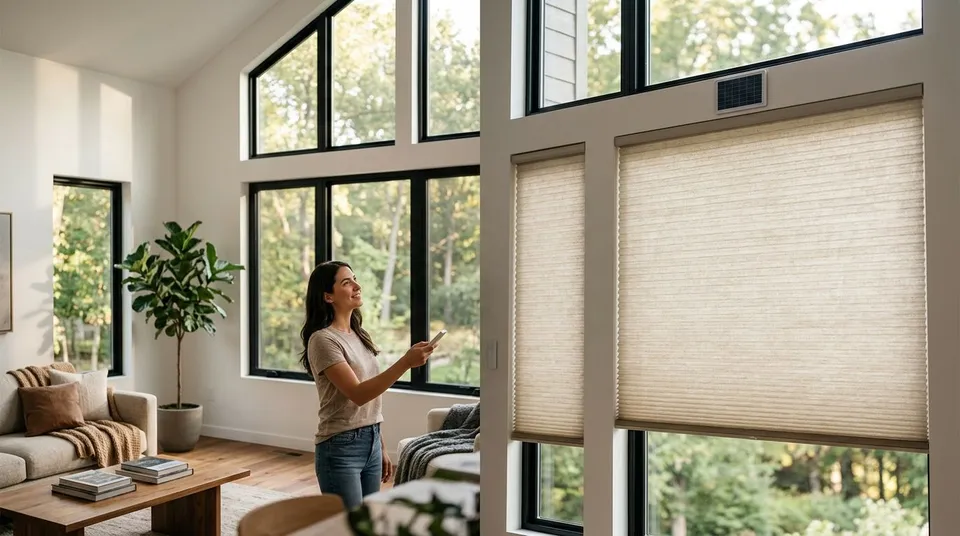
Solar-powered motorized shades for hard-to-reach windows are battery-driven shades charged by a small photovoltaic panel, built so a skylight, stairwell landing, or 20-foot foyer window opens and closes without a ladder, an electrician, or a hardwired switch run through finished walls. Homeowners in the Greater Seattle Area reach for this setup because the windows in question, vaulted living rooms, stair towers, transoms over an entry door, are exactly the ones a contractor quotes highest for wiring and the ones nobody operates by hand anyway.
- Solar powered motorized shades for hard to reach windows charge a battery from a small panel instead of a wired outlet.
- Best for skylights, stairwells, and foyer windows where running conduit costs more than the shade itself.
- A panel needs 3 to 4 hours of direct sun daily; shaded or north-facing windows need a plug-in battery instead.
- Rainier Blinds measures and installs these shades across the Greater Seattle Area; the shade itself comes from a wholesale supplier.
- Pairing the shade with a smart hub replaces a wall switch you physically cannot reach.
Why this matters for hard-to-reach windows
A window you cannot reach with a pole does not get operated. It stays open and fades the floor for years, or stays shut and blocks daylight nobody thought to fix. Running low-voltage wire to a skylight above a vaulted ceiling or a landing window two stories up usually means opening drywall, which turns a simple shade job into a mini remodel.
A solar panel roughly the size of a paperback book solves both problems at once. No wire run, no ladder trips to swap a battery, and a shade that operates on a schedule instead of sitting untouched. That is the whole case for solar-powered motorized shades in 2026: they close the gap between "we should cover that window" and "nobody wants to climb up there every week."
Solar-powered motorized shades work best on skylights, stairwells, high transoms, and vaulted-ceiling windows that get direct sun for at least part of the day; they work poorly on shaded, north-facing, or recessed windows where a plug-in battery is the more honest answer.
Identify which windows actually qualify as hard-to-reach
Not every awkward window needs solar power. Before spending on a panel, confirm the window actually forces the issue.
- Skylights and vaulted-ceiling windows more than 9 to 10 feet up
- Stairwell and landing windows with no safe pole access
- Transom windows above an entry door or garage
- Windows over a stair tower or open-concept great room
- Arched or trapezoid windows where a standard pole won't seat correctly
Match the shade type to the window shape
Hard-to-reach windows are rarely standard rectangles, so the shade has to fit the shape before it fits the power source.
- Trapezoid and arched shades for angled skylights and gable windows
- Roller shades for tall, straight-drop foyer and stairwell glass
- Cellular shades where insulation matters as much as light control
- Zebra shades for landing windows that need alternating privacy and view
- Woven wood roman shades for vaulted windows with a wood-tone interior
Choose motor and power method before you choose a brand
This is the decision that actually determines whether the shade gets used. Manual pole operation works for a window an adult can reach unassisted; anything past that needs a motor, and the motor needs power from somewhere.
- Solar panel kit charging a rechargeable lithium battery inside the tube
- Plug-in rechargeable battery you remove and recharge by hand every few months
- Hardwired low-voltage transformer run during a remodel, before drywall closes
- USB-rechargeable battery wand for shorter-drop windows
Homeowners comparing options against a battery-powered motorized shade built for a retrofit install usually land on solar the moment they realize the alternative is a ladder trip every season.
Size and place the solar panel correctly
A panel mounted in its own shadow, or bolted to a north-facing frame, will not keep the battery charged no matter how good the shade is. Most solar panel kits for motorized shades need 3 to 4 hours of direct sun a day to hold a charge through winter, which rules out deeply recessed skylights and covered porches.
- Mount the panel on the sunniest edge of the frame, not the shade housing itself
- Angle it toward south or west exposure whenever the window allows it
- Check for tree canopy or roof overhang that shades the panel seasonally
- Confirm the battery inside the tube is rated for the shade's drop length
Pair the shade with a remote, wall switch, or smart hub
A motorized shade with no control point defeats the purpose of motorizing it. For hard-to-reach windows specifically, the control has to live somewhere the homeowner can actually use daily.
- Handheld remote programmed to one shade or a group of shades
- Wall-mounted switch placed at a reachable height near the stairs or entry
- Smart hub integration for schedule-based operation by sun angle or time
- Voice control through an existing smart home system
Getting the shade paired with a smart home hub usually happens at install, since the crew is already on a ladder confirming the panel's angle.
Program schedules around actual sun exposure, not a guess
Once the shade is powered and paired, scheduling is where solar-powered motorized shades earn their keep on windows nobody would otherwise touch.
- Close skylight and vaulted-ceiling shades at midday in summer to cut heat gain
- Open stairwell shades in the morning for natural light without a switch flip
- Set seasonal schedules that shift with sunrise and sunset times
- Override manually for cloudy stretches without losing the default schedule
Plan for maintenance access from day one
Solar batteries last longer than plug-in batteries you forget to recharge, but they are not maintenance-free. A shade installed 15 feet up still needs occasional attention, even if it's rare.
- Confirm the panel surface can be wiped clean without a full ladder setup
- Ask about battery replacement intervals before the shade is installed, not after
- Keep the remote or hub app updated so scheduling doesn't drift
- Note which windows are solar versus hardwired so service calls go faster
Maintaining a battery correctly stretches its working life well past what a forgotten, unmonitored battery ever manages, which is worth confirming before the install crew leaves.
Comparing power options for hard-to-reach windows
| Option | Best for | Key limitation |
|---|---|---|
| Solar-charged battery motor | Skylights and stairwell windows with unobstructed sun | Needs 3 to 4 hours of direct light; underperforms on shaded or north-facing glass |
| Plug-in battery motor | Windows near an outlet you're willing to reach occasionally | Still needs manual recharging on a ladder or extension pole |
| Hardwired low-voltage motor | New construction or renovations with open wall access | Requires an electrician and conduit before drywall closes |
| Manual pole or crank | Windows within reach of an 8 to 10 foot extension pole | Doesn't solve anything above a stairwell or vaulted ceiling |
For most hard-to-reach windows with any direct sun exposure, a solar-charged battery motor is the buy; save hardwired motors for new construction and plug-in battery motors for windows you're already willing to touch.
Get a free in-home measure
Rainier Blinds measures skylights and stairwell windows in person before quoting anything.
Common mistakes homeowners make with these shades
- Mounting the panel in the shade's own shadow. The panel needs to sit where the frame or the shade housing itself won't block afternoon sun.
- Undersizing the battery for a long stairwell drop. A shade running 10 feet or more draws more from the battery per cycle than a standard window.
- Assuming a remote will reach through attic framing. Recessed skylights behind insulation and rafters can block RF signal to a hub across the room.
- Skipping a professional measure on an arched or trapezoid window. A stock-size shade rarely fits an angled skylight cut, and a bad fit shows every time it's closed.
- Buying solar for a window that gets no direct sun. A north-facing stairwell landing is a plug-in battery job, not a solar one, no matter how convenient solar sounds.
FAQ
Do solar-powered motorized shades work on cloudy Pacific Northwest days?
They work but recharge slower; a panel needs 3 to 4 hours of direct sun to fully top off the battery, so extended overcast stretches in 2026's fall and winter months draw down the reserve faster than summer.
Are solar-powered motorized shades better than hardwired for skylights?
For most skylights, yes, because running conduit to a vaulted ceiling usually means opening drywall. Hardwired only wins when the wall is already open during new construction.
How long does a battery last in a solar-powered motorized shade?
The battery itself typically outlasts a plug-in battery you forget to recharge, since the panel keeps it topped off automatically instead of relying on someone remembering a maintenance schedule.
Can solar-powered motorized shades be controlled by a smart home hub?
Yes, most motorized shade motors pair with a smart hub for schedule-based operation by sun angle or time, in addition to a handheld remote or wall switch.
What windows benefit most from solar-powered motorized shades?
Skylights, stairwell and landing windows, high transoms, and vaulted-ceiling windows benefit most, since these are the windows a homeowner rarely operates manually and rarely wants wired.
Do solar-powered motorized shades need direct sun year-round to work?
They need direct sun for at least part of the day; a shaded or north-facing window in 2026 still needs a plug-in battery motor instead of solar.
Can I retrofit an existing manual shade with solar power?
Retrofitting existing shades with a new motor and panel is possible on some window types, but a full measure determines whether the current mount and drop length support it.
Is a solar panel visible from inside the room?
The panel mounts on the exterior frame or window opening, not inside the shade housing, so it's placed for sun exposure rather than for indoor appearance.
One last thing
The detail most homeowners skip: a solar panel's placement matters more than the shade's brand or fabric. Two identical shades on two identical skylights will perform completely differently in 2026 if one panel sits in a roofline shadow for half the day and the other doesn't. Get the panel angle checked in person before assuming solar will work on a specific window.