
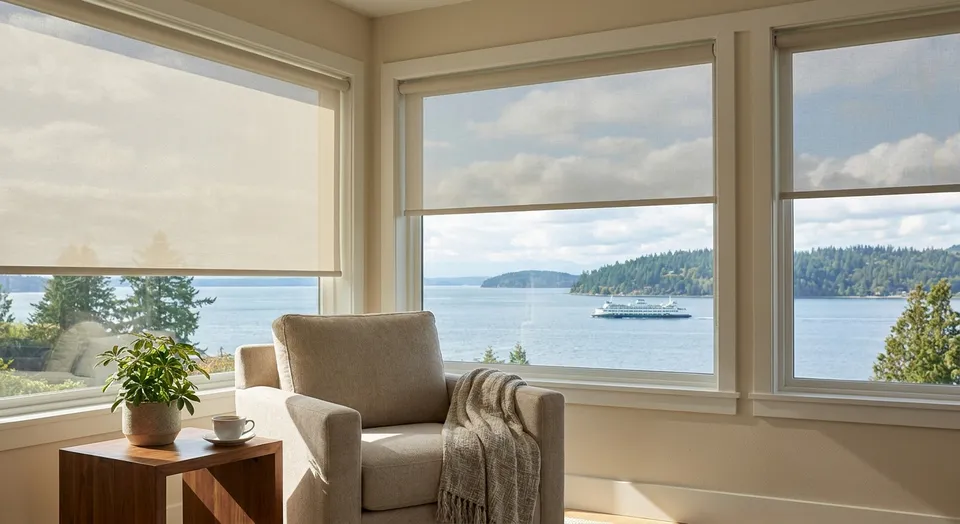
Waterfront homes in Des Moines, WA get more glare, more salt air, and more nosy boat traffic than almost anywhere else in South King County, and that changes what counts as a good roller shade.
- Solar screen roller shades at 5% openness are the buy for Sound-facing living rooms in 2026. They cut glare without blocking the water view.
- Skip big-box vinyl rollers on waterfront homes; humidity off the Sound warps standard hardware within a season or two.
- Motorized roller shades are worth the upgrade on tall marina-facing windows where a wand or chain is a stretch.
- Blackout rollers belong in bedrooms facing Redondo or the marina, not in main living spaces where you paid for the view.
Who this is for
This guide is for homeowners along Des Moines' waterfront, Redondo, Woodmont, the marina strip, Beach Drive, who want daytime privacy and glare control without covering up the reason they bought the house. If your living room faces the Sound and the afternoon sun turns your TV into a mirror, or your bedroom windows look straight into the marina at night, roller shades solve a different problem than they do three miles inland in Auburn or Kent.
Why this matters
Saltwater proximity does two things standard blind guides never mention: it accelerates hardware corrosion and it doubles your glare exposure because light bounces off the water as well as coming straight through the glass. A shade that works fine in a Federal Way subdivision can underperform on a waterfront lot in Des Moines within a single wet Pacific Northwest winter. Before you pick a fabric or a control style, it helps to see how roller shades stack up against roller shades vs. cellular shades for a home that gets this much reflected light. The answer isn't always the same as it is for a landlocked house.
What to look for in roller shades for Des Moines waterfront homes
Fabric openness percentage
Openness percentage, how much light passes through the weave, is the single most important spec for a waterfront window. A 3% openness fabric cuts glare hard but darkens the room noticeably; a 10% openness fabric keeps the view bright but lets more reflected sun through on clear afternoons. For most Sound-facing living rooms, 5% openness is the middle ground that holds up through 2026's longer summer daylight hours.
UV and fade resistance
West-facing waterfront glass takes direct sun for hours longer than an inland window with tree cover or neighboring rooflines blocking it. Furniture, flooring, and artwork fade faster on the water, so fabric with built-in UV blocking matters more here than the openness percentage alone.
Moisture and hardware corrosion resistance
Salt air corrodes standard steel brackets and chains faster than it corrodes anything inland. Ask specifically about the bracket and chain material before you buy. This is the detail that separates a shade that lasts a decade on the water from one that seizes up in three years.
Motorization for hard-to-reach windows
Many waterfront homes in Des Moines have taller-than-standard windows to maximize the view, and a wand or bead chain on an 8-foot window is awkward at best. Motorized roller shades solve the reach problem and let you program shades to lower automatically when the afternoon glare peaks.
Privacy without losing the view
A fully opaque blackout shade blocks the neighbors' view into your bedroom, but it also blocks your view of the water during the day. Light-filtering and solar screen fabrics let you keep the shade down for privacy while still seeing the Sound.
Operating controls and product safety
Cordless controls avoid exposed operating pull cords. Follow the product safety instructions and keep beds, furniture, and other climbing objects away from windows. For a busy deck-facing window, keep the treatment clear of the door and daily traffic.
Top picks for Des Moines waterfront windows
Solar screen roller shades, 5% openness. The daytime pick. These block the worst of the reflected glare off the Sound while keeping the water visible from the couch. Rainier Blinds sees the most repeat requests for 5% openness on south- and west-facing waterfront living rooms in 2026. Buy.
Motorized roller shades, the convenience pick. For tall marina-facing windows where a chain or wand is a stretch, motorized control is worth the upgrade, especially paired with a schedule that lowers shades before peak afternoon glare. The approach lines up with what's covered in motorized window shades for Renton living rooms, where the same tall-window logic applies. Buy.
Blackout roller shades, the bedroom pick. In a bedroom facing the marina, boat lights and dock lighting bleed through anything less than a true 0% openness fabric. Reserve blackout for sleeping spaces only, using it in the main living area defeats the point of a waterfront lot. Consider.
Outdoor-rated roller shades for covered patios. The deck pick. Covered patios overlooking the water get direct wind and moisture that indoor fabrics aren't built for. The motorized outdoor logic in motorized shades guide for Kent, WA translates well to a covered waterfront patio, even though that guide is written for an inland market. Consider.
Basic vinyl roller shades from a big-box retailer. The skip. Standard hardware on these isn't rated for salt air, and openness options are usually limited to one or two percentages. On an inland home this is a fine budget option; on Des Moines waterfront, it's a shade you'll replace by 2028. Skip.
What to avoid on a waterfront window
- Fully opaque roller shades in main living areas. They solve glare but erase the reason you're paying waterfront prices in the first place.
- Standard steel hardware without a corrosion-rated finish. It looks identical to marine-grade hardware on the showroom floor and fails two winters sooner.
- One-size-fits-all fabric across every room. A bedroom, a living room, and a covered patio on the same waterfront lot need three different openness percentages, not one.
A broader look at fabric and hardware options for the region is covered in custom window treatments in Auburn, which walks through the same measure-and-install process Rainier Blinds uses for waterfront jobs in Des Moines.
Verdict comparison
| Pick | Openness | Glare control | View retention | Best room | Verdict |
|---|---|---|---|---|---|
| Solar screen roller shade | 5% | High | High | Living room | Buy |
| Motorized roller shade | 3-5% | High | High | Tall/marina windows | Buy |
| Blackout roller shade | 0% | Highest | None | Bedroom | Consider |
| Outdoor-rated roller shade | 5-10% | Moderate | High | Covered patio | Consider |
| Big-box vinyl roller shade | Fixed, limited | Low-moderate | Moderate | Not recommended waterfront | Skip |
“A fully blackout shade in a waterfront living room solves glare and erases the view in the same motion.”
FAQ
What's the best roller shade openness for a Des Moines, WA waterfront living room?
5% openness is the standard recommendation for Sound-facing living rooms in 2026. It cuts reflected glare off the water while still letting the view through during the day.
Do roller shades hold up against salt air on Puget Sound waterfront homes?
Roller shades with corrosion-rated brackets and chains hold up fine; standard steel hardware from a big-box retailer often doesn't. Ask specifically about hardware material before buying for a waterfront home.
Are motorized roller shades worth it for tall waterfront windows?
Yes, especially on windows over 6 feet tall where a wand or chain is awkward to reach. Motorized shades also let you schedule closing before peak afternoon glare hits the water.
Is a blackout roller shade better than a solar screen for a waterfront bedroom?
Blackout is better for a bedroom facing the marina where dock and boat lights bleed through at night. A solar screen fabric works better in daytime living spaces where you want to keep the water view.
How much does a custom roller shade cost for a Des Moines waterfront window?
Pricing depends on window size, fabric, and whether the shade is motorized or manual. Rainier Blinds measures on site and gives a quote for your selected products rather than a phone estimate.
Can roller shades handle covered patios facing the water?
Outdoor-rated roller shade fabrics can handle a covered patio's wind and moisture exposure, but standard indoor fabrics can't. Confirm the fabric is rated for outdoor use before installing it on an exposed deck.
Do roller shades or cellular shades work better on Sound-facing windows?
Roller shades generally win on waterfront homes because solar screen fabric keeps the view visible while cutting glare; cellular shades trade more of the view for insulation. The tradeoff depends on which room you're covering.
What fabric openness blocks the most glare off water?
3% openness blocks the most glare but darkens the room the most. Most Des Moines waterfront living rooms land on 5% as the practical middle ground for 2026.
One last thing
The detail most homeowners miss on a Des Moines waterfront job isn't the fabric. It's the bracket. A shade with the right openness percentage still fails early if the hardware behind it isn't rated for salt air, and that's the spec a phone quote or online order never asks about. Get it measured and specified in person before you commit to a fabric.