
Our available controls: Rainier Blinds offers Roman and woven wood shades with motorized operation only. Available controls and power options for other products are confirmed at your consultation.
Consultations are free within 60 driving miles of Auburn. Farther projects are considered individually; any consultation or travel fee is quoted before booking and credited toward your order if you proceed.
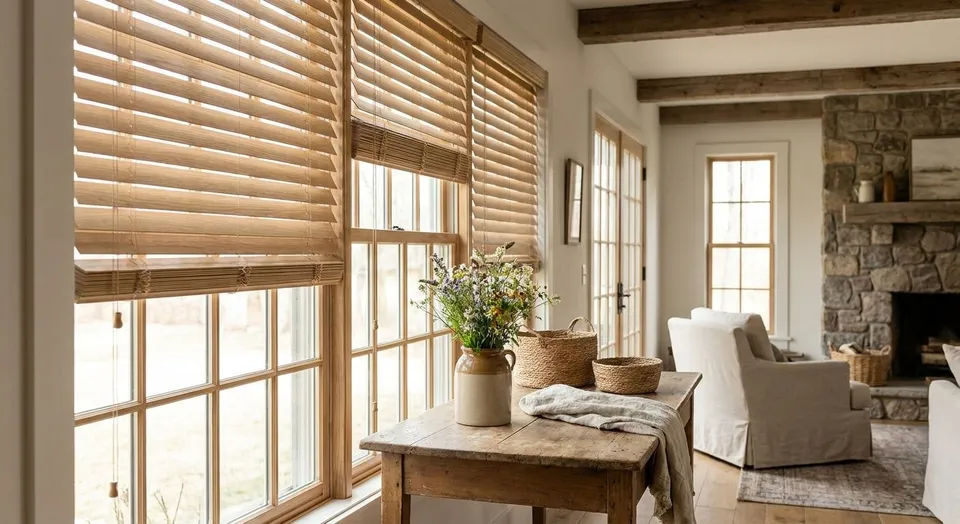
Real wood blinds farmhouse searches almost always run into the same wall: Rainier Blinds does not measure, sell, or install real wood, faux wood, or aluminum blinds anywhere in the Greater Seattle Area. Farmhouse interiors still get the warm, textured look those searches are chasing, just from woven wood roman shades and fabric roman shades that Rainier Blinds' own crew measures and installs across South King County in 2026.
- Real wood blinds farmhouse searches should redirect to woven wood roman shades since Rainier Blinds does not stock wood blinds.
- Woven wood roman shades give the farmhouse texture without swelling in Pacific Northwest humidity year-round.
- Fabric roman shades in linen or waffle weave layer well with drapery for a softer farmhouse living room look.
- Cellular shades work better than wood-look products in farmhouse mudrooms and laundry rooms with constant moisture.
Why this matters
Real wood blinds carry a real risk in this region: humidity from Puget Sound weather swells slats and cracks the finish, especially near kitchen sinks, bathrooms, and exterior doors. That's true whether the blinds come from a big-box store or an online retailer. The farmhouse look people want, natural texture, warm tone, visible grain, doesn't require actual wood slats. Woven wood roman shades use grass and reed weaves that read as farmhouse-rustic and hold up better in a rainy climate.
Rainier Blinds handles the Puyallup farmhouse roman shade look with fabric and woven wood options exclusively, because those are the two product families that combine the aesthetic with a mount and lift system that actually survives daily use in a working farmhouse kitchen or mudroom.
Why woven wood and roman shades matter for farmhouse interiors
Farmhouse-style homes tend to have specific window shapes that other segments don't deal with as often: tall kitchen windows over a sink, transom windows above entry doors, and mudroom or laundry windows that see constant moisture and foot traffic. A shade picked for a suburban colonial doesn't automatically work in a farmhouse layout.
- Kitchen sink windows need a wipeable, moisture-tolerant fabric, not a slatted product that traps grease and steam
- Transom windows over farmhouse entries are often out of reach, which pushes the decision toward motorized lift
- Mudroom and laundry windows need cordless or top-down-bottom-up control for privacy without blocking light
- Open-concept farmhouse living rooms benefit from woven wood texture that reads as a design feature, not just a covering
Pick the right shade for a farmhouse window
Define the farmhouse look before you shop
Farmhouse interiors lean on a specific set of visual cues. Match the shade choice to those cues before comparing fabrics or price.
- Shiplap or board-and-batten walls pair with natural woven textures better than smooth fabric
- Matte black or aged bronze hardware reads farmhouse; polished chrome and brass do not
- Linen, waffle weave, and jute-blend fabrics carry the warmth real wood blinds were supposed to add
- Light-filtering opacity keeps farmhouse rooms bright instead of dim, which matters in Western Washington's low-light winters
Rule out real wood blinds for humid rooms
Before picking a replacement product, confirm which rooms actually need moisture resistance. This step alone eliminates real wood blinds from consideration in most farmhouse floor plans.
- Kitchen windows within a few feet of a sink or stove
- Bathroom windows with any shower or tub nearby
- Laundry room and mudroom windows near exterior doors
- Basement or daylight-level windows with higher ambient humidity
- Any window facing a covered patio where condensation collects
Choose the fabric or weave texture
Once the wet rooms are set aside, the rest of the house is open to fabric and weave choice. This is where the farmhouse look actually gets built.
- Waffle weave cotton for a casual, textured roman shade
- Natural jute or grasscloth-style woven wood for a rustic, wood-adjacent look
- Herringbone linen for a slightly more refined farmhouse dining room
- Neutral oatmeal or bone tones over stark white, which tends to look sterile in a farmhouse setting
For a deeper look at matching weave and color to a room, the custom roman shade fabric guide covers weight, opacity, and how fabric behaves against direct sun.
Pick manual, motorized, or smart operation
Every shade Rainier Blinds installs comes in three operation tiers. Farmhouse floor plans usually mix all three across one house.
- Manual cordless lift for low, easy-to-reach kitchen and bedroom windows
- Motorized lift for transom windows over entry doors and stairwells
- Smart shades on a hub or app for large picture windows in open-concept great rooms
- Battery-powered motorized units where running wiring isn't practical in an older farmhouse-style build
Select the mount and hardware finish
Mount type changes how much of the window trim shows, which matters more in farmhouse interiors than almost any other style because the trim itself is often part of the design.
- Inside mount when the window casing is a farmhouse design feature worth showing
- Outside mount when the casing is narrow or uneven, common in older remodeled farmhouses
- Matte black or bronze headrails and brackets over standard white or beige
- Cordless lift systems in any room with kids or pets
Measure before you commit to a shade
A rough tape-measure check tells you whether a window is standard or a specialty shape like an arch or trapezoid gable window, both common in farmhouse construction. That's the free, do-it-yourself first pass.
- Measure width at the top, middle, and bottom of the frame; farmhouse window casings aren't always square
- Note any obstructions like a sink faucet or cabinet handle that limit clearance
- Check for a transom or arched section above the main window that needs its own shade
- Once dimensions are rough-confirmed, Rainier Blinds' own crew re-measures on-site during an in-home consultation, which is the faster and more accurate path for anything beyond a standard rectangle
Comparing shade options for farmhouse interiors
| Option | Best for | Key limitation |
|---|---|---|
| Real wood blinds | Not offered by Rainier Blinds | Swells and cracks in Pacific Northwest humidity. Skip. |
| Woven wood roman shades | Farmhouse texture in living rooms and dining rooms | Less light-blocking than a dedicated blackout fabric. Buy. |
| Fabric roman shades | Layering with drapery in farmhouse bedrooms | Needs a liner for full room-darkening. Buy. |
| Cellular shades | Mudrooms, laundry rooms, kids' rooms | Reads more modern than rustic on its own. Hold. |
| Roller shades | Kitchen windows needing a simple, wipeable line | Flat surface lacks the farmhouse texture cue. Hold. |
The verdict for most farmhouse interiors in 2026: woven wood roman shades in the main living spaces, fabric roman shades in bedrooms, and cellular shades in wet or high-traffic rooms.
Common mistakes farmhouse homeowners make
- Buying real wood blinds online for a kitchen sink window, then replacing them within a year once the slats warp
- Picking stark white fabric instead of an oatmeal or bone tone, which flattens the farmhouse warmth the room is going for
- Choosing outside mount on a window where the casing itself is a design feature worth showing
- Skipping motorization on a transom window that ends up impossible to reach with a manual wand
- Forgetting to budget separately for drapery layering, which is what actually finishes a farmhouse living room look
Book Your Farmhouse Shade Consultation
Book an in-home consultation to compare samples and get a measured quote.
FAQ
Does Rainier Blinds sell real wood blinds for farmhouse windows?
No. Rainier Blinds does not measure, sell, or install real wood, faux wood, or aluminum blinds. Woven wood roman shades are the closest farmhouse-style alternative the company offers in 2026.
What's the closest alternative to real wood blinds for a farmhouse look?
Woven wood roman shades use grass and reed weaves that read as farmhouse-rustic without the swelling risk real wood carries in humid rooms. Fabric roman shades in linen or waffle weave are the second option.
Do woven wood shades hold up in Pacific Northwest humidity?
Yes, better than real wood blinds do. The woven material doesn't swell or crack the way solid wood slats do near kitchen sinks, bathrooms, and laundry rooms.
Can I layer roman shades with drapery for a farmhouse living room?
Yes. Fabric roman shades paired with drapery panels are a common farmhouse living room combination, giving both texture from the shade and softness from the fabric panels.
What mount type looks best on farmhouse window trim?
Inside mount shows more of the window casing, which matters when the trim itself is a farmhouse design detail. Outside mount works better on narrow or uneven older casings.
How much lead time should I plan for custom farmhouse shades in 2026?
Custom shades are made to order after an in-home measurement, so plan for the measure-to-install process to take longer than an off-the-shelf blind. Ask for a current timeline during your consultation.
Are motorized shades worth it for high farmhouse transom windows?
Yes for windows above entry doors or stairwells that a manual wand can't reach safely. Motorized lift is the practical fix for those specific window shapes.
What's the difference between roman shades and woven wood roman shades?
Roman shades use fabric like linen or cotton weave. Woven wood roman shades use natural grass, reed, or jute material instead of fabric, giving a more textured, wood-adjacent look for farmhouse interiors.
One last thing
The detail that actually sells a farmhouse look isn't the shade fabric, it's the hardware. Swap a standard white headrail for matte black or aged bronze brackets and the same woven wood shade reads as farmhouse instead of generic neutral. Homeowners chasing real wood blinds for that look often skip the hardware upgrade entirely and wonder why the room still feels flat.