
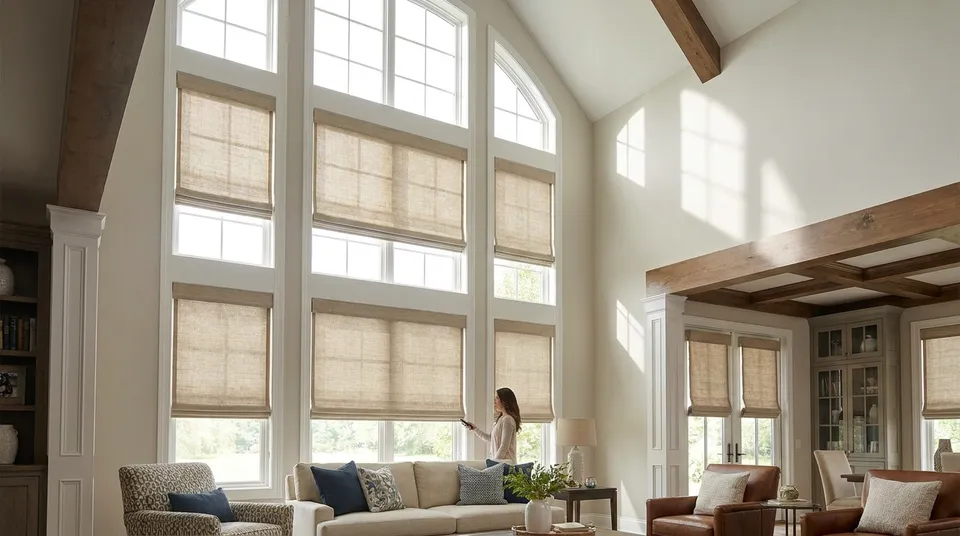
Vaulted living rooms across the Puget Sound area push glass twelve to twenty feet up a wall, and a hand crank or extension wand rarely reaches half that height. Motorized shades solve the access problem on vaulted windows and give you real light and heat control on glass a ladder shouldn't touch.
- Motorized skylight shades are the direct fix for vaulted windows above 12 feet - Buy.
- Motorized cellular shades cut heat gain on south-facing vaulted glass in 2026 builds - Buy.
- Skip battery-only motors above 16 feet - recharging is the same ladder problem you started with.
- Motorized roller shades pair well with a large picture window below the vault - Consider.
- Hardwired motors beat battery on any shade you can't reach without a lift.
Why this matters
A standard living room window tops out around 6 feet. A vaulted living room window can run from the floor to a ridge beam 18 or 20 feet up, and that height is exactly why manufacturers built motorized options in the first place. You're not buying a motor for convenience here - you're buying it because there's no other way to open and close the shade without scaffolding.
Most of that glass also sits at an angle or catches direct sun for hours longer than a standard wall window, which turns the room into a heat trap by early afternoon. Skylight-style shades built for vaulted ceilings handle both problems at once: motorized lift for reach, and fabric rated for steep-angle glare. Get the mount type and fabric wrong on a window this size and you're paying to redo it in a year.
Who this is for
This guide is for homeowners in Bellevue, Tacoma, Seattle, Auburn, and the rest of South King County with a vaulted or cathedral-ceiling living room where at least one window section starts above 8 feet. You've probably already tried a hand crank on a telescoping pole and given up, or you're building new construction and don't want to repeat that mistake. You want a shade that opens on a schedule or a voice command, not one that requires a ladder every time the sun shifts.
What to look for in motorized shades for vaulted windows
Mount height and true reach
Any motor spec sheet lists a maximum shade width and drop, but the real question is whether the motor and its power source can be serviced at that height without special equipment. A shade rated for a 15-foot drop is useless if recharging the battery still means renting a lift twice a year.
Light control and glare on angled glass
Vaulted glass often faces west or catches direct overhead sun that a vertical wall window never would. Fabric opacity matters more here than on a standard window - light-filtering fabric that works fine on a 6-foot living room window can still leave a vaulted room too bright to watch TV in by 3 p.m.
Heat gain and energy loss
A 15-by-8-foot wall of glass loses and gains heat faster than three or four standard windows combined, simply because of the surface area. Cellular fabric with honeycomb construction traps a layer of air against the glass and measurably slows that transfer, which matters more in a room this size than fabric choice does anywhere else in the house.
Motor noise in an open-plan room
Vaulted living rooms are almost always open to a kitchen or dining space, so a motor that whines or clunks on start-up gets heard everywhere. Quieter tubular motors cost more but they're worth it in a room with no walls to absorb the sound.
Power source and backup
Hardwired motors need an electrician before install but never run out of charge. Battery motors install faster but need recharging every few months depending on use - fine on a window you can reach from a chair, a real liability on one you can't.
Smart home and remote integration
Once the crank is gone, your only controls are the remote, an app, or a hub. Confirm the motor you're buying pairs with the smart home hub you already run, whether that's a wall panel, a phone app, or a voice assistant, before you commit to a system.
Top picks for vaulted living room windows
Motorized skylight shades - the direct fix. Built specifically for angled and high-mounted glass, these use a motorized lift system rated for drops well past what a standard living room shade needs. If your vaulted section runs 14 feet or more, this is the skylight shade category built for exactly that problem. Buy.
Motorized cellular shades - the insulation play. Honeycomb cellular fabric on a motorized track cuts solar heat gain on the biggest glass surfaces in the house, and it's the fabric type most often recommended for energy savings in South King County homes. Pair it with the vaulted section that gets the most afternoon sun. Buy.
Motorized roller shades - the picture-window pairing. If your vaulted wall combines a tall upper section with a large lower picture window, roller shades on a motorized track handle the large picture window run in a single fabric piece without a center seam. Use them on the reachable lower glass and save the motorized skylight shade for the height above it. Consider.
Motorized dual-layer zebra shades - the light-control wildcard. Alternating sheer and opaque bands let you dial in glare without going full blackout, which works well in a vaulted living room where you still want daylight most of the day. Fine as a secondary treatment on a lower window; not built for the steepest angles up high. Consider.
Get a quote for vaulted living room shades
On-site measuring and install for windows a ladder can't reach.
What to avoid
- Battery-only motors above 16 feet. The battery still needs recharging on the same schedule whether the window is at eye level or above the ridge beam - you haven't solved the access problem, you've just delayed it a few months.
- Off-the-shelf motorized kits sized for standard windows. Big-box motorized rails are built for 6-foot living room windows. Vaulted glass often runs wider or taller than stock rail lengths, and fabric that's forced past its rated width sags or binds within a season.
- Bottom-up-only shades with no motor override on steep glass. Manual bottom-up shades on angled skylight-style windows fight gravity every time you try to adjust them, and a jammed cord on a window you can't reach is a repair call waiting to happen.
If you need a 14-foot pole to reach the crank, the crank isn't the fix - a motor is.
Verdict comparison
| Pick | Best for | Reach solution | Verdict |
|---|---|---|---|
| Motorized skylight shades | Windows 14+ feet up | Motorized lift rated for steep drops | Buy |
| Motorized cellular shades | Heat gain on large glass | Motorized track, honeycomb fabric | Buy |
| Motorized roller shades | Lower picture-window run | Motorized single-fabric track | Consider |
| Motorized dual-layer zebra shades | Glare control, secondary window | Motorized, standard drop | Consider |
| Battery-only motor above 16 ft | Nothing in this room | Requires recurring recharge access | Skip |
FAQ
What's the best motorized shade for vaulted living room windows?
Motorized skylight shades built for angled or high-mounted glass are the best fit for vaulted windows above 12 to 14 feet in 2026. They use a lift system rated for longer drops than a standard motorized roller shade.
Do motorized shades work on angled skylight-style windows?
Yes, motorized shades designed for skylight and vaulted glass are built for angled mounting and steeper drops. Standard motorized shades meant for vertical wall windows usually aren't rated for that angle.
How much does it cost to motorize shades on tall vaulted windows in 2026?
Cost depends on window height, fabric type, and whether the motor is hardwired or battery-powered, since taller drops and custom widths add to the price. Get a measured, on-site quote rather than relying on a stock size.
Can I retrofit motorized shades onto existing manual blinds?
Some manual roller and cellular shades can be retrofitted with a motor kit, but vaulted windows over 14 feet usually need a purpose-built motorized unit rather than a retrofit. The mounting hardware on a manual shade often isn't rated for the added weight of a motor.
Are battery-powered motorized shades good enough for windows over 15 feet?
Battery-powered motors work on tall windows but still need recharging every few months, which recreates the access problem you're trying to solve. Hardwired motors are the better call on any window you can't reach without a ladder or lift.
How do motorized shades on vaulted windows connect to a smart home hub?
Most motorized shade brands pair with a smart home hub through a wireless bridge, then respond to app schedules or voice commands. Confirm hub compatibility before ordering, since not every motor speaks the same wireless protocol.
How long does the battery last on a motorized shade at that height?
Battery life varies by usage but typically runs several months between charges on a shade operated once or twice a day. Heavier fabric and wider drops draw more power and shorten that window.
Is a hardwired motor better than battery for vaulted glass?
Yes, hardwired motors are the better choice for vaulted glass because they never need recharging at a height you can't reach. The tradeoff is an electrician needs to run power to the window before install.
One last thing
The detail most homeowners miss on vaulted windows isn't the fabric - it's the power source. A battery motor mounted 18 feet up still has to come down for every recharge, so the real question to ask before you buy is who's going to service that shade in three years, not what it looks like on day one. Hardwired costs more up front and saves you the lift rental later.