
Our available controls: Rainier Blinds offers Roman and woven wood shades with motorized operation only. Available controls and power options for other products are confirmed at your consultation.
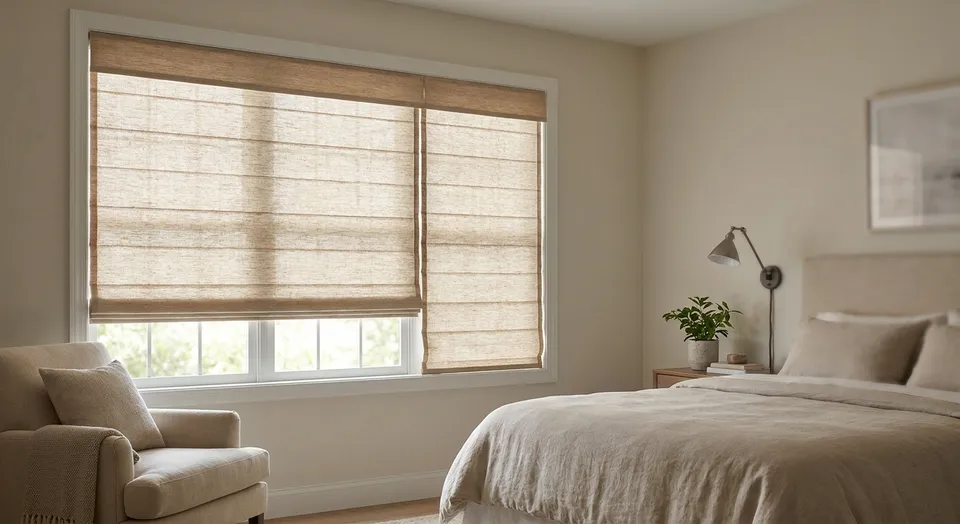
Motorized shades for in-law suite bedrooms have to solve a problem regular bedroom shades don't: two different people, two different schedules, and only one window. Get the shade type and control method wrong and you'll be adjusting cords for someone who can't reach them, or listening to a motor buzz through a shared wall at 6 a.m.
- Motorized cellular shades are the top pick for motorized shades for in-law suites when blackout and quiet mornings matter most in 2026. Buy.
- Motorized zebra shades win when the resident needs daytime privacy without losing all the light. Buy.
- Skip battery-only shades in suites where the resident has mobility limits. A charging port they can't reach defeats the purpose.
- App and hub control matters more than blackout percentage when a caregiver needs to check or adjust shades remotely.
Why this matters
In-law suites, converted basements, and accessory dwelling units are one of the fastest-growing bedroom types across South King County homes in 2026, and most of them get furnished like a guest room instead of a real bedroom with real light-control needs. A resident who naps midday, wakes early, or can't manage a pull cord needs a different setup than a teenager's bedroom down the hall. Custom blinds for in-law suites already gets treated as its own category for a reason. The buying criteria are genuinely different.
Motorization solves the access problem. It doesn't automatically solve the light, noise, or privacy problem, and that's where most people overspend on the wrong shade.
Who this is for
This guide is for homeowners setting up a bedroom for an aging parent, an adult child moving back home, or a long-term guest, anyone converting a spare room, basement, or attached suite into a real sleeping space in 2026. It's also for caregivers who need to control light and privacy for someone with limited mobility or a different sleep schedule than the rest of the house.
What to look for in motorized shades for in-law suites
Quiet motor operation
Motor sound depends on the specific motor, shade size, mounting, load, and measurement conditions. Ask for the selected product’s sound data or an operating demonstration rather than assuming a decibel level from the shade style.
Battery life and charging access
Battery life and charging time depend on the selected motor, shade size, and use. Confirm the approved power option, charger, charging access, and maintenance instructions before ordering; wired products also need service access. Compatibility, controller or hub requirements, and available controls depend on the exact motor and your home setup. We confirm the supported equipment and features before ordering.
Blackout vs. light-filtering balance
A suite occupied by a shift worker or a napping older adult needs real blackout, not just "room-darkening." A suite occupied by someone who wants a bright, cheerful room during the day but privacy at night needs a shade that does both without swapping hardware.
App or voice control for caregivers
If a caregiver needs to check on light levels remotely, or a resident can't operate a remote reliably, app and hub control stop being a convenience and start being the actual reason to motorize in the first place. Window treatments for multi-generational households run into this constraint constantly. Control needs to work for two different comfort levels with technology.
Retrofit compatibility
Most in-law suites are converted spaces, not new builds, which means existing window frames, no dedicated wiring, and sometimes odd window sizes. A motorized shade that mounts inside an existing frame without electrical work saves a renovation step most people don't budget for.
Manual override
Power outages happen in the Pacific Northwest more than people plan for. A shade that locks fully closed or open when the battery dies or the hub loses connection is a real problem in a bedroom someone depends on daily.
Top picks for motorized shades for in-law suite bedrooms
Motorized cellular shades: the sleep-schedule fix
A cellular blackout shade can combine light control with an insulating structure. For an in-law suite, check edge coverage, accessible controls, maintenance access, and a demonstration of the actual motor sound before choosing.
Motorized zebra shades: the daytime privacy pick
Battery life and charging time depend on the selected motor, shade size, and use. Confirm the approved power option, charger, charging access, and maintenance instructions before ordering; wired products also need service access. Compatibility, controller or hub requirements, and available controls depend on the exact motor and your home setup. We confirm the supported equipment and features before ordering.
Motorized roman shades: the quiet-hours pick
Roman shades offer soft fabric folds and a tailored appearance. Light control depends on the fabric and lining, while noise depends on the actual motor and installation. Rainier Roman shades are motorized only; compare a demonstration and complete quote.
App-and-hub controlled roller shades: the caregiver's pick
Compatible app control may let an agreed caregiver adjust a shade remotely. Confirm permissions, power and network requirements, and a simple local control for the resident; pairing time and supported features vary by equipment.
Get a quote for your in-law suite
Local measuring and installation across the Greater Seattle Area.
What to avoid
- Battery-only shades with an inaccessible port. A shade the resident or caregiver can't reach to recharge defeats the entire point of motorizing in the first place.
- Voice-only control with no manual backup. When the hub drops connection or the power goes out, someone needs a physical way to open or close the shade.
- Sheer-only shades with no blackout layer. They look bright and modern in a showroom, but a resident with a variable sleep schedule ends up needing a second shade layered on top within months anyway.
Verdict comparison
| Shade type | Motor noise | Battery/power | Blackout capability | Best control method | Verdict |
|---|---|---|---|---|---|
| Motorized cellular shades | Confirm motor sound | Rechargeable or hardwired | Full blackout available | Remote or app | Buy |
| Motorized zebra shades | Confirm motor sound | Rechargeable, 3-6 mo cycle | Partial to full | App or voice | Buy |
| Motorized roman shades | Low, fabric-dampened | Rechargeable | Partial unless lined | Remote | Consider |
| App-controlled roller shades | Confirm motor sound | Rechargeable or hardwired | Light-filtering to blackout fabric options | App or hub | Buy |
FAQ
What's the best motorized shade for an in-law suite bedroom?
Motorized cellular shades are the strongest overall pick for an in-law suite bedroom in 2026 because they combine blackout capability with quiet motor operation. Zebra shades are a close second when the resident needs daytime privacy without full darkness.
Are motorized shades better than manual shades for aging parents?
Motorization may help someone with limited reach or grip. Choose controls the resident can use comfortably and confirm any agreed caregiver access for the selected system. Plan charging and maintenance access too.
Do motorized shades need an electrician to install?
Most battery-powered motorized shades install without an electrician, since they run on rechargeable batteries rather than home wiring. Hardwired options exist but are usually only needed for shades with heavy daily use or no accessible outlet.
How often do motorized shade batteries need charging?
Battery life and charging time depend on the selected motor, shade size, and use. Confirm the approved power option, charger, charging access, and maintenance instructions before ordering; wired products also need service access. Compatibility, controller or hub requirements, and available controls depend on the exact motor and your home setup. We confirm the supported equipment and features before ordering.
Can motorized shades work without WiFi?
Yes, most motorized shades operate fine with a physical remote alone and don't require WiFi or a hub. A hub becomes necessary only if you want app control, voice control, or scheduled operation.
What happens to motorized shades during a power outage?
Outage behavior depends on the shade’s power, local controls, hub, router, and supported features. A charged battery motor may still have local control, while app or remote-access functions may be unavailable. Confirm and test the intended backup method; do not force a motorized shade by hand.
Are zebra shades or cellular shades better for privacy?
Zebra shades give more graduated privacy control during daylight hours through alternating sheer and opaque bands. Cellular shades give more complete privacy and blackout once fully closed, which matters more at night.
How loud are motorized shade motors?
Motor sound depends on the specific motor, shade size, mounting, load, and measurement conditions. Ask for the selected product’s sound data or an operating demonstration rather than assuming a decibel level from the shade style.
One last thing
The detail most people skip: test the manual override before the resident ever depends on the shade daily. A motorized shade that locks shut when the battery dies at 2 a.m. is worse than no motorization at all, and it's a five-minute check most installers won't mention unless you ask.