
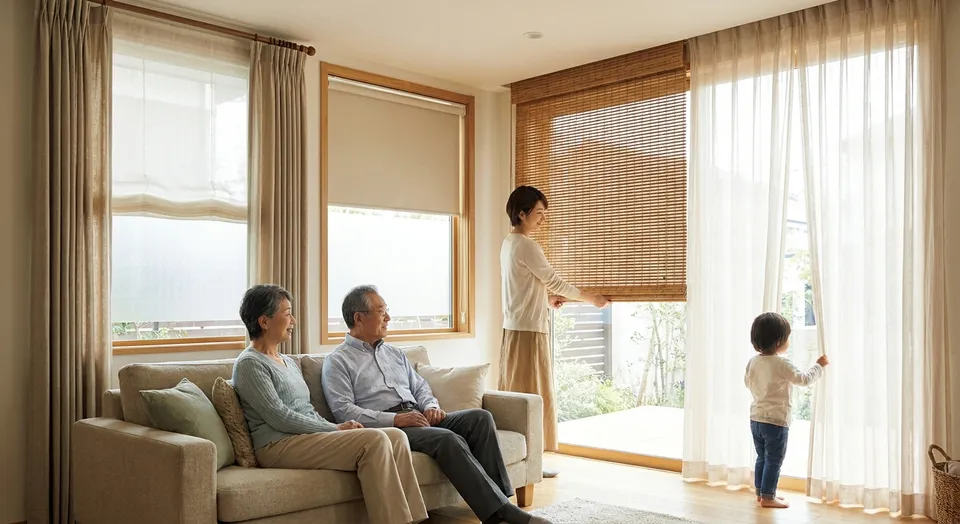
Three generations under one roof means three sets of light, privacy, and safety needs colliding in the same house. And one set of window treatments has to satisfy all of them without anyone compromising.
- Cordless cellular and roller shades are the baseline for window treatments for multi-generational homes with toddlers or older adults present.
- Motorized shades solve the reach problem for aging-in-place family members better than any manual system in 2026.
- In-law suites and ADUs need their own light control zone. Shared living room settings won't work for a separate schedule.
- Skip anything with exposed cords or hardwired-only motors if a grandparent or a toddler shares the house.
Why this matters
A household with a grandparent in an in-law suite, parents running a home office, and a toddler down the hall isn't one buyer profile. It's four, under one address. Standard shade recommendations assume a single lifestyle: one bedtime, one work schedule, one mobility level. Multi-generational households in the Auburn and Greater Seattle area increasingly don't fit that mold, and picking window treatments without accounting for the mismatch means someone in the house ends up squinting, fumbling with a cord, or unable to reach a wand.
The fix isn't one perfect product. It's matching each zone of the house to the person who actually lives in it, then making sure the choices don't conflict where rooms share a wall or a hallway.
Who this is for
This guide is for homeowners managing a house with at least two adult generations under one roof, a parent or grandparent in a converted bedroom, in-law suite, or backyard ADU, alongside younger kids or a working-age couple. If your household juggles a toddler's nap schedule, a grandparent's mobility limits, and a remote worker's video calls in the same set of rooms, the criteria below apply directly to you.
What to look for in window treatments for multi-generational homes
Cordless or fully motorized operation
Any room a toddler or a person with limited hand strength uses regularly should have zero exposed cords. This isn't a preference. It's the single biggest safety and usability filter for a multi-generational house in 2026. Cordless cellular shades and app- or remote-controlled roller shades solve this without requiring anyone to relearn how to open a window covering.
Independent light control per zone
A grandparent waking at 5:30 a.m. and a teenager sleeping until 10 a.m. cannot share one light setting. Look for treatments that let each bedroom, suite, or ADU operate on its own schedule, separate remotes, separate motor groups, or simply separate manual shades, rather than a single whole-house system that forces one household rhythm on everyone.
Low physical effort to operate
Someone with arthritis or limited reach shouldn't need to stand on a step stool or wrestle a stiff wand. Motorized shades remove that barrier entirely, and even manual cordless cellular shades should lift with light, one-hand pressure. If a shade requires two hands and real force to move, it's the wrong pick for an aging-in-place bedroom.
Noise and light isolation between zones
When a nursery, a home office, and a grandparent's suite sit near each other, sound and light bleed matter more than in a single-family layout. Cellular shades add a layer of insulation that also dampens some sound transfer, and blackout fabric in a shared-wall bedroom keeps hallway light from waking a light sleeper.
Durability against daily handling
More people touching the same shades multiple times a day means faster wear on cheap components. Look for reinforced headrails and commercial-grade motor cycles rather than the lightest residential-grade hardware, especially in shared common areas like a living room or kitchen nook.
Compatibility with future mobility changes
Discuss future needs before ordering, but do not assume a manual shade can later accept a motor. Rainier automation service is for Rainier-supplied shades. Confirm any supported upgrade path, caregiver permissions, and compatible controls for the selected product.
Get a Rainier Blinds quote for your home
Local measure and install across Auburn, Bellevue, Tacoma, and Seattle in 2026.
Top picks by zone
The safety-first pick: cordless shades for shared kids' spaces
Choose a suitable cordless or motorized product to avoid an exposed operating pull cord. Follow all product safety instructions and keep cribs, beds, and climbable furniture away from windows. Check that the actual resident can comfortably operate the selected product; manual cordless mechanisms still require reach and effort.
The independence pick: motorized shades for aging-in-place bedrooms
A grandparent with limited grip strength or reduced mobility shouldn't need to reach a wand or crank a cord every morning and night. A remote or app-controlled motor turns a two-handed chore into one button press, and it works from a wheelchair or a bed just as easily as standing. This is the single highest-impact upgrade for a multi-generational home with an aging parent in residence. Verdict: Buy, details in motorized shades for aging-in-place homeowners.
The privacy pick: dedicated shades for the in-law suite
An in-law suite runs on its own schedule, and its window treatments should never be tied to the main house's settings. A separate light-filtering or blackout shade zone lets that resident control their own room without walking through the house to adjust a shared system. This matters most in homes where the suite shares an exterior wall with a bedroom or living space. Verdict: Consider. Check custom blinds for in-law suites for the layout options that apply to a converted room versus a standalone structure.
The separate-structure pick: ADU-specific window treatments
A backyard ADU housing a parent or adult child functions as its own household inside your property, and its shades need to be selected and measured as a standalone unit, not an afterthought bolted onto the main-house order. Insulated cellular shades in an ADU also help offset the temperature swings common in converted garages and small standalone structures. Verdict: Buy if the ADU is a permanent living arrangement. See window treatments for accessory dwelling units for the specifics.
The nursery pick: layered light control for the youngest resident
A newborn or toddler's room needs near-total darkness for naps and a fast switch to light-filtering for daytime supervision, which is a different job than a teenager's blackout-only bedroom. Dual-function shades that layer a blackout liner with a sheer or light-filtering front let one window do both jobs without a second treatment. Verdict: Consider. Full guidance is in best window treatments for nurseries and kids' rooms.
What to avoid
- Corded blinds anywhere a toddler or a person with dementia has unsupervised access. The cord risk outweighs any cost savings, full stop.
- One whole-house motorized system forcing a single schedule, a grandparent's 6 a.m. and a teenager's 10 a.m. cannot share one automated setting without separate zones or groups.
- Hardwired-only motors in a room likely to be reassigned. If today's home office becomes tomorrow's in-law suite, battery or plug-in motorized shades give you flexibility a hardwired install doesn't.
"If a shade requires two hands and real force to move, it's the wrong pick for an aging-in-place bedroom."
Verdict comparison table
| Zone | Best treatment type | Key criterion met | Verdict |
|---|---|---|---|
| Kids' shared bedroom | Cordless cellular/roller | No exposed operating pull cord | Buy |
| Aging-in-place bedroom | Motorized roller or cellular | Low-effort operation | Buy |
| In-law suite | Independent light-filtering/blackout | Zone control | Consider |
| ADU | Insulated cellular shades | Standalone climate control | Buy |
| Nursery | Layered blackout + sheer | Dual-mode light control | Consider |
FAQ
What are the best window treatments for multi-generational homes in 2026?
Cordless cellular or roller shades for shared kids' spaces and motorized shades for aging-in-place bedrooms are the two highest-priority picks in 2026. Each zone of a multi-generational house needs its own light and operation settings rather than one whole-house system.
Are motorized shades worth it for a grandparent living in-house?
Yes, if reduced grip strength or mobility makes daily cord or wand operation difficult. A remote or app control turns a two-handed task into a single button press, which matters most in bedrooms used every morning and night.
Do ADUs need separate window treatments from the main house?
Yes. An ADU functions as its own household and should be measured and selected independently, especially for insulation, since converted garages and standalone structures see different temperature swings than the main house.
Are cordless blinds actually safer than corded blinds for toddlers?
Choose a suitable cordless or motorized product to avoid an exposed operating pull cord. Follow all product safety instructions and keep cribs, beds, and climbable furniture away from windows.
Can one window treatment work for both a nursery and an in-law suite?
No, because the schedules conflict. A nursery needs fast switching between blackout for naps and light-filtering for supervision, while an in-law suite needs a fixed, independent setting the resident controls without leaving their space.
What's the biggest mistake homeowners make with multi-generational window treatments?
Installing one whole-house motorized system on a single schedule. It looks efficient on paper but fails as soon as two generations keep different hours in the same house.
How much does it cost to add motorized shades for an aging-in-place bedroom?
Costs vary by room size and shade type, so get a measured quote for your specific windows rather than relying on a national average. A local install crew can price the exact rooms in your house.
Do cellular shades help with noise between generations sharing walls?
Cellular shades add an insulating layer that dampens some sound transfer along with light, which helps when a nursery, office, or in-law suite shares a wall with another active room.
One last thing
The zone that gets overlooked most often in a multi-generational house isn't the in-law suite or the nursery. It's the hallway or landing between them, where light bleed from one room's shades disturbs sleep in the next. Fixing that one connector space usually solves more friction than upgrading any single bedroom.