
Our available controls: Rainier Blinds offers Roman and woven wood shades with motorized operation only. Available controls and power options for other products are confirmed at your consultation.
Guest houses need window coverings that hold up without daily attention, privacy for whoever's staying, light control for sleep, and hardware that won't need a service call every season. Here's what separates a smart pick from a wrong one for custom blinds for guest houses in 2026, covering detached units, ADUs, and in-law suites across South King County.
- Custom blinds for guest houses in 2026: zebra shades win on privacy control, cordless cellular shades win on insulation.
- Blackout roller shades are the safe pick for overnight guests; woven wood romans cost more per window but add texture.
- Skip corded lift systems in guest houses used by kids or short-term renters. Cordless is standard now.
- Motorized shades pay off for guest houses run as short-term rentals, not for occasional family stays.
Why this matters
A guest house window isn't a living room window. Nobody's home to adjust it twice a day, and whoever's staying there, a relative, a renter, a weekend guest, needs privacy and light control that works without instructions.
If the structure is a permitted accessory dwelling unit, the stakes are higher: these spaces get used more like independent housing than a spare room, and the window treatments need to match that. The window treatments for ADUs guide covers the permitting and layout angle in more depth than this piece does.
Who this is for
This guide is for homeowners in Auburn, Kent, Renton, Tacoma, or the wider Seattle area with a detached guest house, converted garage, or in-law suite who want the windows finished once and left alone. That includes people hosting family a few weekends a year and people running the unit as a short-term rental where turnover speed matters more than décor.
What to look for in custom blinds for guest houses
Privacy without losing light
Guest houses often sit close to a property line, a driveway, or a neighbor's window, so full blackout isn't always the goal. Controlled privacy is. Zebra shades and layered sheers let a guest dial in exactly how much visibility they want at any hour, which matters more in a shared-lot situation than in a standalone home.
Low-maintenance operation
Battery life and charging time depend on the selected motor, shade size, and use. Confirm the approved power option, charger, charging access, and maintenance instructions before ordering; wired products also need service access. Compatibility, controller or hub requirements, and available controls depend on the exact motor and your home setup. We confirm the supported equipment and features before ordering.
Light control for sleep quality
Guests sleep on someone else's schedule. A guest house bedroom window facing east or south needs real blackout capability, not just "room-darkening" fabric that still lets in a glow at 5 a.m. in June.
Durability across turnover
If the guest house sees renters, weekend guests, and the occasional teenager all in one year, the hardware needs to survive repeated use without the mechanism loosening. Cheap tension-mounted units are the first thing to fail under that kind of churn.
Budget per window
Guest houses are usually smaller than the main house, but owners often outfit 3-6 windows at once rather than spreading the cost over years. The budget guide for custom window treatments breaks down what drives cost per window so you're not guessing at the estimate.
Weather exposure on exterior-facing glass
Many guest houses have a sliding glass door or a bank of windows facing a patio, since they're often converted from garages or built as standalone structures. Pacific Northwest rain and seasonal glare put more wear on fabric near that kind of exposure than on an interior-facing window.
Top picks for guest house windows
Zebra shades. The privacy dial-in pick. Alternating sheer and opaque bands let a guest slide from full view to full privacy in one motion, with no separate blackout layer needed for daytime use. Buy for guest houses near a shared driveway or close-set neighbor.
Cellular construction can add an insulating layer at the window. The result depends on the exact product, fit, glazing, climate, and how the shade is used; it does not establish a particular temperature change or utility-bill saving. Confirm the selected product’s thermal data rather than assuming an R-value from the category.
Blackout roller shades. The overnight-guest pick. A tight-weave blackout fabric on a roller mechanism blocks close to full daylight without adding bulk to a small bedroom window. Buy for any guest house bedroom, especially one facing east.
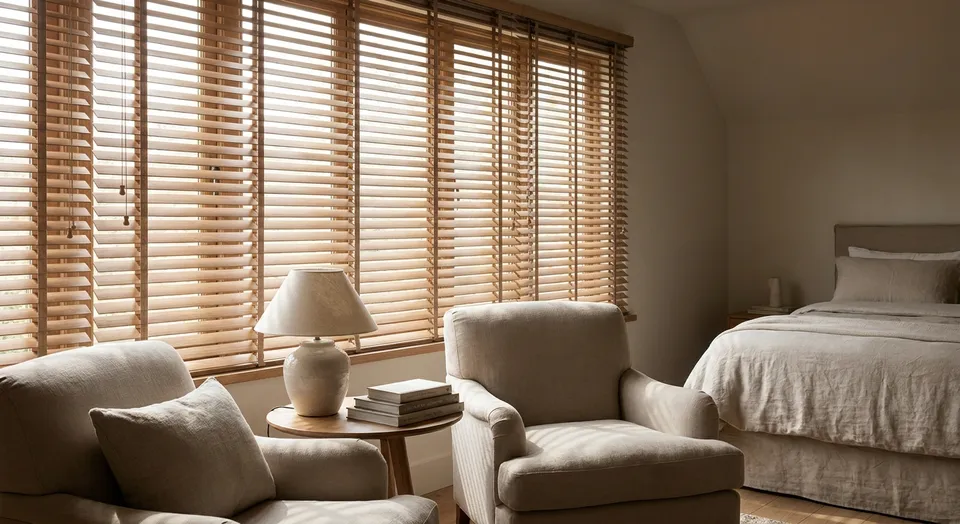
Woven wood roman shades. The textured, guest-ready pick. Natural material adds warmth that vinyl or plain roller fabric doesn't, and it reads as more finished when the guest house doubles as a rental listing photo. Consider if budget allows the higher per-window cost; skip if the space needs true blackout, since woven wood alone won't fully block light.
Motorized shades, the low-touch pick for rental use. Programmable schedules and app control mean a shade can open and close on a timer even when nobody's staying there, which matters for curb appeal and security on a vacant unit. Consider for guest houses run as short-term rentals; Skip if the space is only used a few weekends a year, since the added cost doesn't pay off at that frequency.
Get a quote for your guest house windows
On-site measure and real pricing before you commit to a product.
What to avoid
- Off-the-shelf tension-mount blinds sized by the aisle, not the window. Guest house windows are frequently non-standard sizes from garage conversions, and a stock blind that's an inch off gapes light on both sides.
- Corded lift systems in any guest house used by kids, pets, or short-term renters. Cords are a liability in a space you're not supervising, and cordless is the standard expectation in 2026 rental listings.
- Fabric with no fade resistance on south- or west-facing guest house glass. A guest house that sits at an angle catching afternoon sun all year will visibly fade cheap fabric within a couple seasons.
If the guest house doubles as an in-law suite with different needs than a rental unit, more permanent occupancy, more personal storage, less turnover, the picks shift slightly. The in-law suite blinds guide covers that version of the decision separately.
Verdict comparison
| Product | Privacy control | Light block | Maintenance | Verdict |
|---|---|---|---|---|
| Zebra shades | Excellent | Good | Low | Buy |
| Cordless cellular shades | Good | Moderate | Very low | Buy |
| Blackout roller shades | Good | Excellent | Very low | Buy |
| Woven wood roman shades | Moderate | Fair | Low | Consider |
| Motorized shades | Good | Depends on fabric | Very low (after setup) | Consider |
FAQ
What are the best custom blinds for guest houses in 2026?
Zebra shades and cordless cellular shades top the list for guest houses in 2026 because they handle privacy and insulation without daily upkeep. Blackout roller shades are the better choice specifically for guest house bedrooms.
Do guest houses need blackout shades?
Bedrooms in a guest house benefit from blackout shades, especially on east- or south-facing windows where morning light is strongest. Living areas and kitchens in the same structure can use lighter-filtering fabric instead.
Is motorized better than manual for a guest house?
Motorized shades make sense when a guest house is run as a short-term rental and needs scheduled open/close for curb appeal or security. For occasional family use a few weekends a year, manual cordless shades cover the same needs at lower cost.
How much do custom blinds cost for a guest house?
Cost depends on the number and size of windows and the product chosen, since guest houses typically need 3 to 6 windows covered at once. A detailed cost breakdown is in the budget guide for custom window treatments.
Are cordless blinds required for guest houses used by renters?
Cordless isn't legally required everywhere, but it's the practical standard in 2026 for any space with unsupervised use, including short-term rentals and family guest stays. Corded lift systems carry more liability risk in a space the owner doesn't monitor daily.
What's different about ADU window treatments versus a regular guest house?
A permitted accessory dwelling unit gets used more like independent housing, so window treatments need to hold up to daily, ongoing occupancy rather than occasional stays. The core products don't change, but durability and privacy control matter more.
Can I use the same blinds in a guest house as the main house?
You can match products across both structures for a consistent look, but guest houses often need lower-maintenance versions since nobody's tuning them daily. Cordless and motorized options close that gap.
One last thing
The detail owners miss most often: a guest house with a single exterior door and no interior hallway loses privacy the second a shade fails, since there's no second layer of separation like there is in a main house. Budget for the slightly more durable version of whatever product you pick. It's a small cost difference now against a bigger inconvenience later.