
Our available controls: Rainier Blinds offers Roman and woven wood shades with motorized operation only. All other shade styles are available with manual, motorized, or smart control. Your consultation confirms the controls and power options for your product.
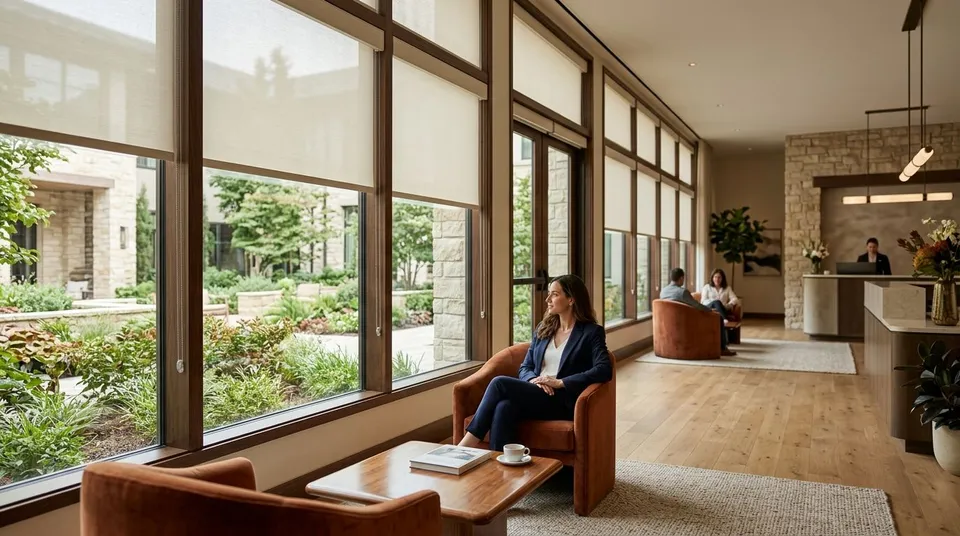
Motorized shades for boutique hotel lobbies are shading systems that raise, lower, or tilt on a schedule or app command, built to control glare and guest privacy across floor-to-ceiling glass without staff hand-pulling cords all day. A boutique hotel lobby runs on different rules than a house or a corporate office: light changes hour to hour as guests check in and out, staff can't stop at every window to adjust a shade, and the covering itself is part of the first impression a guest forms in the first 30 seconds inside the door.
- Motorized roller and zebra shades are the top pick for motorized shades for hotel lobbies in 2026 because they run on schedules without front desk staff touching them.
- Cellular shades add insulation value for lobbies with tall glass walls that lose heat fast in Pacific Northwest winters.
- Manual shades work for small boutique properties with fewer than 10 lobby windows but fail once traffic and glass area scale up.
- Rainier Blinds measures and installs motorized shades across the Greater Seattle Area, including hospitality properties in Auburn, Bellevue, and Tacoma.
Why motorized shades matter for boutique hotel lobbies
A hotel lobby is a public room with commercial-grade traffic and a residential-grade budget compared to a full renovation. Guests sit in it for check-in, for coffee, for waiting on a ride, and glare off an afternoon sun through a west-facing lobby wall makes the space feel worse than it is, no matter what the furniture looks like. Restaurant and hospitality spaces share this exact problem: high glass-to-wall ratios, staff who can't babysit window coverings, and a need for the room to look intentional at every hour of the day.
The difference between a hotel lobby and a house is scheduling. A homeowner adjusts a shade when they feel like it. A front desk team running a 24-hour operation needs shades that move themselves at 7 a.m. and again at sunset, every day, without anyone remembering to do it. That's the entire argument for motorization in this segment, not comfort, not tech for its own sake.
Steps to plan motorized shades for a hotel lobby
Audit your lobby's light exposure and traffic patterns
Walk the lobby at three points in a single day, morning, midday, and just before sunset, and note where glare actually lands on the front desk, seating, or check-in kiosks.
- Mark which walls face east or west, since those get the harshest low-angle sun
- Note whether guests wait near the glass (elevator lobby, coffee bar) or just pass through it
- Check for skylights or clerestory glass above the main entry, common in boutique lobby architecture
- Record how many hours per day the space is staffed versus unattended overnight
Choose motorized over manual for lobby-specific shades
Manual shades work fine in a private office or a guest room where one person adjusts one shade. A lobby with 8, 15, or 30 feet of glass and a front desk team that's already juggling arrivals is a different problem entirely, and it's why motorized shades are the standard recommendation for boutique hotel lobbies in 2026.
- Motorized shades run on a preset schedule tied to sunrise and sunset, no staff involvement needed
- Battery or hardwired motor options both work in lobbies, depending on where power runs to the window wall
- Remote or app control lets front desk staff override the schedule for a private event or a cloudy day
- Manual shades still make sense for small side windows in staff-only areas where nobody needs automation
Match shade type to your lobby's design tier
Not every lobby needs the same fabric or opacity. A minimalist boutique lobby with concrete and steel reads differently than a lodge-style property with wood accents, and the shade type should follow the room, not the other way around.
- Roller shades in a light-filtering or blackout fabric work for most glass walls and large storefront-style entries
- Zebra shades (also called dual shades) alternate sheer and solid bands, useful where the lobby needs adjustable privacy without full blackout
- Cellular shades add insulation on tall glass walls, worth considering for lobbies that lose heat through single-pane or older curtain wall glazing
- Woven wood roman shades suit a lodge or craftsman-style boutique property looking for texture over a flat fabric look
Set opacity and layering for day vs. night use
A lobby needs different light control at 9 a.m. than it does at 9 p.m., and one flat opacity choice usually fails one end of the day.
- Light-filtering fabric keeps the lobby bright and welcoming during business hours
- A blackout or near-blackout layer matters for lobbies with street-facing glass near a residential neighborhood at night
- Dual-layer zebra shades let staff dial opacity up or down instead of choosing one fixed fabric
- Sheer fabric alone rarely controls glare enough for a west-facing entry in Seattle-area summer afternoons
Program schedules and scenes for front desk staff
Once shades are motorized, the schedule does the daily work, but someone still has to set it up correctly the first time. Programming motorized window shades covers the mechanics; for a lobby specifically, plan for these scenarios:
- A morning scene that opens shades fully once staff arrive
- An afternoon glare scene tied to sun position, not just a fixed clock time
- A night scene that closes shades for privacy after the lobby traffic slows
- An override button at the front desk for private events, film crews, or unusual weather
Pair shades with your property's smart building system
Boutique hotels running a smart building platform for HVAC or lighting can often fold shade control into the same system rather than running it separately.
- Confirm whether your motor protocol matches your existing smart hub before ordering
- Group lobby shades into one zone so staff issue one command instead of adjusting each window
- Keep a manual remote as backup in case the network or hub goes down
Plan install around business hours and guest disruption
A lobby can't close for two days the way a house can shut off a room. Installation needs a plan that keeps the front desk running.
- Schedule install during the lowest-traffic hours, typically mid-morning on a weekday
- Stage materials off to the side rather than blocking the main entry
- Confirm power access for motorized units ahead of the install date, not the day of
- Ask the installer to test every shade's schedule before leaving the property
Book a lobby shade consultation
Rainier Blinds measures and installs motorized shades for hospitality properties across the Greater Seattle Area.
Comparing shade options for boutique hotel lobbies
| Option | Best for | Key limitation |
|---|---|---|
| Manual roller shades | Small properties, fewer than 10 lobby windows | Staff must adjust by hand every time light changes |
| Motorized roller shades | Most boutique lobbies with large glass walls | Requires power access or a battery recharge routine |
| Motorized zebra shades | Lobbies needing flexible privacy through the day | Slightly higher setup complexity for scene programming |
| Motorized cellular shades | Lobbies with tall single-pane or older glazing | Less visual texture than woven wood or fabric options |
| Motorized traverse drapery | Formal boutique lobbies wanting a softer look | Bulkier hardware, needs more ceiling or wall clearance |
Properties with corporate-style front-of-house design, rather than a residential boutique feel, should also look at how motorized shades work in corporate office buildings, since the scheduling logic carries over almost directly.
Common mistakes boutique hotels make with lobby shades
- Choosing blackout everywhere. A lobby that goes fully dark during the day feels closed, not private; light-filtering fabric usually reads better for a public space.
- Skipping the schedule test before opening. A shade that's motorized but never programmed correctly just becomes a manual shade with extra steps.
- Ignoring skylight or clerestory glass. Boutique lobbies with vaulted entries often forget the glass above eye level, which drives more glare than the wall-level windows.
- Buying one shade type for the whole property. A lobby, a restaurant space, and guest rooms rarely need the same fabric or opacity, and treating them identically wastes budget on the wrong spec.
- Underestimating install timing. Scheduling install during peak check-in hours creates friction with guests and slows the crew down unnecessarily.
FAQ
What's the best type of motorized shade for a boutique hotel lobby?
Motorized roller shades or zebra shades work best for most boutique hotel lobbies in 2026 because they run on a schedule and handle large glass walls without staff adjustment. Cellular shades are a stronger pick when the lobby has tall single-pane glass losing heat.
Is motorized better than manual for a hotel lobby?
Yes, for any lobby larger than about 10 windows or with high-traffic glass, since manual shades require staff to adjust them by hand throughout the day. Manual shades still work fine for small side windows in staff-only areas.
How much does it cost to add motorized shades to a hotel lobby?
Pricing depends on window count, fabric choice, and motor type, and varies enough by property that a free in-home consultation is the only accurate way to get a number.
Can motorized shades connect to a hotel's existing smart building system?
Many motor protocols integrate with common smart building hubs, but compatibility should be confirmed before ordering since not every system pairs with every motor brand.
Do motorized shades need battery replacement in a commercial lobby?
Battery-powered units need periodic recharging, and high-traffic lobbies running shades on frequent schedules often do better with hardwired motors instead.
What fabric works best for glare control in a west-facing hotel lobby?
Light-filtering fabric handles most west-facing glare while keeping the lobby feeling open; full blackout is usually reserved for after-hours privacy rather than daytime use.
Should a boutique hotel use the same shades in the lobby and guest rooms?
No, lobbies need public-facing durability and schedule-based operation, while guest rooms typically need more privacy control and individual guest adjustment, so the specs usually differ between the two spaces.
One last thing
The detail that trips up most boutique properties isn't the shade type, it's the skylight or clerestory glass above the main entry that nobody accounts for until glare starts hitting the front desk from an angle nobody measured. Walk the lobby ceiling line before finalizing a spec, not just the wall-level windows.