
Our available controls: Rainier Blinds offers Roman and woven wood shades with motorized operation only. All other shade styles are available with manual, motorized, or smart control. Your consultation confirms the controls and power options for your product.
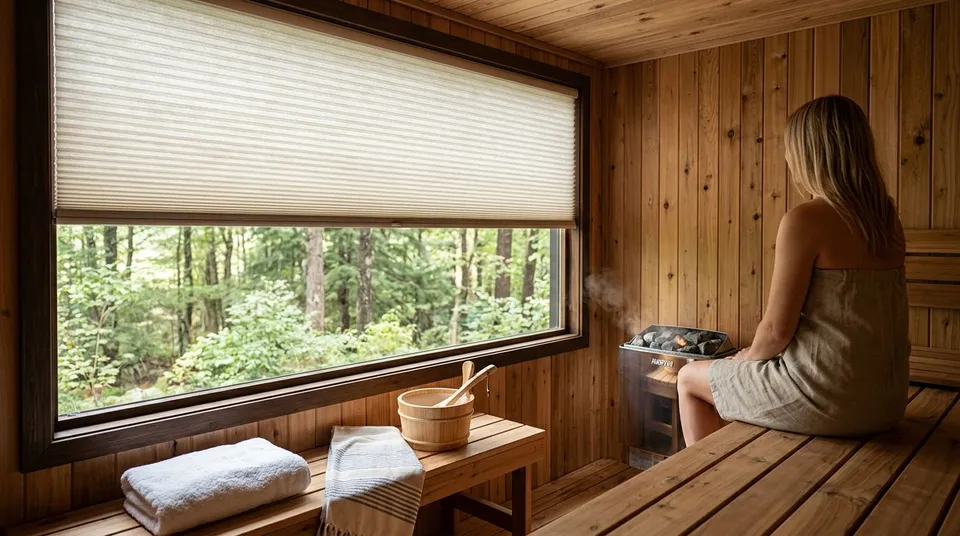
Home sauna room shades need to survive 150-195°F heat and repeated steam bursts without warping, peeling, or trapping mold behind the fabric. Standard fabric shades or paper honeycomb cellular shades that work fine in a living room fail fast in a home sauna, because the heat-and-moisture cycle is more extreme than anything a bathroom or kitchen window sees.
- Moisture resistant shades for home saunas need vinyl or PVC-backed roller fabric, not paper cellular or woven wood.
- Cellular shades and woven wood roman shades absorb steam and warp fast inside a home sauna, so skip them.
- Outdoor-grade zipper track shades handle direct glass-wall exposure in sauna rooms with floor-to-ceiling windows.
- Battery-powered motorized shades work in a sauna only when the housing sits outside the steam zone.
- Rainier Blinds measures and installs custom shades for South King County sauna rooms, using its own crew.
Why moisture resistant shades matter for home sauna rooms
A dry Finnish-style home sauna runs at low ambient humidity most of the time, but every time water hits the rocks the air around the window spikes toward saturation for several minutes. That cycle repeats dozens of times a session, and it happens on glass, window frame, and whatever's covering the window.
Condensation that forms on a cold window in a hot sauna doesn't stay on the glass. It runs down onto the sill and into the shade fabric or headrail, and it does that every single session, not once a year like a rainy bathroom window. A shade that isn't built for it will show warping, mildew spotting, or peeling laminate inside a few months.
This is a narrower problem than general humidity-resistant window treatments. Bathroom shades deal with occasional steam from a shower. Sauna windows deal with sustained high heat plus repeated direct moisture contact in 2026 builds, which rules out more materials than most humidity guides account for.
Assess your sauna window's heat and steam exposure
Before picking a material, look at exactly where the window sits relative to the heater and the water source.
- Note whether the window is within 3-4 feet of the heater rocks, where steam bursts hit hardest
- Check if condensation already beads on the glass during a normal session
- Measure the window and record inside and outside mount depth
- Flag any exterior-facing glass walls or doors that see rain and sun in addition to interior steam
- Write down whether the window opens for post-session ventilation
A sauna room built into a converted garage or backyard structure often shares the same enclosure and heat conditions covered in window treatments for she sheds and backyard studios.
Rule out materials that fail in high heat and humidity
This step saves the most money and the most rework. A short list of materials that consistently underperform in a sauna, based on how each is built:
- Paper or fabric cellular honeycomb shades: the honeycomb structure absorbs moisture and sags or collapses
- Woven wood roman shades: natural reeds and grasses swell, warp, and can mildew under repeated steam
- Uncoated fabric roman shades: fabric wicks moisture and stays damp between sessions
- Any wood-based slat or panel: heat cycling causes cupping and separation
- Unfinished metal headrails: exposed steel corrodes faster in a steam environment than in a normal room
If condensation is forming on the glass, it's forming on the shade too. That single fact eliminates most of the standard shade catalog before you get to fabric color.
Choose a moisture resistant shade material
Once the vulnerable materials are off the list, the realistic options for a home sauna narrow to vinyl and PVC-backed products.
- Vinyl or PVC-coated roller shade fabric wipes clean and doesn't absorb standing moisture
- Solid vinyl blackout roller fabric adds privacy on street-facing sauna windows without a woven backing to trap damp
- Outdoor-rated screen fabrics, normally used for patios, handle repeated wet-dry cycling where the window faces exterior glass
- Synthetic light-filtering roller fabric works in an adjoining changing room with lower humidity than the sauna itself
Rainier Blinds measures each sauna window on-site and recommends roller shade fabric based on how close the window sits to the heat source, not a one-size answer across every room in the house.
Pick a manual or motorized operating system for a hot room
Manual roller shades are the simplest choice for a sauna and have the fewest points of failure, since there's no motor housing to protect from steam.
- A chain-operated roller shade puts no electronics near the window at all
- A cordless spring-loaded roller shade removes cord clutter in a small enclosed room
- A battery-powered motorized roller shade works when the battery pack and receiver sit outside the direct steam path
- A hardwired motor is the least practical option, since running low-voltage wiring through a steam-exposed wall adds a failure point
Homeowners retrofitting an older sauna room in 2026 often apply the same logic used in battery-powered motorized shades for retrofit homes: no new wiring, easier to relocate if the mounting plan changes.
Get your sauna windows measured
Rainier Blinds measures and installs shades in person, with its own crew.
Mount the shades away from direct steam contact
Mounting placement matters as much as material choice in a small, hot room.
- Outside mount brackets keep the headrail off the direct steam plume near the glass
- Leave at least a half-inch gap between shade and glass so condensation runs down the glass, not the fabric
- Use stainless or coated hardware, not raw steel brackets, for anything mounted inside the sauna
- Position any motor or battery housing on the wall adjacent to the sauna, never directly above the heater
Clean and maintain shades on a set schedule
Even moisture resistant fabric needs a routine in a room that sees steam every use.
- Wipe vinyl or PVC fabric down after heavy sessions with a dry or lightly damp cloth
- Leave the shade raised and the window cracked 15-20 minutes after each session to clear residual steam
- Check headrail hardware for corrosion every few months
- Apply the fabric-care basics in how to clean fabric roller shades, adjusted for a wipeable vinyl surface
Match opacity to the sauna's privacy and light needs
Most home saunas need full privacy on any street-facing or neighbor-facing window, plus enough light control to avoid a glare wall late in the day.
- Blackout vinyl roller fabric for windows with direct sightlines from outside
- Light-filtering vinyl fabric for interior-facing glass with no privacy concern
- Layered setups for a sauna that doubles as a relaxation room
- Work through how to choose shade opacity for privacy and natural light before locking in a fabric
Comparison: shade options for home sauna rooms
| Option | Best for | Key limitation | Verdict |
|---|---|---|---|
| Vinyl or PVC-backed roller shades | Windows within a few feet of the heater | Fewer decorative patterns than standard roller fabric | Buy |
| Outdoor-rated zipper track or steel wire shades | Sauna rooms with floor-to-ceiling exterior glass | Built for exterior conditions, bulkier profile indoors | Buy for glass walls |
| Synthetic light-filtering roller shades | Adjoining changing rooms with lower humidity | Not fully wipeable like solid vinyl | Hold for adjacent rooms only |
| Battery-powered motorized roller shades | Hard-to-reach or high sauna windows | Battery housing still needs placement outside the steam zone | Buy with correct mounting |
Common mistakes home sauna owners make
- Installing paper or fabric cellular honeycomb shades because they're cheap at a big-box store, then replacing them within a year
- Choosing a woven wood roman shade for the look without accounting for how fast natural reed warps under repeated steam
- Mounting a motorized shade's receiver or battery pack directly above the heater instead of on an adjacent wall
- Picking blackout fabric with a standard woven backing instead of a solid vinyl-backed blackout fabric
- Skipping post-session ventilation, which leaves residual steam sitting against the fabric for hours
FAQ
What are the best moisture resistant shades for home saunas?
Vinyl or PVC-backed roller shades are the best moisture resistant shades for home saunas in 2026, because the coated fabric wipes clean and doesn't absorb steam the way paper or woven materials do. Outdoor-rated zipper track shades are the second option for sauna rooms with floor-to-ceiling exterior glass.
Can you use cellular shades in a sauna?
Cellular shades are not recommended for a sauna interior because the honeycomb paper structure absorbs steam and sags or collapses over repeated sessions. They work fine in a sauna's changing room where humidity stays lower.
Are woven wood shades okay for a home sauna?
Woven wood roman shades are a poor fit for a home sauna because the natural reed and grass fibers swell and warp under repeated steam exposure. Vinyl-backed roller fabric holds up far longer in the same conditions.
Should sauna shade motors be battery-powered or hardwired?
Battery-powered motorized shades work better in a sauna than hardwired systems because no wiring runs through a steam-exposed wall. The battery housing still needs to sit on an adjacent wall, not directly above the heater.
How close can a shade be mounted to a sauna heater?
Keep shade brackets at least 3-4 feet from the heater rocks, since that is where steam bursts hit hardest during a session. An outside mount with a half-inch gap from the glass also lets condensation drain instead of soaking the fabric.
Do blackout shades work in a sauna?
Blackout shades work in a sauna as long as the fabric has a solid vinyl backing rather than a standard woven blackout liner. A vinyl-backed blackout roller shade adds privacy on street-facing windows without trapping moisture.
How often should sauna shades be cleaned?
Wipe vinyl or PVC roller fabric down after heavy sessions and check hardware for corrosion every few months. Leaving the shade raised with the window cracked for 15-20 minutes after each session cuts down on moisture buildup.
One last thing
The detail most homeowners miss is not the fabric, it is the gap between the shade and the glass. An outside-mounted roller shade with a half-inch of clearance lets condensation run down the window and off the sill instead of pooling against the fabric, which matters more for durability in 2026 than the coating spec on the vinyl itself.