
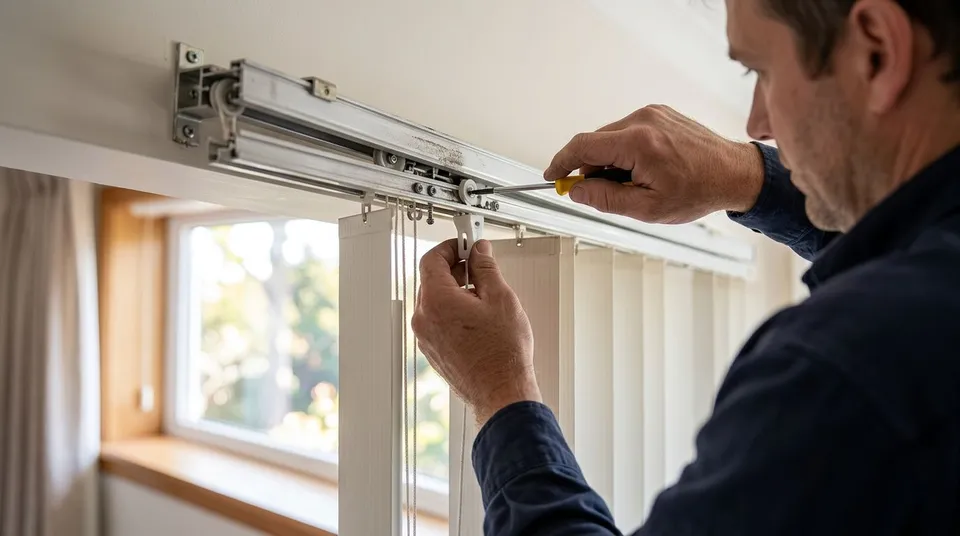
A jammed vertical blind track almost always comes down to a bent headrail, a dirty channel, or a carrier that popped loose, and most of that gets fixed with a screwdriver in one sitting, not a service call.
- Fixing jammed vertical blinds usually means realigning the track, clearing debris, or reseating a popped carrier stem.
- A bent aluminum headrail rarely straightens back to true, so repeated jams point to the track, not dirt.
- Rainier Blinds does not service or install vertical blinds, but installs vertical cellular shades as a direct swap on sliding glass doors.
- Vanes that keep slipping off their hooks usually mean the carrier clip is cracked, not misaligned.
Why this matters
A sticking vertical blind track is a mechanical problem, not an electrical or fabric one, so diagnosing it correctly saves you from replacing parts that were never broken.
Most homeowners assume the vanes are the problem and start pulling on fabric that's perfectly fine, when the actual fault sits in the track channel or the carrier hardware above it.
By 2026, a lot of vertical blind hardware installed in South King County homes is 10 to 20 years old, and aluminum headrails that age develop a slight warp from sun exposure that no amount of cleaning corrects.
How do you fix a jammed vertical blind track?
Work through these steps in order. Most jams clear by step three.
- Cut power or unclip the control wand so the track isn't under tension while you work.
- Slide each carrier by hand along the track to isolate which one is catching, rather than assuming the whole rail is bad.
- Inspect the channel for debris - dust, pet hair, and dropped screws are common in tracks that haven't been repaired as a broken window blind before.
- Check for a bent section by running a straightedge along the top of the headrail; a gap of roughly a quarter inch anywhere means the aluminum has warped.
- Reseat any popped carrier by pressing the stem back into the track groove until it clicks and slides freely.
- Wipe the channel with a dry cloth, then run a light coat of dry silicone spray, never a wet lubricant that attracts more dust.
- Retest the full glide from fully open to fully closed before reattaching the wand.
If the carrier still binds after cleaning and realigning, the track itself is out of true and cleaning won't fix that.
Why vertical blind tracks jam
- Warped headrail - aluminum flexes from years of sun exposure or a single hard bump, and it doesn't bend back.
- Cracked plastic carriers - the small stem that holds each vane is the single most common failure point in vertical blind hardware.
- Debris buildup - dust, pet hair, and dropped hardware collect in the channel over years of use.
- Vanes off their hooks - standard vertical blind vanes run 3.5 or 4.5 inches wide, and a slipped vane snags the neighboring carrier as it travels.
- Loose bracket screws - a track pulling away from the wall or header at one end throws off the whole glide path.
- Bent vanes catching the frame - a vane that's taken an impact can drag against the window frame or an adjacent vane; the fix there is closer to what you'd do for bent or broken blind slats than a track repair.
A vertical blind track that jams again within weeks of a DIY fix has a warped headrail, not a dirty one, and no amount of cleaning fixes warped aluminum.
Can you repair a jammed vertical blind track without replacing the whole headrail?
Yes, in most cases - cleaning the channel and reseating a popped carrier resolves the majority of jams without touching the headrail itself. Replacement only becomes necessary when the aluminum rail is visibly bent or when three or more carriers have cracked, since individual carrier parts for older vertical blind lines are frequently discontinued by 2026.
When does it make more sense to replace vertical blinds instead of repairing the track?
Replacement makes sense once a headrail is bent in more than one spot or the same carrier keeps failing after a repair, because a warped track will keep throwing new carriers out of alignment. At that point you're paying for parts and labor repeatedly instead of solving the underlying problem once.
Are vertical blinds still a practical choice for sliding glass doors in 2026?
Vertical blinds are still common on sliding doors, but the track-and-carrier hardware that causes jams in the first place is the tradeoff for that style. Rainier Blinds does not sell or service vertical blinds, and instead installs vertical cellular shades for sliding glass doors, which cover the same opening without a rail system that can bend or crack over time.
Get a free in-home consultation
See sliding door shade options in person before you decide.
FAQ
How do you fix a jammed vertical blind track?
Slide each carrier by hand to find the sticking point, clear debris from the channel, and reseat any popped carrier stem back into the track groove. If the headrail itself is bent, cleaning won't resolve the jam and the track needs replacing.
Why do vertical blinds keep getting stuck?
Repeated sticking almost always traces back to a warped aluminum headrail rather than dirt, since a bent track throws every carrier out of alignment as it travels. Dust and debris cause one-time jams; a bent rail causes recurring ones.
Can WD-40 fix a sticking blind track?
No, wet lubricants like WD-40 attract more dust and make the channel stickier over time. A dry silicone spray after cleaning the channel with a dry cloth is the better choice.
How do you remove a bent vertical blind carrier?
Slide the carrier to the open end of the track and pull it free from the channel groove, then press a replacement stem in until it clicks into place. Bent or cracked carriers rarely snap back into shape, so replacement is usually the only fix.
Is it cheaper to repair or replace vertical blinds?
Repair is cheaper for a single popped carrier or a dirty channel, since those fixes take common hand tools and no new parts. Replacement becomes the better value once the headrail is bent or several carriers have failed, because parts for older vertical blind lines are often hard to source by 2026.
What can replace vertical blinds on a sliding glass door?
Vertical cellular shades and wide roller shades both cover sliding glass door openings without the rail-and-carrier hardware that jams on traditional vertical blinds. Rainier Blinds installs vertical cellular shades as a direct swap for sliding doors across the Greater Seattle Area.
Do cellular shades work on sliding glass doors?
Yes, vertical cellular shades are built specifically for sliding glass door openings and operate on a stack system rather than a horizontal track with individual carriers. That design removes the most common failure point in vertical blind hardware.
One last thing
The carrier stem, not the headrail, is the part that fails first on most vertical blind installations, and it's usually the cheapest piece to replace if you catch it early. Once you're testing carriers one by one and two or more come off in your hand, stop troubleshooting and start pricing a track replacement instead, because a headrail with multiple failed carriers is on its way to a full jam regardless of how clean the channel is.