
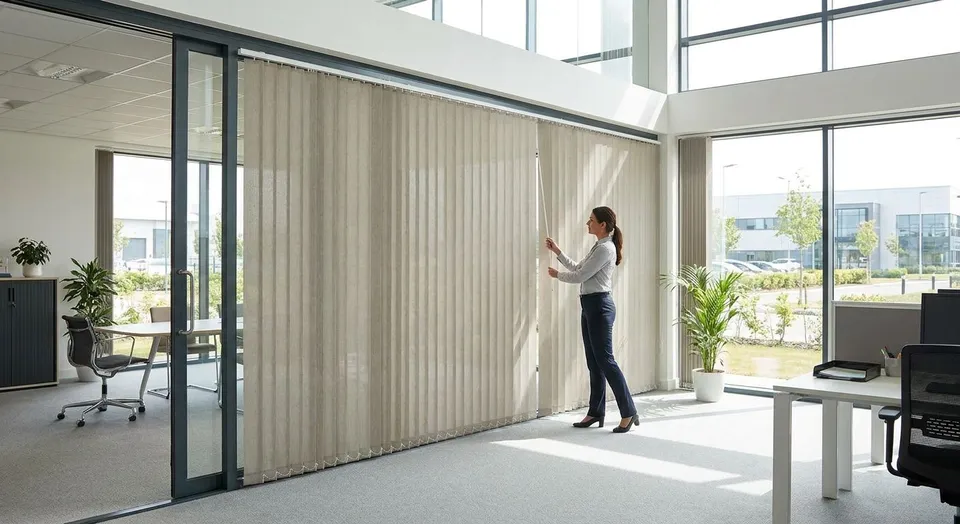
Traditional vertical (vane) blinds are not part of the Rainier Blinds catalog, and for a good reason: on a commercial sliding door, vanes rattle in the track, snap off at the clips, and fade unevenly within a year or two of daily use. The fix that actually holds up in 2026 is a vertical cellular shade or a motorized roller/outdoor shade sized to the door track, paired with a mount deep enough to clear the door handle and stack hardware.
- Vertical cellular shades for sliding glass doors replace vane-style vertical blinds on commercial doors 6 to 12 feet wide.
- Confirm the selected system’s exposure limits
- Motorized roller shades fit high-traffic commercial entries that need scheduled open/close cycles.
- Mount depth and door handle clearance matter more than fabric choice on most commercial installs.
- Rainier Blinds measures and installs in the Greater Seattle area; it does not build or manufacture the shades.
Why this matters
Commercial sliding doors get more daily cycling than a residential patio door, and a vertical blind's vanes were never built for that kind of traffic. Property managers and office leads who search for vertical blinds for commercial sliding doors are usually chasing a specific outcome: glare control on a wide glass opening, without a treatment that jams or looks worn out by year two. Vertical cellular shades for sliding glass doors solve that same problem with a honeycomb structure that stacks cleanly to one side and does not have vanes to snap.
What covers a commercial sliding door best in 2026
Four treatments handle commercial sliding doors well, and each fits a different door condition. The table below compares them on the two things that actually determine fit: exposure and traffic.
| Option | Best for | Operation tiers | Watch out for |
|---|---|---|---|
| Vertical cellular shades | Wide interior sliding doors needing glare and privacy control | Manual, motorized, smart | Track alignment gets harder past 8 feet wide |
| Outdoor zipper track shades | Exterior sliding doors exposed to wind and direct sun | Manual, motorized | Not built for interior-only spaces |
| Motorized roller shades | High-traffic doors needing scheduled open and close cycles | Motorized, smart | Needs power access near the header |
| Drapery on a rod or track | Lobby-style sliding doors used as a design focal point | Manual, motorized | Stack back needs clearance on both sides of the door |
Vertical cellular shades: best for glare control on wide doors
A vertical cellular shade stacks vertically along the side of a sliding door track the same way a vertical blind did, but the honeycomb cell blocks glare more evenly than a single vane ever could. Most commercial sliding doors run 6 to 12 feet wide, and cellular fabric holds its shape across that whole span without sagging in the middle. Verdict: buy for interior commercial sliding doors where light control matters more than weather exposure.
Outdoor zipper track shades: best for exterior sliding door exposure
An exterior-rated shade can help with sun and glare. Select the exact system for the opening, mounting structure, and exposure. Follow its documented wind limits and retraction instructions; neither cable guides nor zipper tracks guarantee protection from wind, rain, or storms.
Motorized roller shades: best for high-traffic commercial doors
An entry that opens and closes dozens of times a day, like a retail storefront or a break room slider, benefits more from scheduled motorized operation than from a manual pull cord that gets worn out fast. A motorized roller shade can be set to open at business hours and close at close, which a vertical blind's manual wand never handled well anyway. Verdict: buy when the door sees heavy daily traffic and you want it to run on a schedule.
Drapery track systems: best for lobby-style sliding doors
A lobby or conference room sliding door sometimes needs to look intentional rather than purely functional, and a rod or track drapery panel does that better than a stack of narrow vanes ever did. The tradeoff is stack back space; panels need clear wall on both sides of the door to open fully. Verdict: hold for lobbies with wall space to spare, skip for tight commercial corridors.
Why the right shade type varies for a commercial sliding door
The treatment that fits one sliding door often fails on the next one a floor away, and the difference usually comes down to a short list of factors:
- Door width and track type. Doors over 10 feet often need a two-panel cellular shade rather than one continuous run.
- Interior vs exterior exposure. Anything facing weather needs a zipper track or outdoor-rated fabric, not an indoor cellular shade.
- Motorization and power access. Motorized and smart tiers need a power source near the header; retrofits without one usually default to manual.
- Traffic pattern. Doors opened dozens of times a day wear out manual cord mechanisms faster than motorized lifts.
- Mount depth and handle clearance. The shade has to clear the door handle and any stack hardware without binding.
- Glare and privacy needs. A south or west-facing commercial door usually needs denser fabric than a shaded north-facing one.
Get a measurement for your sliding door
A in-home consultation confirms width, mount depth, and motorization options.
Offices and multifamily buildings with a mix of sliding doors and French doors run into a related problem: the mounting logic changes once the door swings instead of slides. Panel stack-back has to clear the door's swing arc rather than a fixed track, so the panel has to sit clear of the hinge side entirely. Getting that measurement wrong on a French door wastes a full custom order, so it is worth confirming door swing direction before ordering anything.
Most commercial spaces mix door types across a single building, sliding on the patio side, French on an interior conference room, so treating each opening on its own terms rather than picking one product for the whole floor plan saves a reorder later.
Related questions about commercial sliding door coverings
Are vertical blinds still used for commercial sliding doors?
Vertical blinds still show up in older commercial buildings, but most replacements in 2026 move to vertical cellular shades or motorized roller shades because vanes crack and the pull mechanism wears out faster under daily commercial traffic. The honeycomb structure in a cellular shade holds its shape across a wide door in a way loose vanes never did.
Can commercial sliding doors use motorized shades?
Yes, motorized shades work on commercial sliding doors as long as there is power access near the header or a battery-powered motor is used instead. Motorized shades for sliding glass doors are common on high-traffic entries because they can run on a set schedule instead of relying on staff to open and close them manually.
What's the difference between vertical cellular shades and traditional vertical blinds?
Vertical cellular shades use a honeycomb fabric structure that stacks to one side of the door, while traditional vertical blinds use individual rigid vanes on a track. The cellular version holds up better on wide commercial doors because there are no vanes to crack, warp, or fall out of alignment over time.
Do outdoor sliding doors need a different shade than interior ones?
An exterior-rated shade can help with sun and glare. Select the exact system for the opening, mounting structure, and exposure. Follow its documented wind limits and retraction instructions; neither cable guides nor zipper tracks guarantee protection from wind, rain, or storms.
FAQ
What's the best window covering for a commercial sliding door in 2026?
A vertical cellular shade or motorized roller shade is the best fit for most commercial sliding doors in 2026, replacing older vertical blinds that crack and misalign under daily traffic. Exterior-facing doors need a zipper track or outdoor-rated shade instead.
Is a vertical cellular shade better than a traditional vertical blind?
Yes, a vertical cellular shade holds up better than a traditional vertical blind on wide commercial doors because the honeycomb fabric stacks cleanly with no vanes to snap or warp. It also blocks glare more evenly across the full width of the door.
Can a commercial sliding door use a motorized shade?
A motorized shade works on a commercial sliding door as long as power access exists near the header or a battery-powered motor is used. High-traffic entries benefit most from scheduled open and close cycles.
How wide can a shade go on a commercial sliding door?
Most commercial sliding doors span 6 to 12 feet, and a single cellular shade panel handles that range without sagging. Doors wider than that typically need a two-panel configuration to keep the fabric aligned.
Do outdoor sliding doors need a different shade than interior ones?
An exterior-rated shade can help with sun and glare. Select the exact system for the opening, mounting structure, and exposure. Follow its documented wind limits and retraction instructions; neither cable guides nor zipper tracks guarantee protection from wind, rain, or storms.
What mount type works best for a commercial sliding door?
An outside mount usually works best for a commercial sliding door because it clears the door handle and track hardware without binding. Inside mounts require deeper frame depth than most commercial door frames provide.
Does Rainier Blinds install vertical blinds for commercial sliding doors?
No, Rainier Blinds does not install traditional vertical blinds; it measures and installs vertical cellular shades, motorized roller shades, and outdoor zipper track shades for commercial sliding doors instead.
One last thing
The detail most property managers miss on a commercial sliding door is not the fabric, it is the handle clearance. A shade mounted too shallow catches on the door handle every single time the door opens, and that one measurement error is the single most common callback on commercial installs in 2026. Confirm mount depth against the handle and stack hardware before ordering anything, not after.
Related guides
In-home consultations are free within 60 driving miles of Auburn. Farther projects are considered individually; any consultation fee is quoted before booking and credited toward your order.