
Our available controls: Rainier Blinds offers Roman and woven wood shades with motorized operation only. Available controls and power options for other products are confirmed at your consultation.
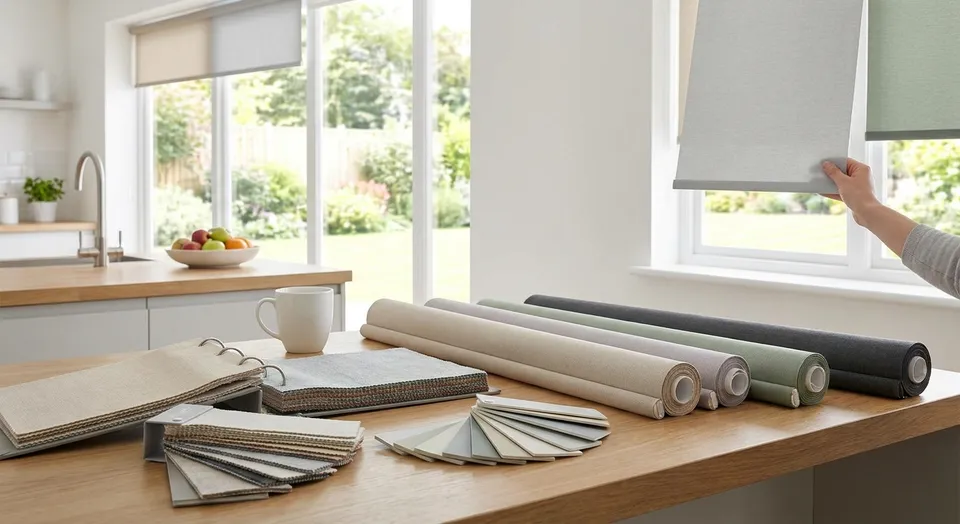
Picking blind colors for a kitchen remodel comes down to matching your cabinet finish, counter material, and light direction, not just grabbing a swatch that looks nice in the store. This guide walks through the exact steps for how to choose blind colors kitchen projects need, plus the mistakes that show up two months after installation.
- Match blind color to your cabinet undertone first, not your wall paint. Walls change color trends faster than cabinets.
- White and off-white shades are useful options to compare with a kitchen’s cabinet, wall, and hardware finishes. Check physical samples in the actual light before choosing.
- Rainier Blinds recommends testing a fabric swatch against your counter under both daylight and under-cabinet LED light before deciding.
- Zebra shades in a warm gray split the difference between white and wood tones, a safe pick for open-concept kitchens.
- Skip pure black blinds near sinks and stoves unless your kitchen gets heavy natural light; they show water spots and grease film fast.
Why this matters
A kitchen remodel touches more finishes at once than any other room, cabinets, counters, backsplash, hardware, and flooring all compete for attention. Blind color is the one decision homeowners make last and regret first, because it's the largest fabric surface in the room after the wall paint.
Get the undertone wrong and a $4,000 cabinet job looks mismatched against $300 worth of shades. Get it right and the blinds disappear into the design, which is the actual goal for most kitchens in 2026, nobody wants window treatments competing with a waterfall-edge island.
What you'll need
- Paint chips or cabinet door samples pulled from your remodel plan
- A counter sample (quartz, granite, or butcher block swatch)
- Fabric swatches from at least 3 blind or shade colors, Rainier Blinds brings swatches to in-home consultations across the Greater Seattle Area
- A phone flashlight to simulate under-cabinet lighting
- 20-30 minutes of daylight viewing time (morning and afternoon, since kitchens often face two different exposures)
- Painter's tape to hold swatches against the window frame for a full day
The steps
1. Pull your undertone before you touch a swatch book
Cabinets and counters read as either warm (cream, taupe, honey wood) or cool (gray, white, black). Stand in the kitchen at midday and decide which category dominates, most remodels lean one way even with mixed materials.
Choosing a warm, cool, or neutral direction can narrow the sample choices. Compare the remaining fabrics beside the installed finishes in both daylight and evening lighting.
Common mistake: matching to the wall paint instead of the cabinets. Walls get repainted; cabinets don't, so anchor to the fixed finish.
2. Test swatches against the counter, not just the cabinet
Hold each fabric sample directly against your counter material for 30 seconds under natural light. Quartz with gray veining pulls blue undertones out of anything off-white; butcher block pulls warm out of anything cream.
A color that looks neutral against a cabinet door can shift noticeably against stone. Compare at least two competing shades side by side rather than judging one swatch in isolation.
3. Check the fabric under both daylight and LED light
Under-cabinet LED strips run cooler (4000K-5000K) than most living room lamps, and they hit the window sill directly in a lot of kitchen layouts. A warm white shade that looks perfect at 2pm can read slightly yellow under LED task lighting at 7am.
Use your phone flashlight on the swatch for ten seconds to approximate this. Expected outcome: the fabric should hold its undertone within one shade step across both light sources. If it swings from cream to gray, keep looking.
4. Match the shade opacity to your window's sun exposure
For sunny kitchen windows, compare fabric samples and documented exposure and care requirements. Fabric color or a light-filtering label alone does not establish fade resistance or service life.
Check the roller vs. cellular shade comparison for South King County homes if you're weighing insulation against light control for a south-facing kitchen.
5. Coordinate hardware finish with the blind's headrail
Brushed nickel and matte black cabinet pulls each pair differently with a headrail color. A black headrail against white cabinets with nickel hardware creates a visual line that splits the window from the wall, usually not the effect homeowners want in an open kitchen.
Fix: choose a headrail that matches the wall color or ceiling trim so the mechanism disappears and the fabric does the talking.
6. Commit to one accent color, not two
If your kitchen already carries an accent (a colored island, a patterned backsplash, black hardware), let the blinds stay neutral. Two competing accent colors in one sightline reads busy, not designed.
Common mistake: choosing a bold blind color to "tie in" the backsplash. In practice this usually just adds a third competing pattern to a room that already has two.
7. Judge a sample large enough to be accurate, not a 2-inch chip
A 2x2 inch swatch chip can't show you how a fabric drapes or how light passes through it at full width. Ask to see a larger cutting, or view an installed sample in a showroom, before committing to a full set across every kitchen window.
Get color-matched shades for your remodel
Rainier Blinds measures and installs custom shades across the Greater Seattle Area.
Troubleshooting
- The white shade looks yellow next to bright white cabinets. True whites and off-whites aren't interchangeable. Choose a swatch labeled "bright white" instead of "warm white" or "linen."
- The fabric matched in the store but looks off at home. Store lighting is almost always warmer than kitchen LED task lighting. Always test at home before finalizing.
- Gray shades read blue against a beige counter. Cool grays clash with warm stone. Move to a greige (gray-beige blend) fabric instead.
- Blackout fabric looks too heavy for a small kitchen window. Switch to light filtering or a cellular shade with a lighter weave, full blackout rarely suits kitchen proportions.
- The color looked right on the sample but the room feels flat. Add texture instead of changing color, a woven wood or textured roller fabric in the same tone breaks up flatness without introducing a new hue.
- Two kitchen windows face different directions and the same color looks different on each. This is normal. Use the same fabric for both; the perceived difference comes from light angle, not the product.
Tools and resources
- Cabinet and counter samples from your remodel contractor or showroom
- A fabric swatch kit from a local installer rather than an online-only retailer, since regional light conditions in the Pacific Northwest affect color perception
- The custom window treatments guide for Auburn, WA homes for material options specific to this region's light and humidity
- A phone flashlight app for quick LED-light testing
- Painter's tape for holding fabric against the frame during a full-day light test
What to do next
Once you've narrowed color to one or two finalists, book a measure. Getting exact window dimensions before your shades are custom-made avoids the two most expensive kitchen remodel mistakes: shades that are a shade off in color and shades that are a half-inch off in fit. Rainier Blinds handles both the color consult and the measurement in the same visit for homeowners across Auburn, Kent, Renton, and the rest of the Greater Seattle Area.
FAQ
What's the best blind color for a kitchen in 2026?
Bright white and warm off-white roller shades remain the safest choice for most 2026 kitchen remodels because they don't clash with cabinet hardware or counter veining. Gray zebra shades are the second most common pick for kitchens mixing white and wood-tone cabinets.
Should blind color match the cabinets or the walls?
Match the cabinets first, since they're the fixed, expensive finish that won't get repainted. Wall color changes far more often than cabinetry, so anchoring to paint creates a mismatch risk down the road.
Is white or off-white better for a kitchen window?
Off-white handles LED under-cabinet lighting better because it holds its undertone across warm and cool light sources. Pure white can look slightly blue or gray under 4000K-5000K LED strips.
How much does custom shade installation cost for a kitchen remodel?
Cost varies by window size, fabric, and whether the shade is manual or motorized, so get a measured quote rather than relying on a national average. Rainier Blinds provides on-the-spot pricing after an in-home measure across the Seattle area.
Do dark blinds work in a small kitchen?
Dark colors work only when the kitchen gets strong natural light for most of the day; otherwise they make a small kitchen window feel smaller. Light filtering fabrics in a mid-tone gray are a safer middle ground.
How many shade color samples should I test before deciding?
Test at least three fabric swatches against both your counter and cabinet under two different light sources. Deciding after a single swatch comparison is the most common cause of color regret in kitchen remodels.
Can I use the same shade color for every kitchen window?
Yes, and it's recommended even when windows face different directions, since matching fabric keeps the room visually consistent despite light variation. Using different colors per window usually looks unintentional rather than designed.
What's the difference between roller shades and cellular shades for kitchen color matching?
Roller shades show fabric color as a flat, even surface, while cellular shades break the color up with a honeycomb texture that can read slightly lighter. Check a cellular sample against your counter before assuming it matches a roller shade in the same listed color.
One last thing
The fabric swatch that looks perfect held against a cabinet door in a showroom is not the same test as a full shade hanging in your actual kitchen window for a week. Take the sample, tape it to the frame, and live with it through one full day-night cycle before you commit to a whole-house set. It's the cheapest insurance in the entire remodel.