

Commercial window treatment budgets swing widely because they are built from a handful of variables you actually control: how many windows you are covering, which operation tier you pick, and how complicated the install site is. This guide breaks those variables apart so you know what moves the number before you ever request a quote in 2026.
- Budget for commercial window treatments hinges on window count, operation tier, and mounting complexity, not square footage alone.
- Manual shades run the lowest upfront cost; motorized and smart tiers add wiring, hubs, and labor time to the total.
- Rainier Blinds measures every commercial site in person because a remote quote misses trim depth, obstructions, and code requirements.
- Rush installs and after-hours labor push a commercial budget higher than a standard daytime schedule.
- A maintenance contract changes the long-term budget more than the original install invoice does.
Why this matters
A residential budget and a commercial budget for window treatments are not the same math problem. A single-family home has a handful of window shapes and one decision-maker. A commercial site has repeat window sizes across floors, ADA and egress rules to respect, and often a property manager or GC coordinating the schedule around tenants or staff.
That is a different set of line items than the ones covered in the guide to budgeting for a residential window treatment project, and treating them the same way is how commercial budgets end up short. The variables below are the ones that actually move a commercial number up or down.
How do you budget for commercial window treatments in 2026?
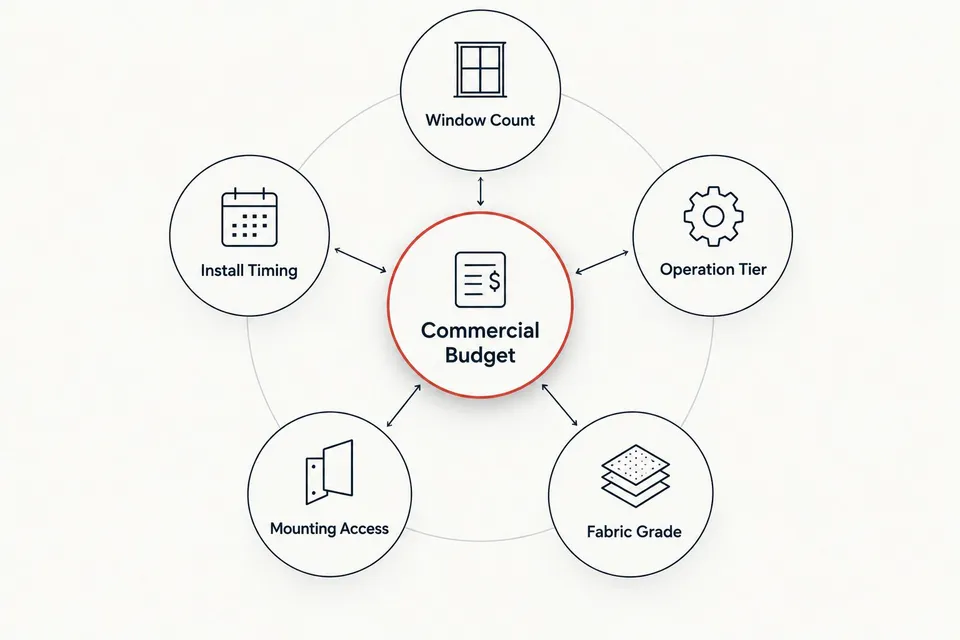
Start with three questions before you talk to anyone about a number: how many windows, what operation tier, and how hard is the mounting. Everything else is a modifier on those three answers.
| Cost driver | Relative budget impact | Why it moves the number |
|---|---|---|
| Window count and sizing | Scales directly | More units and larger openings mean more fabric and more labor hours |
| Operation tier (manual/motorized/smart) | Low to high | Motors, hubs, and wiring stack cost on top of the shade itself |
| Fabric and opacity grade | Low to moderate | Commercial-grade, high-traffic fabrics cost more than standard residential fabric |
| Mounting type and access | Moderate | Recessed pockets, high ceilings, and ADA-compliant hardware add labor time |
| Power and wiring access | Moderate to high | Concealed wiring for motorized shades adds an electrician or extra install hours |
| Installation timeline | Variable | Rush jobs and after-hours work outside normal business hours cost more than a standard schedule |
Each of these is independent. A small office with forty standard-height windows on a manual tier can land in a completely different place than a ten-window lobby running smart shades tied into a building automation system.
Manual, motorized, and smart shades: budget tiers compared
Commercial shades come in three operation tiers, and each one changes the labor and hardware side of the budget, not just the shade itself.
| Tier | Relative budget impact | Best for |
|---|---|---|
| Manual | Baseline | High window counts where staff can operate shades by hand |
| Motorized | Mid to high | Offices needing scheduled light control without staff involvement |
| Smart | Highest | Spaces integrating shades with an existing building automation system |
Manual shades: the baseline tier
Manual shades keep the budget lowest because there is no motor, no hub, and no wiring to plan around. The tradeoff is operational: someone on-site has to raise and lower every unit, which matters more in a forty-window office floor than a ten-window reception area.
Best for: multi-window commercial spaces where budget matters more than automation. Manual is the right call when staff or a facilities team is already on-site daily and willing to operate shades by hand.
Motorized shades: the mid-tier upgrade
Motorized shades add a motor, a power source (wired or battery), and often a remote or wall switch. That raises the labor side of the budget because an installer needs to run power or plan battery access, and it can add an electrician's visit if the building lacks accessible outlets near the window.
The payoff is consistency: every shade on a floor opens and closes on the same schedule without anyone touching it. Best for: offices, storefronts, and lobbies that need scheduled light control on a predictable routine.
Smart shades: the top-tier system
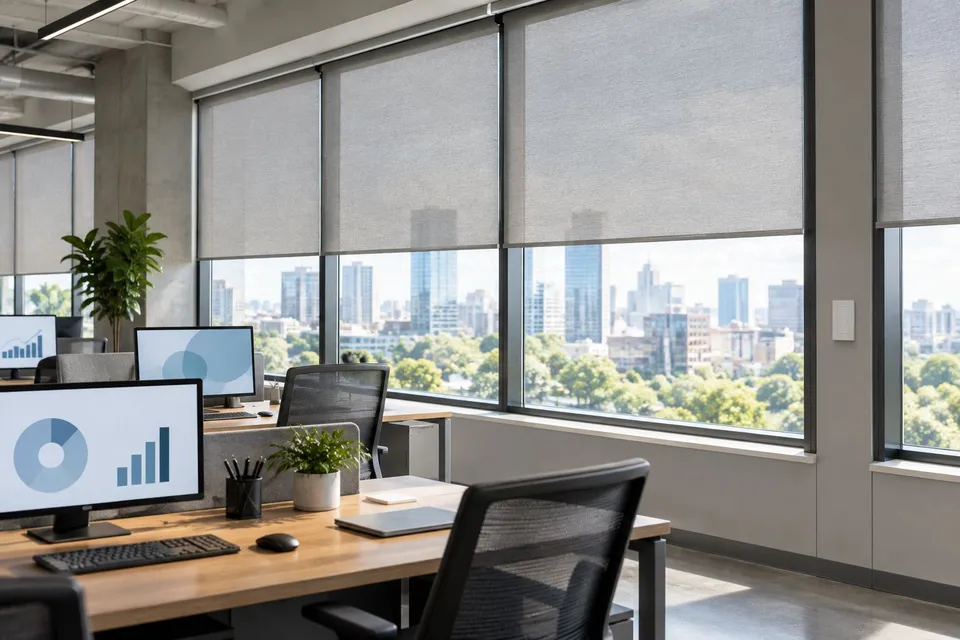
Smart shades connect to a hub, app, or existing building automation system, which is the most expensive tier to budget for because it adds integration time on top of the motorized hardware. This tier makes sense when a building already runs on a smart system and shades are one more device joining it, not the reason the system exists.
Best for: new construction or major renovations already installing a building automation system. Retrofitting smart shades into a building with no existing automation is rarely the most efficient use of a commercial budget in 2026.
Why commercial window treatment budgets vary
Four to six factors decide where a specific site lands inside these tiers:
- Number of floors and units. A single-tenant office and a multi-floor property with dozens of units are different budgeting exercises even at the same tier.
- Existing wiring and power access. Buildings without outlets near windows add electrical work to any motorized or smart install.
- Code and ADA requirements. Egress windows, cord safety in childcare or medical settings, and ADA-compliant controls all add hardware and labor.
- Fabric and light-control needs. A conference room needing full blackout for video calls costs differently than a lobby needing light filtering only.
- Installation timing. Coordinating around tenants, patients, or staff schedules, or requesting after-hours work, adds time to the labor side of the budget.
- Property type. A medical office, a daycare, or a retail storefront each carry different fabric, safety, and mounting requirements that shape the total.
Common budget questions from property managers and business owners
Do property managers get a different budget structure than single-tenant businesses?
Property managers usually budget across repeat window sizes and multiple units, which lowers the per-window cost of measuring and fabric sourcing compared to a one-off single-tenant job. A single business ordering shades for one office floor pays for a smaller, more custom scope with less standardization to lean on.
How far in advance should a business budget for an install?
Budget for a commercial install well before a lease start date or renovation deadline, since fabric sourcing and scheduling around tenants both take time. Rush requests near a deadline are the fastest way to add cost through after-hours labor.
Does mounting type change the budget as much as the shade itself?
Mounting type can add as much to a commercial budget as the shade selection itself when the site has recessed pockets, unusually high ceilings, or ADA-compliant control requirements. A straightforward surface mount on a standard window is the cheapest scenario in the mounting category.
Get a real budget number for your site
Rainier Blinds measures commercial sites in person before quoting anything.
FAQ
What is the average budget for commercial window treatments in 2026?
There is no single average budget because commercial costs scale with window count, operation tier, and site complexity. A five-window reception area and a forty-window office floor land in completely different budget ranges even on the same fabric and tier.
Is motorized cheaper than manual over time for a commercial space?
Motorized shades cost more upfront than manual because of the motor, power source, and added labor, and that gap does not close on its own. The value shows up in consistency across a floor, not in a lower total budget.
Do commercial installs cost more than residential installs?
Commercial installs typically carry a higher total than residential jobs because of window count, code requirements, and scheduling around tenants or staff. The per-window cost can actually drop on large multi-unit jobs due to standardized sizing.
Should smart shades be part of a new construction commercial budget?
Smart shades make the most sense in a new construction budget when the building is already installing a broader automation system. Adding smart shades to a building with no existing automation is the most expensive way to get motorized function alone.
What increases a commercial window treatment budget the most?
Wiring and power access for motorized or smart tiers increases a commercial budget the most, followed closely by rush installation timelines. Fabric grade matters less to the total than most business owners expect.
Do maintenance contracts affect the long-term budget?
Maintenance contracts change the long-term budget more than the original install invoice, since motorized components and high-traffic fabric both need periodic servicing. Skipping a contract does not remove the cost, it just delays it.
Can a business get a commercial quote without an on-site visit?
Rainier Blinds does not quote commercial jobs without an in-person site visit, since trim depth, obstructions, and code requirements cannot be measured remotely. Every commercial quote in 2026 starts with a measurement on-site.
One last thing
The line item most commercial budgets miss entirely is the one after the install: a commercial blind cleaning and maintenance contract. Motorized components and high-traffic fabric both need servicing on a schedule, and a budget that only accounts for the initial install invoice gets surprised by that cost a year or two later. Build it in from the start instead of treating it as a surprise line item in 2027.