
Our available controls: Rainier Blinds offers Roman and woven wood shades with motorized operation only. Available controls and power options for other products are confirmed at your consultation.
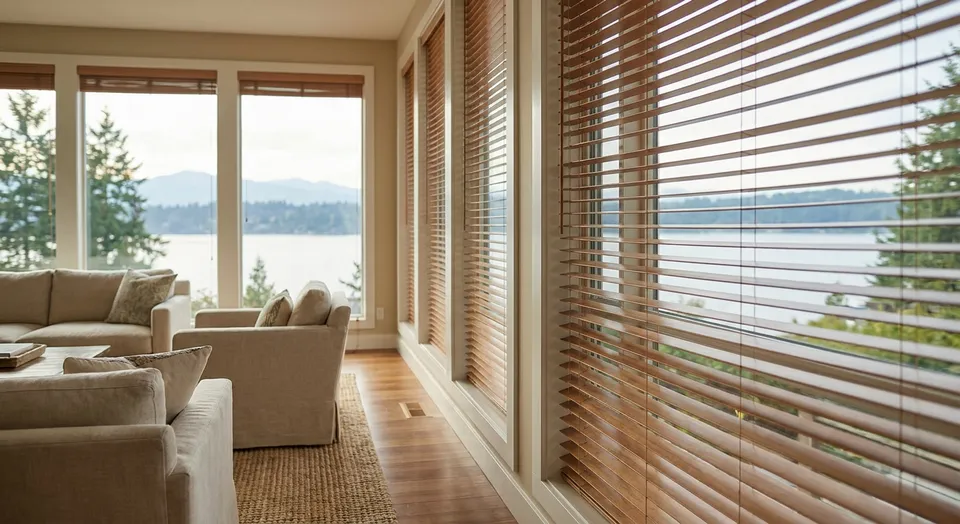
Kirkland lakefront homes on Lake Washington share one problem builders rarely solve well: floor-to-ceiling glass walls that pull glare off the water by mid-afternoon, plus close enough boat traffic and neighboring docks that privacy at slat height matters as much as the view.
- Motorized solar roller shades win for custom blinds Kirkland lakefront homes need on west-facing great rooms in 2026 - buy.
- Skip real wood blinds on lakefront properties - humidity off the water warps slats within two seasons.
- Cellular shades add insulation value for north-facing bedrooms but cost more per window than roller shades.
- Motorization matters more here than typical Eastside homes because lakefront window walls often run 8 feet or taller.
Why this matters
A standard Auburn or Renton living room window runs 4 to 5 feet tall. A Kirkland lakefront great room window wall runs 8 feet or taller, sometimes floor-to-ceiling across three panels. That height changes what actually works: a pull cord on an 8-foot shade is a hazard and a hassle, and a fabric with the wrong UV rating fades a sofa within a year of daily lake glare.
Rainier Blinds measures and installs custom motorized and manual shades across the Greater Seattle Area, and lakefront properties in Kirkland come with a specific set of constraints that inland homes in Auburn or Federal Way don't face: humidity off the water, glare bouncing up off the surface at low sun angles, and windows tall enough that a standard-drop shade won't cover them without being custom-made to your exact measurements.
Who this is for
This guide is for homeowners on Lake Washington in Kirkland, Yarrow Point, or Hunts Point with oversized window walls facing the water, who need shades that block UV and glare without losing the reason they bought the house. It's also for anyone replacing blinds that warped or faded within a year or two of installation because the original product wasn't rated for lakefront exposure.
What to look for in custom blinds for Kirkland lakefront homes
UV and glare control off the water
Lake-facing windows can receive reflected glare. Compare solar-fabric samples at the time of strongest light and check the selected fabric's tested UV data; openness alone does not guarantee UV protection or a clear view. Motorization can help with tall or obstructed glass.
Privacy without losing the view
Dock traffic, boat wakes, and close-set lakefront lots mean full blackout defeats the point of buying the house. Dual-layer or zebra shades let you dim a room at night while keeping the water visible during the day, which a single-layer blackout roller can't do.
Moisture and humidity resistance
Lake-adjacent air runs more humid than inland Auburn or Kent, and that humidity is what warps wood blinds and swells MDF headrails over a season or two. Coated-polyester and PVC-based solar fabrics hold shape where real wood won't.
Motorization for oversized window walls
An 8-foot or 10-foot drop is too tall for a wand or cord to operate comfortably twice a day. Motorized shades with app or remote control solve the reach problem and let multiple window walls tie into one scene, which matters when a great room has three or four separate panels.
Fade-resistant fabric grade
Direct lake glare degrades untreated fabric faster than a north- or east-facing inland window. A fabric rated for UV exposure holds its color for years where a standard fabric visibly fades within a single summer.
Matching the architecture
Kirkland lakefront homes run from modern glass-and-steel builds to older traditional Craftsman-style waterfront properties, and the shade style needs to match. A slim-profile roller reads modern; a roman shade or drapery panel suits a more traditional facade.
Top picks for lakefront window walls
Lake-facing windows can receive reflected glare. Compare solar-fabric samples at the time of strongest light and check the selected fabric's tested UV data; openness alone does not guarantee UV protection or a clear view. Motorization can help with tall or obstructed glass.
Cellular honeycomb shades, the insulator. A 3/4-inch double-cell honeycomb traps air against the glass, which pulls double duty on a lakefront property where humidity swings are wider than inland Auburn or Kent. They cost more per window than a basic roller and don't suit the widest window walls as cleanly, but they're the right call for north-facing bedrooms that lose heat overnight. Compare the tradeoffs in the roller shades vs. cellular shades comparison. Verdict: Buy for bedrooms, Consider for great rooms.
Zebra dual shades. The light-control specialist. Alternating sheer and opaque bands let you dial in exactly how much dock traffic you want visible without going full blackout. They work well on side-facing windows that see boat wakes and neighboring decks but look busy on a true 8-foot window wall. Verdict: Consider.
Outdoor patio shades. The wildcard. Marine-grade fabric on a covered lakeside patio holds up to humidity and spray in a way an indoor-rated fabric won't, and it extends usable outdoor time into shoulder-season months. Not every lakefront property has the patio structure to support them. Verdict: Consider if you have a covered outdoor space.
“When a west-facing lakefront wall runs eight feet tall, a wand control turns into a two-hand chore every evening.”
Get lakefront windows measured right
In-house measure and install for Kirkland waterfront homes, not a subcontractor.
What to avoid
- Real wood blinds near the water. They look right in a showroom and warp within one or two humid seasons on a lakefront property. A coated-polyester roller or solar shade holds up where real wood doesn't.
- Big-box mini blinds on oversized windows. Standard ready-made widths don't cover an 8-foot or 10-foot lakefront window wall without visible gaps, and off-the-shelf mini blinds rarely offer a motorized option at all.
- Untreated sheer fabric on west-facing glass. It looks elegant on day one and visibly fades within a single summer of direct lake glare. Anything without a UV-rated fabric grade is the wrong call on a water-facing window in 2026.
Verdict comparison
| Shade type | Privacy | Motorization | Verdict |
|---|---|---|---|
| Motorized solar roller | Moderate | Standard | Buy |
| Cellular honeycomb | High | Available | Buy for bedrooms |
| Zebra dual shade | Adjustable | Available | Consider |
| Outdoor patio shade | Low | Available | Consider |
| Real wood blinds | High | Rare | Skip |
FAQ
What's the best window treatment for Kirkland lakefront homes facing the water?
Lake-facing windows can receive reflected glare. Compare solar-fabric samples at the time of strongest light and check the selected fabric's tested UV data; openness alone does not guarantee UV protection or a clear view. Motorization can help with tall or obstructed glass.
Do motorized shades work on oversized lakefront window walls?
Yes, motorized shades are built for window walls 8 feet or taller where a manual wand becomes impractical. Multiple panels across one great room can operate on a single remote or app scene.
Is cellular shade better than roller shade for humidity near a lake?
Cellular shades add more insulation value than roller shades because the honeycomb cell traps air against the glass, which helps in bedrooms with wider overnight temperature swings. Roller shades still handle humidity fine and cost less per window for large great room installs.
How much UV do solar shades block on lake-facing windows?
Lake-facing windows can receive reflected glare. Compare solar-fabric samples at the time of strongest light and check the selected fabric's tested UV data; openness alone does not guarantee UV protection or a clear view. Motorization can help with tall or obstructed glass.
Will wood blinds warp in a lakefront home?
Real wood blinds commonly warp within one to two seasons in humid lakefront air, which is why coated-polyester and PVC-based solar fabrics are the better call on Lake Washington properties. Inland homes in Auburn or Federal Way don't see the same humidity exposure.
Can you keep the lake view and still get privacy at night?
Yes, dual-layer or zebra shades let you dim a room for privacy while daylight hours stay fully open to the water. A single-layer blackout roller removes the view entirely, which defeats the purpose on a lakefront property.
Do zebra shades work well on lakefront homes with boat traffic?
Zebra shades work well on side-facing windows that see dock and boat traffic because the alternating bands let you dial privacy up or down without going fully opaque. They look busier than a plain roller on a true floor-to-ceiling window wall.
What fabric fades fastest in direct lake glare?
Untreated sheer fabric fades fastest under direct west-facing lake glare, often within a single summer. UV-rated solar fabric or a fade-resistant polyester blend holds color for years under the same exposure.
One last thing
The detail most homeowners miss on a Kirkland lakefront property isn't the shade fabric. It's the mounting depth. An 8-foot window wall with a recessed pocket needs a different headrail than a surface-mount install, and getting that wrong in 2026 means a shade that either won't retract fully or leaves a gap that lets glare back in at the top.