
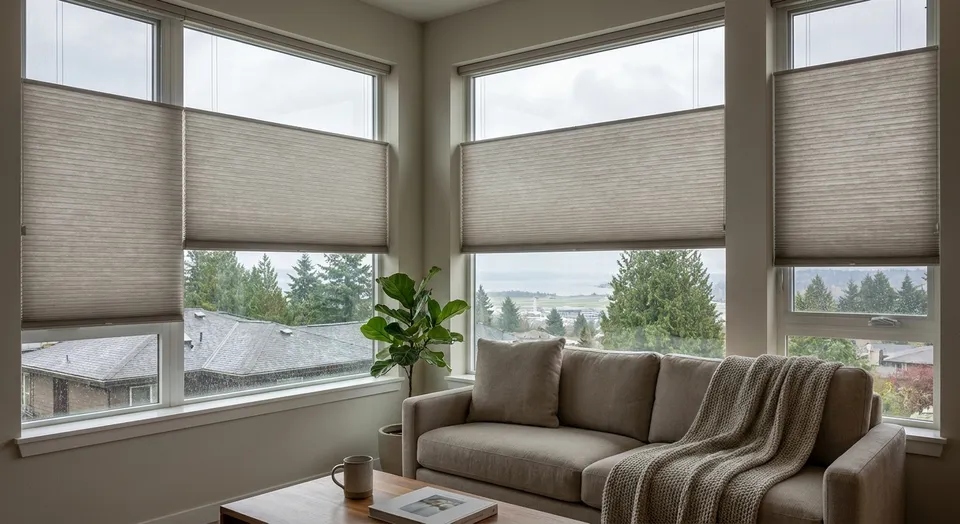
Cellular shades solve two problems SeaTac condo owners deal with every day: light that never really goes away near the airport, and windows that sit close enough to the next building that privacy is not optional. This guide breaks down what to buy for a SeaTac condo in 2026, what to skip, and which configuration fits your unit.
- Compare light-filtering cellular shades for daytime privacy and insulating fabric construction. Confirm controls, mounting, and your building's rules before ordering.
- Blackout cellular shades win for shift workers and anyone under a SeaTac Airport flight path dealing with red-eye glare.
- Top-down/bottom-up cellular shades are the pick for ground-floor or low-rise units facing a parking lot or neighboring balcony.
- Skip vinyl mini blinds and bargain fabric roller shades. Neither insulates a single-pane condo window the way cellular shades do.
Why this matters
A SeaTac condo may need both after-dark privacy and light control for a changing work schedule. Cellular fabric adds insulating air pockets, but it should not be promised to reduce aircraft noise. Compare the actual windows and ask the building about any proposed mounting or exterior-facing changes.
Who this is for
This guide is for SeaTac condo owners and renters picking window coverings for units built before double-pane became standard, especially anyone dealing with airport-adjacent glare, shift-work sleep schedules, or windows that face directly into a neighboring unit's balcony. If you're in a single-family home in Federal Way or Kent instead, the buying math changes. Check the Federal Way custom blinds guide for that comparison.
What to look for in cellular shades for SeaTac condos
Cell size and construction
Cellular shades trap insulating air and can help reduce heat transfer at a window. Results depend on the product, fit, glazing, climate, and how the shade is used; a specific energy or bill saving is not guaranteed.
Cordless or motorized lift
Confirm the exact operating control and follow the product safety instructions. CPSC recommends cordless coverings where young children are present. Check your own condominium rules rather than assuming a universal HOA requirement.
Light control that matches your schedule
A red-eye flight schedule or airport shift work calls for blackout cellular shades in the bedroom, full stop. Light-filtering is fine for a living room where you want daylight without a direct sightline to the neighboring tower.
Mount depth for condo window frames
Measure the actual frame depth, hardware, and clearances. Some cellular products may fit a shallow recess; others need an outside mount or a different configuration. Use the selected product's mounting requirements.
HOA and lease restrictions
Ask your condominium association or landlord about exterior-facing color, mounting, and approval requirements before ordering. No fabric color guarantees approval for every building.
Energy performance on older glass
If the window feels cold, compare suitable cellular options and their documented thermal performance. Product construction, fit, glazing, and use affect the result; double-cell construction alone does not guarantee a particular comfort improvement.
Top picks for SeaTac condos
The safe pick: light-filtering double-cell shades
Cellular shades trap insulating air and can help reduce heat transfer at a window. Results depend on the product, fit, glazing, climate, and how the shade is used; a specific energy or bill saving is not guaranteed.
The shift-worker pick: blackout single or double cell
For daytime sleep, compare blackout cellular fabrics and the mounting needed to reduce edge light. Single- and double-cell versions have different dimensions and prices, so use the actual product specifications and measured quote.
The privacy pick: top-down/bottom-up cellular shades
This configuration lowers from the top for privacy while still letting light in from the top of the window, the right call for a ground-floor or low-rise unit facing a parking lot, walkway, or a neighboring balcony at eye level. It costs more than a standard bottom-up shade because of the added hardware, but it solves a privacy problem no amount of cell size or color choice fixes on its own. Verdict: Consider.
The convenience pick: motorized cellular shades
Motorized lift makes sense on any condo window you can't reach without a step stool, or on a unit where you want the shades on a schedule tied to the sun's position over the airport. The motorized shades guide for Kent covers the install and control-app side of this in more detail. Verdict: Consider for hard-to-reach windows, otherwise stick with manual lift to save the upgrade cost.
What to avoid
- Choosing only from a product label. Compare the actual fabric, mounting, controls, and documented thermal data; do not expect ordinary shades to solve aircraft noise.
- Bargain fabric roller shades. They're cheaper up front but roll to a single flat layer with no insulating air pocket; see the roller shades vs. cellular shades comparison for the full trade-off.
- Assuming an older clearance product suits the room without reviewing its controls, safety instructions, and your building's rules. Confirm those details before ordering.
Verdict comparison table
| Option | Light control | Privacy | Best for | Verdict |
|---|---|---|---|---|
| Light-filtering double-cell | Moderate | Good | Most living rooms/bedrooms | Buy |
| Blackout single/double-cell | Full | Good | Shift workers, red-eye sleepers | Buy |
| Top-down/bottom-up cellular | Adjustable | Excellent | Ground-floor/low-rise units | Consider |
| Motorized cellular | Full (scheduled) | Good | Hard-to-reach windows | Consider |
| Vinyl mini blinds | Poor | Fair | Nothing in an airport-adjacent unit | Skip |
Choose the shade for light, privacy, and fit; evaluate aircraft noise as a separate acoustic problem.
FAQ
Do cellular shades actually reduce airport noise in a SeaTac condo?
Window coverings can change reflections in a room, but ordinary shades should not be sold as soundproofing. Do not assume a specific reduction in traffic noise or echo without acoustic test data for the selected product and installation.
What's the best cellular shade for a condo bedroom near Sea-Tac Airport?
A blackout cellular fabric can help with daytime sleep, provided the mounting addresses light at the edges. Compare available cell constructions using the product's specifications and your window dimensions.
Are cordless cellular shades required in SeaTac condo buildings?
Exposed window-covering cords can create a strangulation hazard. CPSC recommends cordless coverings where young children are present. Cordless controls avoid exposed operating pull cords. Follow the product safety instructions and keep beds, furniture, and other climbing objects away from windows.
How much do cellular shades cost for a typical SeaTac condo window?
Pricing depends on the actual dimensions, fabric, controls, and installation scope. We prepare a measured quote for the selected condo windows and products.
Is top-down/bottom-up better than a standard cellular shade for privacy?
Top-down/bottom-up wins for ground-floor or low-rise units where a neighboring balcony or walkway sits at eye level, since it lowers from the top while keeping the bottom covered. A standard bottom-up shade works fine for higher floors with no direct sightlines.
Do cellular shades fit condo windows with shallow mount depth?
Possibly, depending on the selected headrail and bracket requirements. Measure the actual recess and window hardware; an outside mount or another product may be needed when the available depth is limited.
Are motorized cellular shades worth it in a condo?
Motorized lift is worth the added cost on any window you can't easily reach, or if you want the shades to open and close on a schedule tied to sunlight. Manual lift is the better value pick on standard-height windows where reach isn't an issue.
One last thing
The detail most SeaTac condo owners miss until installation day: the difference between inside-mount and outside-mount isn't cosmetic here, it's the difference between a shade that clears your window crank hardware and one that doesn't. A lot of older condo units still have manual window cranks along the frame, and an inside-mount cellular shade measured without accounting for that hardware ends up rubbing every time the window opens.