
Our available controls: Rainier Blinds offers Roman and woven wood shades with motorized operation only. All other shade styles are available with manual, motorized, or smart control. Your consultation confirms the controls and power options for your product.
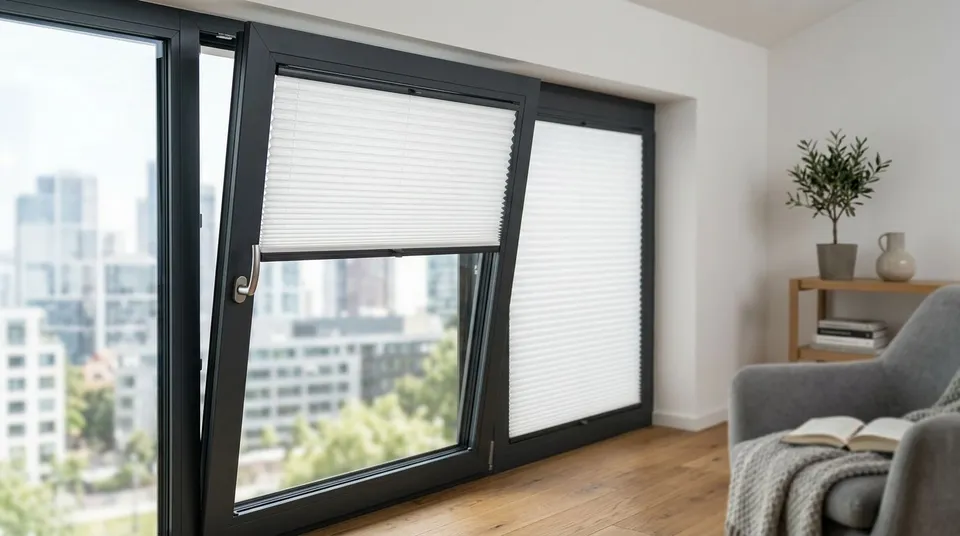
Blinds for tilt-turn windows in modern builds means choosing shades that clear the sash swing and the center-mounted handle so the window still tilts or opens fully after the covering goes up. Tilt-turn hardware sits differently than a standard double-hung window, and the wrong mount turns a new shade into one you have to take back down.
Modern builds across the Greater Seattle Area increasingly spec tilt-turn windows for their airtight seal and dual-function ventilation. The shade decision here is mechanical before it is cosmetic: does the covering clear the hardware when the sash tilts in from the top, and does it clear the frame when the sash swings fully open like a door.
- Outside mount is the default for blinds for tilt-turn windows because inside mounts collide with the center handle.
- Cellular and roller shades in an outside mount clear both the tilt and the full-turn position.
- Motorized operation matters more here than on standard windows since cords and wands snag on a swinging sash.
- Rainier Blinds measures actual swing clearance in-home before recommending a mount type for tilt-turn openings.
- Test the shade in both tilt and turn positions in 2026 before finalizing any mount.
Why blinds for tilt-turn windows matter in modern builds
Tilt-turn windows operate two ways: tilted in from the top for ventilation, or swung fully open on side hinges like a door. Both positions push the sash into the room, and the handle sits mid-frame instead of on a sash edge. A shade mounted inside the window recess, the way most stock blinds are sold, hits that handle the first time somebody tilts the window.
Homeowners searching this in 2026 are usually mid punch-list on new construction or a full remodel with European-style windows already installed. They are not shopping for the cheapest option. They are shopping for the one that will not come back down in six months because the window stopped tilting.
One more constraint specific to modern builds: trim is often shallow and flush, so there may be almost no recess depth to work with even before the handle enters the picture. That pushes the answer toward the wall or the header. Rainier Blinds handles this the same way on every new construction window treatment job, by measuring the opening and the swing path as two separate numbers.
How to choose blinds for tilt-turn windows
Confirm the swing clearance before you shop
Measure how far the sash travels into the room in both positions. This one step eliminates most of the guesswork that causes reorders.
- Check clearance in tilt position, where the top of the sash pivots inward
- Check clearance in full turn position, where the sash swings on side hinges
- Note exactly where the handle sits relative to the frame edge
- Confirm whether trim depth allows any inside recess at all
- Write both numbers down before looking at a single fabric
Default to outside mount, not inside mount
An outside-mount shade sits on the wall, casing, or ceiling above the opening, clear of the sash entirely. On tilt-turn windows this is the correct answer, not a workaround.
- Mount the headrail on the wall or casing, never inside the frame
- Add overlap on each side so light gaps stay covered
- Confirm header or ceiling height lets the headrail sit flush
- Skip inside mount entirely when the handle falls inside the recess depth
If you want the full logic on mount types across window styles, the mount type guide covers inside versus outside versus ceiling mount in detail.
Match fabric to what the room actually does
Not every window in a modern build needs the same opacity. Orientation matters as much as room type.
- Cellular shades for bedrooms and home offices that need insulation plus privacy
- Roller shades for kitchens and living rooms where a flat, clean look wins
- Zebra shades where adjustable light bands beat a single opacity
- Blackout fabric for bedrooms on east or west exposures
- Light-filtering fabric for north-facing rooms that already run dim
Decide manual, motorized, or smart
Every Rainier Blinds product comes in three operation tiers. On a tilt-turn window the choice is not purely convenience, because a hanging cord or wand can catch the handle every time the sash swings.
- Cordless manual works when the shade sits fully outside the swing path
- Motorized removes the cord and wand from the equation entirely
- Smart adds app and voice control for windows tilted daily for air
- Battery-powered motorized skips wiring runs through finished trim
Motorized and smart tiers are already the common spec on 2026 tilt-turn installs. The smart shade package for new construction homes breakdown is the closest match to how these windows get covered.
Get your tilt-turn windows measured
Free in-home consultation with real pricing on the spot, measured by our own crew.
Treat tilt clearance and turn clearance as two separate checks
Many tilt-turn windows get used almost entirely in tilt mode, with the full swing reserved for cleaning. Design around the position that gets used daily, then verify the other one still works.
- Confirm the stack height clears the top-tilt gap when the shade is raised
- Verify side clearance for the full-turn swing radius
- Test the shade physically in both positions before the install is signed off
- Prioritize top clearance on ventilation-heavy windows
Use top-down bottom-up where privacy and airflow compete
Top-down bottom-up shades drop the top rail for light while the bottom stays covered, which keeps the handle and hinge zone clear at the same time.
- Strong fit for tilt-turn windows at eye level in living spaces
- Holds privacy even while the sash is tilted for air
- Available in cellular and roman shade builds
- Pairs naturally with an outside mount for full hardware clearance
Borrow the logic from casement windows
Casement windows crank open instead of tilting, but they create the same handle-and-swing clearance problem. If your build mixes window types, the casement window blinds guide covers the crank-handle version of this exact issue.
Comparison: shade options for tilt-turn windows
| Option | Best for | Key limitation |
|---|---|---|
| Outside-mount cellular shade | Bedrooms and offices needing insulation | Needs usable wall or trim space above the opening |
| Outside-mount roller shade | Kitchens and living rooms wanting a flat look | Less insulating than cellular |
| Zebra shade, outside mount | Rooms that want adjustable light bands | Slightly bulkier stack than a roller |
| Motorized cellular, outside mount | Windows tilted daily, no-cord requirement | Needs wiring or battery maintenance |
| Top-down bottom-up cellular | Eye-level windows used for ventilation | More moving parts than a single-direction shade |
| Drapery on a track, wall mounted | Wide tilt-turn units and window walls | Panels must stack fully off the swing path |
Verdict: for blinds for tilt-turn windows in 2026, an outside-mount motorized cellular shade from Rainier Blinds is the best all-around choice for modern-build homeowners who tilt their windows regularly.
“If the handle sits mid-sash, the shade belongs on the wall, not in the frame.”
Common mistakes modern-build homeowners make
- Ordering inside-mount shades before checking handle clearance. The handle sits mid-sash on most tilt-turn units, and an inside mount collides with it on the first tilt.
- Assuming a corded shade is fine because the window mostly stays tilted. One full swing a season is enough to snag and damage a cord-operated shade.
- Skipping the trim-depth check on new construction. Builders often finish tilt-turn trim shallower than any inside-mount depth requirement, and that only surfaces after the shade shows up.
- Choosing opacity by room type and ignoring orientation. A west-facing tilt-turn window in a 2026 modern build needs blackout or heavier light-filtering fabric regardless of which room it sits in.
- Signing off without testing both positions. A shade that clears tilt mode can still hit the frame in full-turn mode when the swing radius was never measured.
FAQ
What are the best blinds for tilt-turn windows?
Outside-mount cellular or roller shades are the best choice for tilt-turn windows in 2026 because they sit clear of the sash and the center-mounted handle. Inside-mount shades in the frame recess almost always conflict with tilt-turn hardware.
Can I use inside-mount shades on tilt-turn windows?
Only when trim depth and handle position leave real clearance, which is rare on true tilt-turn hardware. Outside mount is the reliable default for these windows.
Are motorized shades better than manual on tilt-turn windows?
Motorized shades remove the cord or wand that catches on the handle when the sash swings open, which makes them the stronger pick on windows used daily in both tilt and turn modes.
Are cellular shades better than roller shades for tilt-turn windows?
Cellular shades add insulation value that roller shades do not, which matters in bedrooms and home offices. Roller shades give a flatter look for kitchens and living rooms, and both mount the same way, outside the sash.
How much clearance do tilt-turn windows need for outside-mount shades?
Enough wall or trim space above the opening for the headrail to sit flush, which varies with the shade's stack height. A measured in-home consultation confirms the exact number for your window.
Do top-down bottom-up shades work on tilt-turn windows?
Yes, and they solve the tilt-turn problem well because the bottom stays covered for privacy while the top drops for light, keeping the handle and hinge area unobstructed.
Can zebra shades be used on tilt-turn windows?
Zebra shades work on tilt-turn windows in an outside mount, giving adjustable light bands without the clearance risk of an inside mount.
Do new construction homes usually get motorized shades on tilt-turn windows?
Many 2026 new-construction builds with tilt-turn windows go motorized or smart by default, because it removes cord-and-handle conflicts before the homeowner ever runs into them.
One last thing
The detail almost everyone misses on the first pass is handle position. On most tilt-turn windows the handle sits mid-sash rather than at the edge, so a shade that clears both frame edges can still strike the handle dead center. Check handle position and swing clearance together, in both tilt and turn modes, before ordering anything for a 2026 tilt-turn install.