
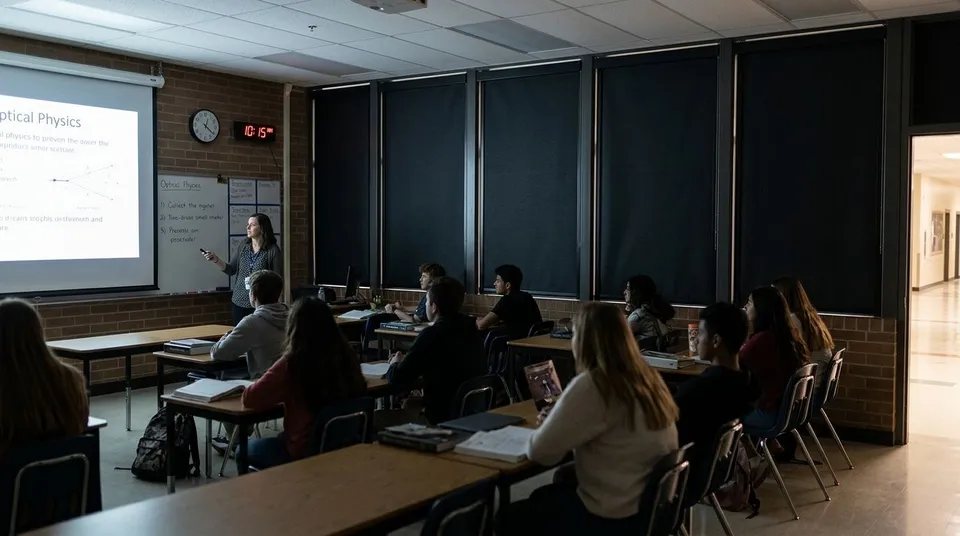
School classrooms and auditoriums need blackout shades that kill glare on projector screens, hold up under daily contact from students, and meet cord-safety rules in spaces full of kids. A single-family bedroom blackout shade and a classroom blackout shade solve different problems: the classroom version has to survive being yanked, bumped by rolling carts, and operated by a teacher who has thirty seconds between bells, not a homeowner with an evening routine.
- Blackout shades for school classrooms need cordless or motorized operation to meet child-safety standards in occupied spaces.
- Rainier Blinds measures and installs motorized and manual blackout roller and cellular shades across the Greater Seattle Area, not shutters or blinds.
- Side-channel or track-mounted blackout roller shades close the light gaps that cause glare on projector screens and stage lighting.
- Group-controlled motorized shades let one teacher or AV operator black out an entire auditorium from a single switch or app.
Why blackout shades matter for schools and auditoriums
Facilities managers buying window coverings for schools aren't shopping the way a homeowner shops. They're comparing rooms across a building, coordinating installs around the academic calendar, and answering to a district procurement process, not personal taste. Blackout performance for school classrooms and auditoriums has to solve three things at once: total light block for screens and stage productions, cord safety for rooms full of children, and a product that survives years of daily handling without a service call every semester.
A gym-auditorium running assemblies, testing sessions, and evening performances needs a different light-control setup than a third-grade classroom running a projector for twenty minutes a day. Both fall under the same search term, but the right shade differs by room use, ceiling height, and who's operating the shade day to day. That distinction is where most district buyers get the spec wrong the first time.
Rainier Blinds measures and installs custom shades across the Greater Seattle Area, including buildings in Auburn, Bellevue, and Tacoma, and the same fundamentals apply whether the room is a single classroom or a full auditorium.
Assess light control needs room by room
Don't spec one blackout product for an entire building. A classroom with morning sun on the east wall behaves differently than a windowless auditorium lit only by stage rigging.
- Walk each room at the time of day it's actually used for screen or stage work
- Note whether the glare source is direct sun, reflected light, or hallway spill from interior windows
- Flag rooms with skylights or clerestory windows separately since they need a dedicated shade, not an extension of the wall-window fix
- Separate "needs full blackout" rooms (auditoriums, testing rooms, media rooms) from "needs light-filtering" rooms (general classrooms)
- Check ceiling height and mount depth before assuming a standard headrail will clear obstructions like sprinkler heads or HVAC ducts
Choose cordless or motorized operation first, not last
Cord safety isn't optional in a room full of children. Standard corded shades create a strangulation risk that most school insurance policies and many state codes now flag directly, and continuous-loop cords still require anchoring that a busy classroom rarely maintains correctly.
- Specify cordless lift for any classroom shade reachable by students
- Consider motorized blackout shades for windows above six feet or behind fixed furniture where a manual lift isn't practical
- For auditoriums, motorized is close to mandatory since a single operator needs to control multiple large shades from one point during a performance or assembly
- Battery-powered motorized shades avoid running new electrical to older buildings, which matters in schools built before modern wiring codes
- Ask about group control before ordering room by room, since retrofitting a hub after installation costs more than speccing it up front
Pick a blackout fabric and mounting method that closes light gaps
Blackout fabric alone doesn't guarantee a dark room. Light leaks in around the edges of a standard roller shade, and that gap is exactly what shows up as a glare halo on a projector screen.
- Choose side-channel or track-mounted blackout roller shades for rooms where total darkness matters, like testing rooms and media rooms
- Standard fascia-mounted blackout shades work fine for general classrooms where dimming, not total blackout, is the goal
- Confirm the fabric is rated for full opacity, not just "room darkening," since the two terms aren't interchangeable
- Match headrail color and mount depth to the window trim so the install looks intentional, not retrofitted
- For auditoriums with stage lighting bleed, ask whether a double layer, such as a blackout roller paired with a light-filtering layer, solves both daytime and evening use
Match the shade to the room's AV setup
A classroom running a projector or interactive whiteboard has a specific glare problem: light hitting the screen from the side, not the front. Auditoriums running stage productions have a different one: ambient light washing out lighting design.
- Position blackout shades to cover the full window before the shade reaches the screen's sightline, not just the top half
- For rooms with a fixed projector angle, test blackout coverage at that exact angle before finalizing shade width
- In auditoriums, coordinate shade control with the existing AV or lighting control system so one person can run both from a booth or wall panel
- Confirm the shade fabric doesn't reflect stage or projector light back into the room, which some glossy blackout fabrics do
Plan group control for buildings with many rooms
A school with forty classrooms and one auditorium doesn't want forty separate remotes. Group control turns a room-by-room product into a building-wide system.
- Wall-switch groups let one teacher control every shade in a single classroom from one panel
- Building-wide smart hub control lets a facilities manager schedule blackout shades to close before a testing window automatically
- Battery-powered motorized shades reduce the electrical work needed to add group control to an older building
- Keep a manual override at each window in case the group system goes down mid-lesson
Budget and phase the install across the building
School procurement rarely funds every room in one purchase order. Phasing the install by priority room keeps the project moving without waiting on full-building approval.
- Start with testing rooms and the auditorium, where blackout performance has the most immediate academic impact
- Phase general classrooms next, prioritizing rooms with the worst existing glare complaints
- Schedule installs around school breaks to avoid disrupting class time
- Get a written measure and install plan before committing to a full-building order, since a mismatched headrail across forty rooms is expensive to fix later
Comparison: blackout shade options for schools and auditoriums
| Option | Best for | Operation | Key limitation |
|---|---|---|---|
| Manual cordless blackout roller shades | General classrooms with standard window sizes | Manual, cordless lift | Slower to operate room by room, no group control |
| Motorized blackout roller shades | Auditoriums, media rooms, high or hard-to-reach windows | Motorized, wall switch or remote | Needs power or battery planning per window |
| Motorized blackout cellular shades | Rooms needing insulation plus blackout, like older buildings with drafty windows | Motorized | Higher cost per window than a standard roller |
| Smart blackout shades with hub control | Buildings with many rooms needing scheduled, group-wide control | Smart hub or app, scheduled | Requires a building-wide setup plan, not a quick single-room fix |
Verdict: motorized blackout roller shades with side channels are the standard for auditoriums and testing rooms in 2026, while cordless manual blackout rollers cover general classrooms without the added electrical work.
Common mistakes schools make with blackout shades
- Speccing one shade type for the whole building. A general classroom and an auditorium have different light-control needs; a single spec usually underperforms in one room type.
- Skipping side channels on testing rooms. Standard fascia-mounted shades leave edge gaps that defeat the purpose of a blackout order for standardized testing.
- Choosing corded lift to save on upfront cost. Cord safety liability and code compliance issues cost more later than paying for cordless or motorized lift up front.
- Ignoring group control until after installation. Retrofitting a hub or wall-switch group after forty rooms are already wired individually is a second project, not an upgrade.
- Not coordinating with the AV or lighting team. Shade width, mount position, and control integration should be confirmed with whoever runs the projector or stage lighting before the order is finalized.
Get a classroom blackout shade consultation
In-home or on-site measuring and installation across the Greater Seattle Area.
A daycare or childcare facility runs into many of the same cord-safety and durability questions as a K-12 classroom; the approach in window treatments for daycare and childcare centers applies almost directly to elementary classrooms. Auditoriums share more with worship spaces than with general classrooms when it comes to controlling large volumes of light across a stage area, covered in window treatments for churches and worship spaces.
FAQ
What's the best blackout shade for a school classroom?
A cordless motorized or manual blackout roller shade with side channels is the standard choice for 2026 classroom installs. Side channels close the edge gaps that cause glare on projector screens, which a standard fascia-mounted shade doesn't fully solve.
Are corded blackout shades allowed in classrooms?
Most schools now avoid corded lift shades in any room accessible to students due to strangulation risk. Cordless manual or motorized shades meet current safety expectations without the cord hazard.
Do auditoriums need motorized blackout shades?
Yes, in most cases. A single operator needs to control multiple large windows at once during a performance or assembly, which manual shades can't do efficiently across a full auditorium.
How much does it cost to install blackout shades in a school building?
Cost depends on window count, mount type, and whether shades are manual or motorized. A measure and quote from an installer covers the specifics for a given building.
Can blackout shades fully darken a testing room?
Full blackout requires side-channel or track-mounted blackout fabric, not a standard roller shade. Standard mounts leave light gaps around the edges that a testing room can't tolerate.
What's the difference between blackout and light-filtering shades for classrooms?
Blackout fabric blocks light entirely, while light-filtering fabric dims glare but still admits daylight. General classrooms often only need light-filtering; testing rooms and auditoriums need true blackout.
Can one system control blackout shades across an entire school building?
Yes, motorized blackout shades can be grouped by wall switch or smart hub so a facilities manager schedules or controls multiple rooms at once. This needs to be planned before installation, not added afterward.
Do blackout shades work with existing AV and projector setups?
They should be positioned and sized around the projector's sightline before the order is finalized. Coordinating with whoever runs the AV system avoids a shade that covers the wrong part of the window.
One last thing
The detail that gets missed most on school blackout orders isn't the fabric, it's the mount. A side-channel or track-mounted blackout roller shade closes the light gap around the edges that a standard fascia mount always leaves open, and that gap is exactly what shows up as a glare halo on a projector screen or a test proctor's complaint. If total darkness is the actual requirement, spec the track mount from the start, not as a fix after the first complaint comes in.