
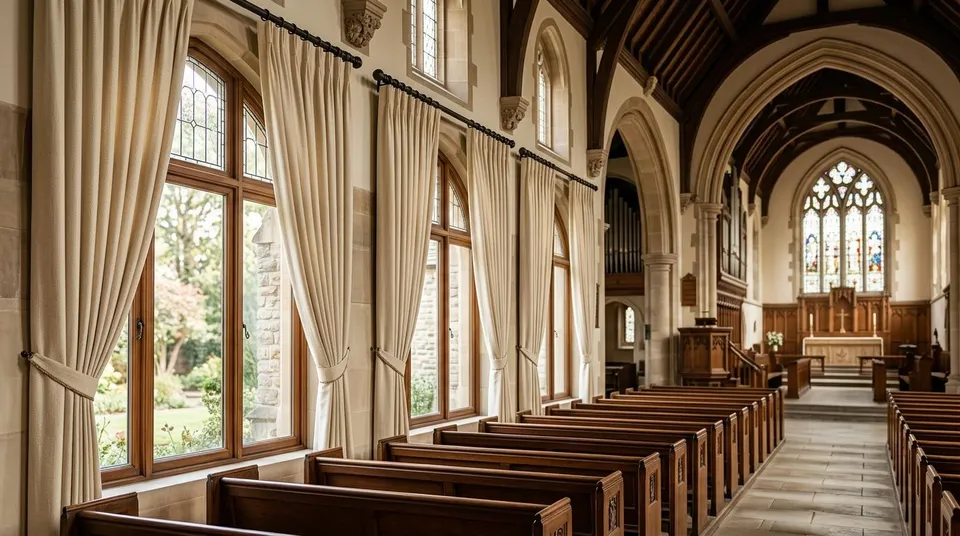
Window treatments for churches and worship spaces are custom shades installed to control glare on the altar or stage, protect stained glass and finishes from UV fade, and manage acoustics and light for services, weddings, and community events. A sanctuary has different problems than a living room: sightlines to a projector screen, windows 20 feet up a wall, and a congregation that needs the room dark for a Sunday video announcement and bright for a Tuesday potluck.
- Motorized shades solve the access problem for clerestory and high sanctuary windows over 12 feet up.
- Cellular shades cut sound bounce and add insulation in large open naves with hard surfaces.
- Blackout shades in the fellowship hall or media room support projector use for services and events.
- Window treatments for churches should be quoted room by room, not as one blanket order.
- Rainier Blinds measures and installs shades across the Greater Seattle Area, including sanctuaries and fellowship halls.
Why window treatments matter for churches and worship spaces
A sanctuary is a public building with a schedule that a house doesn't have. Sunday morning light hits the east windows during the 9 a.m. service, then the same room hosts a projector-dependent evening event where every stray beam of daylight washes out the screen. Stained glass and painted finishes take direct sun for years without anyone budgeting to protect them, and by the time fading shows up on pews or carpet it's already done.
Acoustics compound the light problem. Vaulted ceilings and hard plaster walls that make a choir sound good also bounce noise during announcements, children's programs, and coffee hour in a shared hall. Fabric shades absorb sound that bare glass and drywall reflect back, which is a detail most churches never think about until an audio tech complains about echo on a livestream mic.
Assess the sanctuary's light and glare problems room by room
Start with a walkthrough at two different times of day, not one. Morning light and afternoon light hit different walls, and a west-facing sanctuary with afternoon weddings has a different problem than an east-facing one with 8 a.m. services.
- Note which windows sit directly behind or beside the stage, altar, or screen
- Mark windows with stained glass or other finishes that shouldn't be covered, only shaded from behind
- Identify rooms that double as classrooms, meeting rooms, or event space
- Check ceiling height at each window bank, since anything over 10-12 feet changes the install approach
- Flag any window currently covered with a temporary fix like paper or a bedsheet
Choose motorized shades for high and hard-to-reach windows
Clerestory windows, arched windows above a stage, and second-story sanctuary glass are the reason most churches stall on window treatments for years. A manual pole or crank on a 15-foot window means a ladder every time light needs adjusting, and most staff won't do it.
Motorized shades solve this by moving the adjustment to a wall switch, remote, or scheduled app control, no ladder required.
- Group high windows on one remote or switch so ushers can adjust the whole bank before service starts
- Battery or wired motor options exist depending on wall access near the window
- Scheduled operation opens shades for morning light and closes them before an afternoon event automatically
- Smart hub pairing lets one person control multiple rooms from a phone during setup
- Manual shades remain the lower-cost option for reachable windows where a ladder isn't the barrier
Control acoustics with cellular shades
A nave with plaster walls, wood pews, and tall glass reflects sound instead of absorbing it. Fabric-based cellular shades add a soft surface at the window that a bare pane doesn't offer, and their honeycomb structure also traps air for insulation in a building that's often heated only part of the week.
- Cellular shades reduce sound reflection off window glass in rooms with hard flooring and ceilings
- The trapped-air structure cuts heat loss through large glass areas in winter
- Light-filtering fabrics keep some natural light while softening the acoustic bounce
- Double-cell versions add more insulation value than single-cell for sanctuaries with older single-pane windows
- Cellular shades work on standard and arched frames, useful for older church architecture
Add blackout shades where a screen or projector is in use
Any room running a projector for a sermon slide, a youth group movie night, or a livestream needs the option to go fully dark regardless of time of day. This is usually the fellowship hall or a secondary meeting room, not the main sanctuary.
- Blackout shades block daylight completely for projector contrast during daytime services
- Rooms with south or west light need blackout more than north-facing rooms
- Consider blackout paired with a light-filtering shade behind it for a room used both ways
- Motorized blackout on a remote lets one volunteer black out a room in seconds before a video plays
- Fabric color affects perceived room darkness even with a true blackout liner, so ask to see a swatch under real light
Match opacity to worship, meeting, and community-hall needs
Not every room in a church building needs the same shade. A children's classroom wants privacy and glare control without going dark. A conference room used for staff meetings wants light filtering, not blackout. The sanctuary itself might want daylight most of the week and full control on Sunday.
- Light-filtering fabrics keep the room bright and usable for daily activities
- Room-darkening (not full blackout) works for classrooms that need glare control but not total dark
- Dual shades, a sheer layer paired with a blackout or light-filtering layer, cover both needs in one window without swapping hardware
- Skylight shades handle vaulted-ceiling naves where the light source is overhead, not on a wall
Skylight shades for vaulted ceilings cover the specific case of overhead glass in a sanctuary roofline, which is a common feature in newer church construction and one that standard wall-mounted shades can't touch.
Budget and phase the project across the building
A church rarely funds every window at once. Phasing by room, sanctuary first, then fellowship hall, then classrooms, is standard practice and keeps a building committee from stalling on a single large number.
- Prioritize rooms with the worst glare or fade problem first
- Group similar windows (same size, same wall) into one order to simplify install day
- Ask for a written quote broken out by room so a finance committee can approve in stages
- Factor motor and remote costs separately from the shade fabric cost, since motorized windows cost more per opening
Get a sanctuary walkthrough quote
Free in-home consultation, measured and installed by our own crew.
Get the space measured and installed correctly
Church windows run larger and taller than residential windows, and arched or clerestory openings need an installer who's measured that shape before. A measurement error on a 14-foot window is expensive to fix twice.
- Confirm mount type (inside vs outside) before ordering, since deep window casings common in older churches change the fit
- Ask whether the installer has experience with commercial or high-ceiling installs, not just residential rooms
- Schedule install around the service calendar, not a random weekday, to avoid disrupting a Sunday
- Get a maintenance plan in writing for motorized units, since a motor that fails in a sanctuary is harder to reach than one in a bedroom
Comparing shade options for churches
| Option | Best for | Key limitation |
|---|---|---|
| Motorized roller shades | High clerestory and stage-adjacent windows | Needs power access or battery swap schedule |
| Cellular shades | Acoustic control and insulation in the nave | Adds cost over a basic roller for the same window |
| Blackout shades | Fellowship halls and media rooms with projectors | Not needed in rooms without screen use |
| Skylight shades | Vaulted-ceiling sanctuaries with overhead glass | Requires specialized mount for angled or flat-roof glass |
| Drapery | Stage backdrops and formal entry areas | Higher maintenance than a fixed shade |
| Zebra shades | Classrooms and offices needing adjustable light bands | Less blackout capability than a dedicated blackout shade |
Verdict: for a typical Greater Seattle church with high sanctuary windows and a projector-dependent fellowship hall, motorized cellular shades in the nave paired with blackout shades in the media room cover the two biggest problems, glare and screen visibility, without over-buying for rooms that don't need it.
Common mistakes churches make with window treatments
- Ordering one shade type for the whole building. A sanctuary and a classroom don't have the same light problem, and a single spec wastes money in rooms that needed less.
- Skipping the high windows because they're hard to quote. Clerestory and arched windows get left uncovered for years because nobody wants to deal with the ladder, which is exactly what motorized shades exist to fix.
- Buying blackout for rooms that never run a projector. Full blackout costs more and isn't needed in a room used only for daytime meetings.
- Not accounting for install day around the service calendar. A crew working through a sanctuary on a Saturday before Sunday service creates unnecessary friction.
- Ignoring acoustics until an audio problem shows up. Cellular shades solve part of the echo problem cheaply if they're specified up front instead of added later as a fix.
FAQ
What window treatments work best for church sanctuaries?
Motorized cellular or roller shades work best for church sanctuaries because they handle high clerestory windows without a ladder and add some sound absorption in rooms with hard walls and ceilings. Blackout shades are better reserved for rooms with a projector or screen.
Can motorized shades help with glare during church services?
Yes, motorized shades let staff close high windows from a switch or remote right before a service starts, which manual shades on a 15-foot window can't do practically. Scheduling can also close them automatically at a set time each week.
Do churches need blackout shades or light-filtering shades?
It depends on the room: media rooms and any space with a projector need blackout, while classrooms and meeting rooms usually do better with light-filtering or room-darkening fabric that keeps the space usable during the day.
How do you protect stained glass windows from sun damage?
A shade mounted on the interior side of the frame, not directly against the stained glass, protects the pews, carpet, and finishes behind it from UV fade without covering the glass itself. Light-filtering fabric is usually enough for this purpose.
Are cellular shades good for reducing echo in a church building?
Cellular shades add a soft fabric surface at the window that reduces some sound reflection compared to bare glass, which helps in naves with hard plaster walls and wood pews. They won't fully solve an acoustics problem on their own but they help.
How much does it cost to add window treatments to a church?
Cost depends on the number of windows, their size, and whether motorized options are chosen, since churches often have taller and larger openings than residential homes. Get a room-by-room quote at an in-home consultation rather than estimating from a single window price.
Should church window treatments be motorized or manual?
Motorized makes sense for high or hard-to-reach windows like clerestory glass above a stage, while manual shades are fine for reachable windows at standard height where cost matters more than convenience.
One last thing
The fellowship hall usually gets forgotten in a church window treatment project because it's not the sanctuary, but it's the room running the projector for movie nights, potlucks with slideshows, and youth group events, which means it needs blackout capability more than the sanctuary does in most buildings.