
Our available controls: Rainier Blinds offers Roman and woven wood shades with motorized operation only. All other shade styles are available with manual, motorized, or smart control. Your consultation confirms the controls and power options for your product.
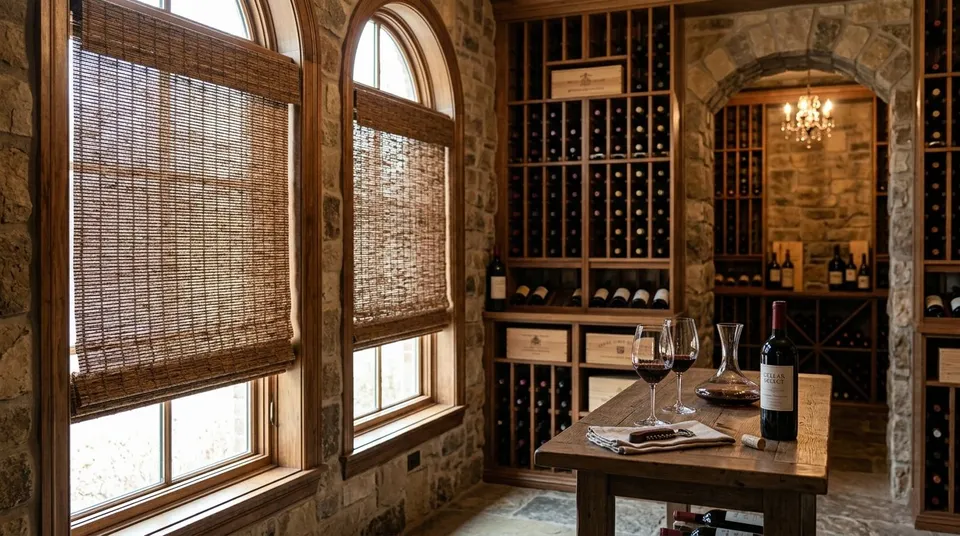
Wine cellars and tasting rooms live and die on light control, and woven wood roman shades are the one window treatment that filters that light without turning a tasting room into a cave. This guide ranks the woven wood configurations worth installing in 2026, from blackout liners over storage racks to motorized shades on tall tasting room windows.
- Woven wood roman shades with a blackout liner win for protecting stored bottles from UV-driven light damage.
- Motorized woven wood shades suit tasting rooms with large picture windows staff can't reach daily.
- Light-filtering woven wood shades without a liner work best for tasting room ambiance during pours and events.
- Smart woven wood shades automate light schedules for cellars that need consistent exposure through 2026 and beyond.
Why this matters
Wine cellars and tasting rooms share one enemy: direct sun hitting glass. Ultraviolet exposure causes light strike, a chemical reaction that produces off flavors in wine, and it hits clear and light green bottles hardest. A cellar held near 55°F with 60-70% humidity does no good if the racks sit under a south-facing window all afternoon.
Woven wood roman shades solve this differently than a roller or cellular shade because the weave itself does double duty: it filters daylight for tasting room ambiance while a blackout liner behind it blocks UV where bottles are stored. Homeowners setting up shades for home bars and entertainment spaces run into the same light-versus-atmosphere tradeoff, just with lower stakes than an actual cellar.
What makes the best woven wood shades for wine cellars
- Light control range — from near-total blackout to soft filtering, since a cellar and a tasting room rarely want the same setting
- Weave density — tighter weaves filter more UV before a liner is even added
- Operation fit — manual, motorized, or smart, matched to how often the shade gets touched during a shift
- Fit against racks and openings — arched, skylight, or standard windows all show up in cellar architecture
- Humidity tolerance — cellar air runs damp compared to the rest of the house
- Cleaning and upkeep — tasting room fabric picks up wine drips and needs a wipeable or brushable surface
Woven wood shades for wine cellars: at a glance
| Item | Best for | Standout feature | Key limitation |
|---|---|---|---|
| Blackout-lined woven wood roman | UV protection over storage racks | Liner blocks light strike almost entirely | Too dark for a working tasting room |
| Motorized woven wood roman | Large tasting room picture windows | No wand needed on tall openings | Needs a nearby power source |
| Light-filtering woven wood roman | Tasting room ambiance | Natural light without harsh glare | Offers no meaningful UV protection alone |
| Smart woven wood roman | Automated cellar climate management | Runs on a fixed daily schedule | Requires a hub and setup time |
| Motorized woven wood | Custom fit and controls confirmed at consultation |
1. Blackout-lined woven wood roman shades: best woven wood shades for wine cellar UV protection
A woven wood roman shade with a blackout liner stops light strike before it starts. The liner sits behind the natural weave and blocks the UV wavelength responsible for that chemical breakdown in wine, while the woven wood face still reads as texture rather than a flat blackout panel.
Blackout-lined woven wood pros:
- Full light block over racks and storage walls
- Keeps the natural woven texture visible from inside the room
- Works on standard, arched, and most skylight-adjacent openings
Blackout-lined woven wood cons:
- Too dark for a tasting room meant to feel open during pours
- Liner adds bulk, which matters on tight-mounted cellar windows
- Manual lift is standard; motorized upgrades add another step to the install
Best for: cellar storage rooms with any direct window exposure. Verdict: Buy if UV protection is the priority over ambiance.
2. Motorized woven wood roman shades: best woven wood shades for tasting room picture windows
Our woven wood shades use motorized operation. Choose the fabric and lining for your room, then we confirm the motor, power option, and controls at your free consultation.
Motorized woven wood pros:
- No manual reach needed on tall or wide picture windows
- Consistent light setting every time it's programmed
- Pairs with a schedule so the room opens and closes on its own
Motorized woven wood cons:
- Needs power nearby, which older cellar buildouts may not have
- Costs more to install than manual operation
- Battery or wired motors both need occasional maintenance
Anyone running motorized shades already knows pairing motorized shades with a smart home hub turns a single shade into part of a bigger routine, not just a standalone motor.
Best for: tasting rooms with large windows and regular staff turnover. Verdict: Buy for high-traffic rooms.
3. Light-filtering woven wood roman shades: best woven wood shades for tasting room ambiance
A light-filtering woven wood shade without a blackout liner does the opposite job of the storage-room pick: it softens direct sun into a warmer, diffused light that suits a tasting flight better than a fully open window. The natural fibers cast texture and shadow rather than a flat glow.
Tasting rooms increasingly pair wine flights with small bites during events, and the same logic that shapes those pairing menus applies to light: matching subtlety to the occasion matters. A host choosing artisan chocolate for wine pairings over something heavier follows that same principle, and the room's light level should follow it too.
Light-filtering woven wood pros:
- Softens harsh afternoon sun without blocking the view
- Reads warmer and less clinical than a roller shade
- Suits event spaces where full blackout feels unwelcoming
Light-filtering woven wood cons:
- Offers no real UV protection on its own
- Not appropriate for actual bottle storage areas
- Weave gaps let in more glare than a lined shade at certain sun angles
Best for: the public-facing tasting room, not the storage side. Verdict: Buy for ambiance-focused spaces.
4. Smart woven wood roman shades: best woven wood shades for automated cellar climate control
A smart woven wood roman shade adds scheduling and app control on top of the motorized build, which matters most in a cellar where light exposure needs to stay consistent whether or not anyone is on site. Set once in 2026, the schedule keeps running without a staff member remembering to check it every morning.
Smart woven wood pros:
- Runs on a fixed schedule without daily attention
- Can tie into existing smart home routines
- Useful for seasonal light changes across a Pacific Northwest year
Smart woven wood cons:
- Requires a hub and initial setup time
- More moving parts than a manual shade means more to service
- Overkill for a single small window
Best for: cellars that sit unattended for stretches of the week. Verdict: Buy if the room already runs on smart home infrastructure.
Choosing your motorized controls
Our woven wood shades are motorized only. We help you choose controls and a power option suited to your windows, and confirm the final configuration in your quote.
How we ranked these
Each configuration was scored against the six criteria above: light control range, weave density, operation fit, opening compatibility, humidity tolerance, and upkeep. The blackout-lined pick wins on UV protection specifically because a liner is doing measurable work against light strike, not because it's the most versatile option in the group.
Which woven wood shade should you choose?
Start with the room, not the feature list. A working wine cellar with any window exposure needs the blackout-lined woven wood roman shade first, before motorization or smart controls even enter the conversation. A tasting room built for guests should lean toward light-filtering woven wood, motorized if the windows are large enough that daily hand operation gets old fast.
If sunlight reaches the racks, the wine ages faster than the label promises, and that single fact should settle most of the debate for a storage-side window.
“If sunlight reaches the racks, the wine ages faster than the label promises.”
Get a cellar light plan
Free in-home consult, measure, and install by Rainier Blinds' own crew.
FAQ
What are the best woven wood shades for wine cellars?
A woven wood roman shade with a blackout liner is the best option for wine cellars in 2026 because the liner blocks the UV wavelength responsible for light strike. Light-filtering versions without a liner belong in the tasting room, not the storage area.
Do woven wood shades block UV light from damaging wine?
Only with a blackout liner added behind the natural weave. A standard light-filtering woven wood shade softens glare but does not stop UV exposure on its own.
Are woven wood shades good for tasting rooms?
Yes, light-filtering woven wood roman shades work well in tasting rooms because they diffuse harsh sun into a warmer, textured light without blocking the view entirely.
Can woven wood shades be motorized for wine cellars?
Yes, woven wood roman shades come in manual, motorized, and smart operation tiers. Motorized versions suit large tasting room windows where daily manual operation is impractical.
What's the difference between light-filtering and blackout woven wood shades?
Light-filtering woven wood shades let diffused daylight through the weave, while blackout versions add a liner behind the weave to stop nearly all light and the UV that comes with it.
What temperature and humidity should a wine cellar hold?
Most wine storage guidance points to roughly 55°F with 60-70% humidity. Direct sunlight through an uncovered window works against both of those targets.
Do woven wood shades work on arched or skylight-adjacent cellar windows?
Woven wood roman shades fit standard and arched openings well; skylight openings above a cellar are typically handled with a dedicated skylight shade instead.
Are woven wood shades better than roller shades for wine storage?
For a cellar prioritizing texture and warmth alongside light control, a blackout-lined woven wood roman shade does the same UV-blocking job as a blackout roller shade while adding a different look to the room.
One last thing
Clear and light green wine bottles are the most vulnerable to light strike, more so than dark green or amber glass. If a cellar uses glass-front racks, the shade covering the window is doing more protective work in 2026 than the rack's glass door ever will.