
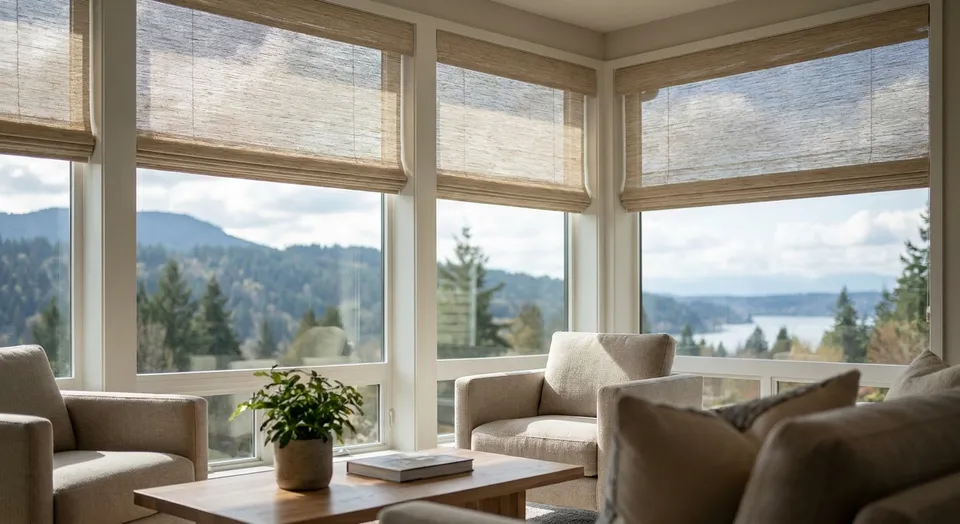
Issaquah view homes face a specific problem: floor-to-ceiling glass that frames Cascade foothills or Lake Sammamish also floods living rooms with afternoon glare and lets every neighbor with a good pair of binoculars see straight in. The right window treatment protects the view instead of covering it up.
- Motorized roller shades with solar screen fabric are the top pick for best window treatments in Issaquah view homes in 2026, Buy.
- Cellular shades win on insulation for homes with 15+ foot glass walls but block more of the view, Consider.
- Zebra shades split the difference between privacy and light for great-room windows, Buy.
- Sheer horizontal shades soften glare without killing the view but skip them on true south-facing walls. Consider.
- Motorized drapery works for statement walls over 10 feet wide. Consider only with a dedicated track budget.
Why this matters
Issaquah's elevation and tree cover mean light hits differently depending on which ridge your house sits on. A house backing up to Tiger Mountain gets low, raking afternoon sun through west glass most of the year; a house facing Lake Sammamish gets glare off the water starting around 4pm in summer. Standard mini blinds or off-the-shelf cellular shades from a big-box store don't account for either condition, they're built for a standard 36-inch window, not the 8-to-12-foot glass walls common in newer Issaquah builds.
Rainier Blinds measures and installs custom blinds, shades and drapery across the Greater Seattle Area, and view-home jobs in Issaquah, Sammamish and the Newcastle corridor come with the same recurring request: keep the view, kill the glare, don't make the room feel like a fishbowl at night. The picks below are ranked on how well each treatment type solves that three-way problem in 2026, not on price alone.
How this list was ranked
Each treatment type is scored against three criteria specific to view homes: how much of the visible view survives when the shade is down, how well it manages solar heat gain on west- and south-facing glass, and how it performs after dark when interior lights turn windows into mirrors. Motorization is scored as a bonus, not a requirement, since not every view window needs a remote. The ranking reflects patterns seen across South King County installs in 2026, not a single lab test.
The ranked list
1. Motorized roller shades with solar screen fabric: the view preserver
Solar screen can preserve some daytime view and reduce glare, but even a low-openness fabric can be see-through when interior lights are on at night. Add an appropriate privacy layer if nighttime privacy is required.
For tall view windows, consider motorized operation when daily manual adjustment would be difficult. Compatibility, hub requirements, and available controls depend on the selected motor and your home setup. We confirm those details before ordering. Confirm safe access for installation and maintenance as well as the daily controls.
Verdict: Buy. This is the default recommendation for any Issaquah great room with unobstructed west or south exposure.
2. Cellular (honeycomb) shades: the insulation pick
Double-cell honeycomb shades trap air in sealed pockets and measurably cut heat transfer through glass, which matters in a house where a 12-foot window wall is your single biggest energy loss point. They also block sound better than roller shades, which helps on homes near I-90.
The tradeoff: even light-filtering cellular fabric obscures more of the outside view than a screen weave does, since the pleats create texture rather than a flat scrim. A side-by-side comparison of the two is covered in this roller shades vs. cellular shades breakdown for South King County homes.
Verdict: Consider. Right call for bedrooms and home offices where insulation and blackout beat view preservation; not the first choice for the room you built the house around.
3. Zebra (dual) shades: the light control wildcard
Zebra shades alternate sheer and solid bands on the same roll, so sliding the fabric shifts the window between a soft-filtered view and a fully closed slat pattern. For a room that's a home office by day and a media room by night, that flexibility solves two problems with one shade.
They read as more contemporary than a standard roller shade, which fits the finish level of most newer Issaquah construction. Installs paired well with the same hardware used in recent custom blinds projects across South King County in 2026.
Verdict: Buy for multi-use rooms; Skip if you already have a dedicated blackout shade for movie nights elsewhere in the house.
4. Sheer horizontal shades: the soft glare filter
Sheer horizontal shades use fabric vanes sandwiched between two sheer face panels, giving you the light-diffusing softness of a curtain with the adjustability of a blind. Tilting the vanes redirects direct sun toward the ceiling while keeping the view visible through the sheer layer, useful on windows that catch low winter sun.
They underperform on true south glass in summer, when the sun angle is too high for the vane tilt to fully block glare. On those walls, pair them with a secondary solar screen or skip to the roller shade pick above.
Verdict: Consider. Strong for east- and west-facing view windows with seasonal low-angle sun; not the first choice for south-facing walls that get hit hard from May through September.
5. Motorized drapery: the whole-wall statement
For wide window walls, a motorized drapery track may make daily adjustment easier. Confirm the span, fabric weight, stack-back, mounting support, power, and operating speed for the actual system.
Cost and installation complexity are higher than any shade on this list, and drapery alone does little for solar heat gain unless paired with a blackout lining or a shade layer underneath.
Verdict: Consider. Reserve this for a genuine statement wall, not a routine bedroom window. Layering it over a roller shade solves the heat problem drapery alone doesn't.
6. Standard 2-inch faux wood blinds: the one to skip
Faux wood blinds are the default at big-box stores and they do work on a standard bedroom window. On an 8-to-12-foot view window, the slats stack up thick at the head rail, the cords sag over time under the extra weight, and the view gets chopped into horizontal strips even when fully raised.
Verdict: Skip. Fine for a laundry room window, wrong for the window you paid a view premium for.
Get shades sized for your view windows
On-site measuring and installed pricing for Issaquah view homes.
Comparison table
| Treatment | View preserved | Heat/glare control | Privacy after dark | Motorized option |
|---|---|---|---|---|
| Solar screen roller shades | High (5-10% openness) | Strong | Strong (1-3% option) | Yes |
| Cellular/honeycomb | Low-medium | Strongest (insulation) | Strong | Yes |
| Zebra/dual shades | Medium-high | Medium | Strong when closed | Yes |
| Sheer horizontal shades | High | Medium (seasonal) | Medium | Limited |
| Motorized drapery | Depends on lining | Weak alone | Strong | Yes |
| Faux wood blinds | Low | Medium | Strong | Rare |
Getting these installed in Issaquah
- Measure on-site, not from a floor plan. Custom window treatments for a wall of glass depend on exact head-rail width and fascia clearance; a quarter-inch error on a 10-foot track shows.
- Get one crew for measuring and installing. A subcontractor model adds a handoff where measurements get lost between the sales visit and the install date. Ask directly whether the same crew does both.
- Confirm motorization compatibility before ordering fabric. Not every solar screen fabric ships in a motorized-compatible roll width; check this before you fall in love with a specific openness percentage.
FAQ
What are the best window treatments for Issaquah view homes in 2026?
Motorized roller shades with solar screen fabric in the 5-10% openness range are the top pick for 2026, since they cut glare and heat while keeping most of the visible view. Cellular shades win instead when insulation matters more than sightlines, such as bedrooms.
Do solar screen shades actually block glare without blocking the view?
Solar screen can preserve some daytime view and reduce glare, but even a low-openness fabric can be see-through when interior lights are on at night. Add an appropriate privacy layer if nighttime privacy is required.
Are cellular shades better than roller shades for view windows?
Cellular shades insulate better and cut more sound, but roller shades with solar screen fabric preserve more of the outside view. Choose cellular for bedrooms and offices, roller shades for the main view room.
Is motorization worth it on large view windows?
On any window wall past 8 feet, yes. Manual chains and cords wear out faster under the extra fabric weight and become awkward to operate daily. Motorized shades also allow scheduling so they drop automatically when afternoon glare hits.
What should I avoid for a floor-to-ceiling view window?
Standard 2-inch faux wood blinds are the wrong call, the slats stack thick at the head rail and chop the view into strips even fully raised. They're built for a standard bedroom window, not an 8-to-12-foot glass wall.
How much privacy do sheer horizontal shades actually give at night?
Sheer horizontal shades give medium privacy after dark since the sheer face panels still allow silhouettes through with interior lights on. For full nighttime privacy on a view window, pair them with a blackout shade or choose a solar screen roller shade instead.
Do zebra shades work for a room used both as an office and a media room?
Yes, zebra shades slide between a sheer-filtered view position and a fully closed slat position on the same roll, which suits rooms with two different daily uses. That flexibility is the main reason they rank above single-purpose shades for multi-use rooms.
What's the biggest mistake people make on Issaquah view windows?
Measuring the window from a floor plan instead of on-site, which causes gaps or binding on wide glass walls where a quarter-inch error is visible. On-site measuring before ordering fabric or motorized hardware avoids this entirely.
One last thing
Openness and color both influence the view and glare, while measured solar and UV properties depend on the fabric. Compare physical samples at the window and review the actual performance data before choosing.