
Our available controls: Rainier Blinds offers Roman and woven wood shades with motorized operation only. All other shade styles are available with manual, motorized, or smart control. Your consultation confirms the controls and power options for your product.
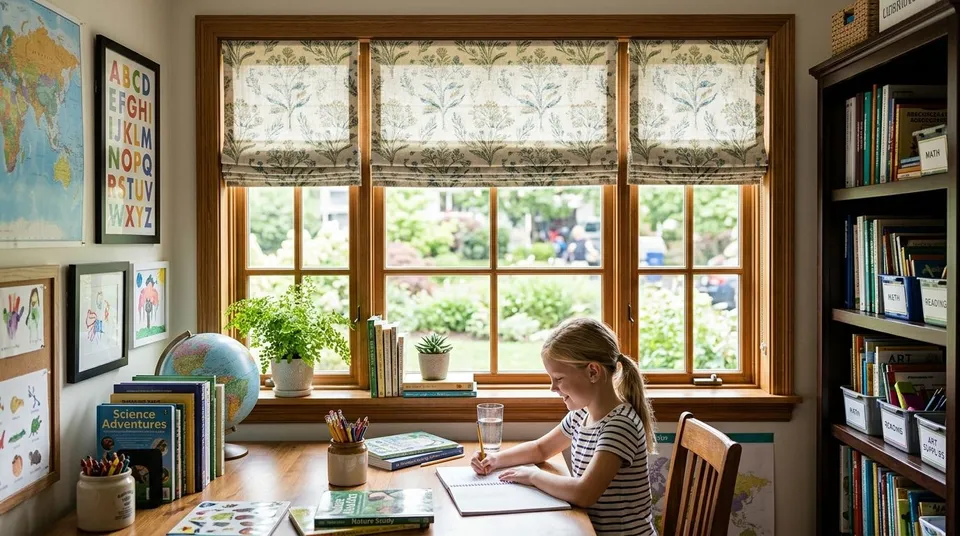
Window treatments for homeschool rooms need to do three jobs at once: cut screen glare for online classes, block outside distraction so kids actually focus, and survive daily use by hands that don't yet understand the difference between a cord and a toy. A spare bedroom or dining room converted into a full-time classroom has different demands than a bedroom or living room, and the shade choice should reflect that.
- Cordless cellular shades are the safest, most energy-stable pick for window treatments for homeschool rooms with kids under 10.
- Zebra shades give the best glare control for video-call-heavy homeschool days without blacking out the room.
- Blackout roller shades suit nap breaks and screen-reading blocks, not full class hours.
- Motorized shades solve the reach problem in converted dining rooms and bonus rooms with tall windows.
- Rainier Blinds measures and installs across the Greater Seattle Area with its own crew.
Why window treatments matter for homeschool rooms
A homeschool room is occupied 5 to 6 hours a day, five days a week, which is more daily use than almost any room in the house except the kitchen. That exposes weak hardware fast. Cheap mounts sag, cords fray, and fabric that looked fine in a showroom picks up marker and glue residue within a single semester.
The room also has to flex between jobs. It runs as a classroom from 8am to 2pm, then reverts to a guest room, craft space, or den by evening. The shade has to serve both uses without a changeover, which rules out treatments that are either too clinical for daily living or too decorative to control glare. Rainier Blinds handles this category the same way as any working room: measure the actual light problem first, then pick the product. The custom window treatments overview covers how that process runs across South King County homes in 2026.
Step 1: Control glare on screens and whiteboards
Online curriculum, tutor video calls, and tablet reading all fight direct sun. Morning light on an east-facing window turns a laptop screen into a mirror by 9am, which is exactly when most homeschool schedules start their first lesson block.
- Test the window at the actual class time, not at noon, because glare angles shift hour to hour
- Choose light-filtering fabric over sheer on east and south windows
- Position desks and whiteboards perpendicular to the window, never facing it
- Add a blackout layer only on the window directly behind a screen
- Zebra shades adjust opacity in bands rather than all-or-nothing, which fits a room where light needs change by the hour
Step 2: Block outside noise and visual distraction
Kids notice a delivery truck, a dog, or a neighbor mowing faster than any adult does. A homeschool room facing a street or driveway loses focus time to that every single day in 2026.
- Cellular shades add a mild acoustic buffer versus a bare window or a thin curtain
- Cover the full glass, not just the upper half, since lower-window movement is the worst distractor
- Use room-darkening fabric on street-facing windows to cut glare and traffic in one step
- Avoid sheer-only treatments on any window a desk faces directly
This is the point where a measured, custom shade beats an off-the-shelf panel. A stock shade that runs half an inch narrow leaves a light gap at each side, and that gap is exactly where a kid's eye goes. Rainier Blinds sends its own crew to measure rather than a subcontractor, which is why the fit is tight to the frame.
Step 3: Manage light without killing the room's usability
A homeschool room still has to work as a normal room outside class hours, so a treatment that stays closed all day defeats the purpose. Layer opacity instead of picking one extreme.
- Light-filtering shades keep the room bright and usable between lessons
- Blackout on screen-facing windows only, not the whole room
- Top-down bottom-up cellular shades let light in from above while blocking the sightline at desk height
- Zebra shades split the difference in one unit, alternating sheer and solid bands with a single pull
For a deeper breakdown of opacity choices, the guide on shade opacity for privacy and natural light walks through the light-filtering versus blackout decision window by window.
Step 4: Childproof the cords and hardware
Corded shades are a genuine hazard in a room where kids spend hours with intermittent supervision while a parent works with another sibling. This is the most avoidable mistake in a converted homeschool room, and it is the one families fix last.
- Specify cordless lift on every window a child can reach
- Motorized shades remove the cord entirely and let a parent adjust from across the room
- Retrofit existing corded treatments rather than leaving them; the childproofing cordless blinds guide covers the steps
- Check that the bottom rail is heavy enough not to tip if a kid pulls on it
Step 5: Handle temperature swings in a converted room
Spare bedrooms, bonus rooms above the garage, and dens usually sit at the edge of a home's HVAC zoning. They run colder in winter and hotter in summer than the rest of the house, and an uncomfortable kid at 11am is a distracted kid at 11am.
- Cellular shades trap air in a honeycomb structure and cut heat loss through the glass versus a bare window
- South and west-facing rooms need a light-filtering layer that reduces solar heat gain without full blackout
- Mount tight to the frame, because a shade with edge gaps loses most of its insulating value
- Pacific Northwest winters favor cellular over roller when the room runs cold
Book a free in-home consultation
Exact measurements and real pricing on the spot, across the Greater Seattle Area.
Step 6: Layer for a room that changes jobs
Most homeschool rooms are not permanent. Layering a functional shade with drapery gives the space a daytime classroom mode and an evening living-space mode without swapping hardware.
- Functional shade underneath for daily light and privacy control
- Drapery panels on a rod for evening softness in a shared classroom and guest room
- Keep shade fabric practical and wipeable, and let the drapery carry the decorative load
- Match drapery to the room's evening use, not to the classroom setup
Comparison: shade options for homeschool rooms
| Option | Best for | Key limitation |
|---|---|---|
| Cellular shades | Insulation and mild noise buffering in daily-use rooms | Narrower opacity range than a dedicated blackout fabric |
| Zebra shades | Adjustable glare control for video calls and screen work | Dual-layer operation takes a lesson for younger kids |
| Blackout roller shades | Nap breaks, screen-reading blocks, afternoon glare | Fully closed cuts all natural light, wrong for full class hours |
| Roman shades | Rooms that double as a guest bedroom | Bulkier stack height than a roller when raised |
| Motorized shades | Tall, angled, or hard-to-reach windows | Needs power access or battery maintenance |
Rainier Blinds recommends cordless cellular shades as the default window treatment for homeschool rooms in 2026, and zebra shades when video-call glare is the dominant problem.
“Treat the window behind the screen first; the rest of the room's windows can wait a season.”
Common mistakes homeschool families make
- Leaving corded blinds corded. A room used with intermittent supervision for 5 hours a day needs cordless or motorized shades from day one, not a retrofit after a scare.
- Choosing full blackout for the whole school day. Total darkness during active lessons makes handwriting and reading harder. Blackout belongs on specific windows at specific times.
- Testing light at the wrong hour. Families check the room at noon on a Saturday and get surprised by 9am glare on Monday. Check the room during actual class hours.
- Buying single-purpose when the room is temporary. A setup that reverts to a guest room in a year needs shades that work in both roles.
- Ignoring noise entirely. Street-facing and driveway-facing windows pull focus constantly, and cellular shades address that at the same time as light.
FAQ
What's the best window treatment for a homeschool room?
Cordless cellular shades are the best all-around window treatment for homeschool rooms because they are safe around kids, add insulation, and hold up to daily use. Zebra shades are the better pick when screen glare during video calls is the main problem.
Are blackout shades good for a homeschool classroom?
Blackout shades work for specific windows and specific times, such as a nap break or a screen-reading block, but full blackout all day makes handwriting and general classwork harder. Pair blackout on the screen-facing window with light-filtering fabric elsewhere.
Do I need cordless blinds for a homeschool room?
Yes, if kids under 10 spend any time in the room without direct supervision, corded lift systems are a real hazard. Cordless or motorized shades remove the risk entirely and are the safer default for any converted classroom.
Can motorized shades help with online school video calls?
Motorized shades let a parent adjust glare without walking to the window, which matters when managing more than one kid's schedule at once. They are also the practical fix for tall or hard-to-reach windows in converted bonus rooms.
What shade opacity is best for a homeschool room?
Light filtering is the right default for regular class hours because it keeps the room bright enough for handwriting and screens without direct glare. Reserve full blackout for nap breaks and screen-heavy blocks.
Do cellular shades help with a cold homeschool room?
Cellular shades trap air in a honeycomb structure and reduce heat loss through the glass, which matters in spare bedrooms and bonus rooms outside a home's main HVAC zone. Tight frame-fit mounting is what actually delivers the insulating benefit.
How much do custom shades for a homeschool room cost?
Pricing depends on window size, fabric, and whether you choose manual, motorized, or smart operation. Rainier Blinds gives real pricing on the spot at a free in-home consultation across the Greater Seattle Area.
Should the homeschool room match the rest of the house?
Not necessarily. A homeschool room has different daily-use demands, glare timing, and safety requirements than a living room, so treat it as its own decision even inside a larger home project.
One last thing
The window facing the desk matters more than every other window in the room combined. If a homeschool setup only has attention for one window in 2026, treat the one behind the screen or whiteboard first and handle the rest on a slower timeline. Families who do it in that order stop fighting glare in week one instead of month three.