
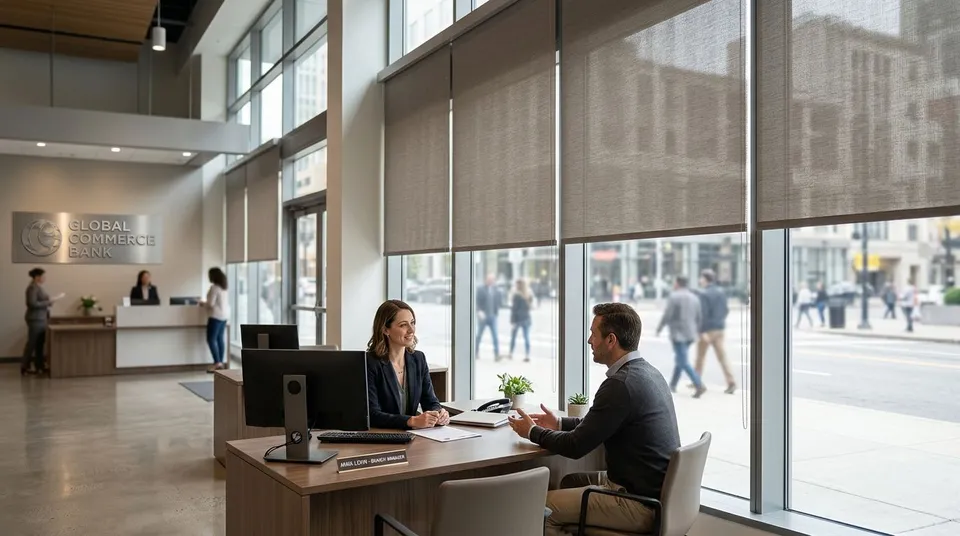
Window treatments for bank branches are shades installed across teller lines, drive-up lanes, and lobby glass to control glare, protect account privacy at the counter, and cut cooling costs without turning a branch into a cave. A branch has different needs than a house or a coffee shop: sightlines for security cameras, ADA-compliant controls, and a look that has to match across every location in the credit union's footprint.
- Window treatments for bank branches: light-filtering roller shades and zebra shades win for teller lines needing glare control without blackout.
- Motorized shades win for lobby glass over 8 feet tall where staff cannot reach a manual wand.
- One fabric and one color standardized across every branch location keeps the brand consistent for site visits and audits.
- Cellular shades add insulation value on west-facing branch glass that runs the AC hard every afternoon.
Why window treatments matter for bank branches
A branch lobby is glass on at least two sides, usually facing a parking lot that catches full afternoon sun. Tellers stare at monitors eight hours a day, and glare off a screen is a productivity problem before it is a comfort problem. Credit unions and community banks also answer to a brand standards document that says every location has to look the same, so a shade choice made for one branch becomes the default for the next fifteen.
Security is the other variable a house never deals with. Cameras need sightlines, alarm sensors sit near the glass, and a shade that is too opaque can create blind spots regulators and insurers ask about. Commercial window treatments for retail storefronts cover a lot of the same storefront-glass logic, but a branch adds the teller-line and vault-adjacent windows that a retail floor plan does not have.
In 2026, most branch remodels in the Greater Seattle Area touch the glass before they touch the millwork, because glare complaints from staff arrive faster than any other facilities ticket.
Assess glare and heat load at teller stations first
Start at the counter, not the lobby. Teller stations facing east or south get direct sun for hours, and a screen glare problem does not fix itself with a lobby-wide blackout order from corporate.
- Walk the branch at 9am, noon, and 3pm to log which teller windows get direct sun each time
- Note which stations face a parking lot versus a side street, since parking-lot glare bounces off windshields too
- Check whether existing window film or tint is already cutting some heat, which changes what shade opacity you actually need
- Flag any teller window within camera sightline before picking an opacity level
- Separate drive-up lane windows from walk-in teller windows since they carry different privacy rules
Match opacity to the job at each type of window
Not every pane in a branch needs the same shade. Lobby glass wants light filtering so the space still reads open. Teller-adjacent glass often needs a step up in opacity for account privacy without going full blackout.
- Light-filtering roller shades for general lobby glass and waiting-area windows
- Zebra shades, which alternate sheer and solid bands, for teller-line glass where staff need to dial privacy up or down through the day
- Blackout shades reserved for back-office and vault-adjacent rooms, not customer-facing glass
- Cellular shades on west-facing branch walls that take the worst afternoon heat load
- Drapery kept to executive offices and conference rooms, not the transaction floor
Standardize operation type across every branch you run
A multi-branch operator gains nothing from branch A running manual shades and branch B running motorized. Staff transfer between locations, and a mismatched fleet means retraining every time someone moves.
- Pick one operation tier (manual, motorized, or smart) as the default for teller-line glass across the portfolio
- Reserve motorized upgrades for glass staff genuinely cannot reach with a wand or crank
- Write the standard into whatever vendor spec sheet gets handed to a general contractor on new-branch builds
- Keep drive-up lane shades on the same operation tier as the main lobby so maintenance calls do not multiply
Specify motorized shades for tall or hard-to-reach glass
Many bank branches built in the last two decades run floor-to-ceiling lobby glass, sometimes 10 to 12 feet tall. A manual wand does not reach the top third of that glass, and a step stool in a customer-facing lobby is a liability nobody wants to explain to a district manager. Motorized window shades for corporate office buildings cover the same tall-glass math for open floor plans.
- Motorize any pane where the top rail sits above 7 feet
- Group motorized shades on a single wall switch or app zone per branch, not one remote per window
- Confirm battery or hardwired power access before install day, since branch electrical runs are usually locked down by facilities
- Schedule motorized programming after business hours so tellers are not testing shades mid-transaction
Coordinate installation around security and access rules
Branches do not hand out keys the way a homeowner does. Install day means coordinating with a branch manager, a security protocol, and sometimes a regional facilities contact who has to sign off before anyone touches the glass. Rainier Blinds runs its own measure and install crew rather than a subcontractor, which keeps the badge-and-access list short on a bank site.
- Confirm which staff member has authority to grant after-hours or early-morning access
- Ask whether the alarm system needs to be disarmed for the glass zone during install
- Route cabling for motorized shades away from any sensor or camera mount point
- Plan a Saturday or after-close install if the branch cannot lose lobby access during business hours
Keep branding consistent across every branch location
A credit union with twelve branches loses the consistency argument the moment one location gets a different fabric because a manager liked a sample. Best zebra shades for conference rooms and shared workspaces walks through the same standardization logic for shared office space.
- Lock in one fabric and one neutral color as the portfolio default before the first branch gets measured
- Keep conference room and executive office shades on a slightly different tier, such as drapery or a heavier fabric, without breaking the overall color story
- Document the spec in 2026 so a new branch build in 2027 pulls from the same file instead of starting over
- Order replacement stock notes against the same fabric name so a damaged shade matches the rest of the line
Plan maintenance and warranty coverage per location
A branch shade gets operated far more than a residential one. Tellers raise and lower the same shade twice a day, five days a week, and that duty cycle is what eventually kills a cheap mechanism.
- Log the install date and fabric spec per branch so warranty claims are not guesswork three years later
- Assign one facilities contact per region as the single point for shade service calls
- Dust roller and zebra fabric on the same schedule as the HVAC filter change
- Check motorized battery levels twice a year on branches with battery-powered units
Comparison: shade options for bank and credit union branches
| Product | Best for | Operation options | Key limitation |
|---|---|---|---|
| Light-filtering roller shades | Lobby glass, waiting areas | Manual, motorized, smart | Not enough privacy for teller-adjacent glass on its own |
| Zebra shades | Teller lines needing adjustable privacy | Manual, motorized, smart | More per window than a single-layer roller |
| Cellular shades | West-facing glass with high heat load | Manual, motorized | Less visual openness than a sheer roller fabric |
| Drapery | Executive offices, conference rooms | Manual, motorized | Not suited to teller-line or drive-up glass |
Zebra shades win for teller-line glass in 2026 because they move a teller from open to filtered without a second shade layer, and that is the one recommendation a branch manager should walk away with.
“If a teller has to leave the counter to adjust a shade, the shade is specified wrong.”
Get branch glass measured right
One free consultation covers real pricing on the spot for every window in the branch.
Common mistakes banks and credit unions make
- Blacking out teller-line glass entirely. Full blackout kills the natural surveillance a branch relies on to deter loitering near the counter. Light-filtering or zebra shades keep visibility working both directions.
- Skipping motorization on tall glass, then never operating it. A wand that does not reach the top of a 10-foot pane means that section stays open or closed forever, whichever way it sat on install day.
- Letting each branch manager pick their own fabric. Consistency across a multi-branch footprint matters more to a regional director than any single manager's preference.
- Ignoring drive-up lane glare. Tellers at the drive-through window deal with headlight glare in winter and windshield glare in summer, and that window is often left off the initial walkthrough.
- Treating conference room glass the same as teller glass. A conference room can run heavier drapery or a solid shade. A teller window cannot, because it still has to function as a transaction point.
FAQ
What is the best window treatment for a bank teller line?
Zebra shades are the best window treatment for a bank teller line in 2026 because the alternating sheer and solid bands let staff adjust privacy through the day without switching to full blackout. They also keep camera sightlines usable.
Should bank branches use motorized or manual shades?
Manual works for glass under 7 feet tall. Motorized shades are the better call for taller lobby glass where a wand cannot reach the top rail safely.
Do bank branches need blackout shades?
Blackout shades belong in back-office and vault-adjacent rooms, not customer-facing teller or lobby glass. Full blackout removes the natural surveillance a branch depends on.
How do you keep window treatments consistent across multiple branch locations?
Lock in one fabric and one neutral color as the portfolio default before the first branch gets measured, then spec every new branch build against that same file. Document it so a 2027 build pulls the same numbers.
Are cellular shades worth it for bank branches?
Cellular shades are worth it on west-facing branch glass that takes heavy afternoon heat, since the insulating cell structure cuts cooling load compared with a single-layer roller fabric.
Can drapery work in a bank branch?
Drapery fits executive offices and conference rooms in a branch. It is not suited to teller-line or drive-up glass, where a roller or zebra shade functions better day to day.
How much do window treatments for bank branches cost?
Pricing depends on window count, fabric, and whether the shades are manual or motorized. Rainier Blinds gives real pricing on the spot at a free consultation rather than an estimate over email.
Who measures and installs window treatments for commercial branches near Seattle?
Rainier Blinds measures and installs custom shades across the Greater Seattle Area, including Bellevue, Tacoma, and Auburn, using its own crew rather than a subcontractor.
One last thing
The branch mistake that costs the most is not the shade choice, it is skipping the walkthrough at three different times of day. A teller window that looks fine at 9am can be unusable by 3pm, and that is the detail a spec sheet written at a district office in 2026 never catches. Do the 9am, noon, and 3pm pass before anyone orders fabric.