
Our available controls: Rainier Blinds offers Roman and woven wood shades with motorized operation only. All other shade styles are available with manual, motorized, or smart control. Your consultation confirms the controls and power options for your product.
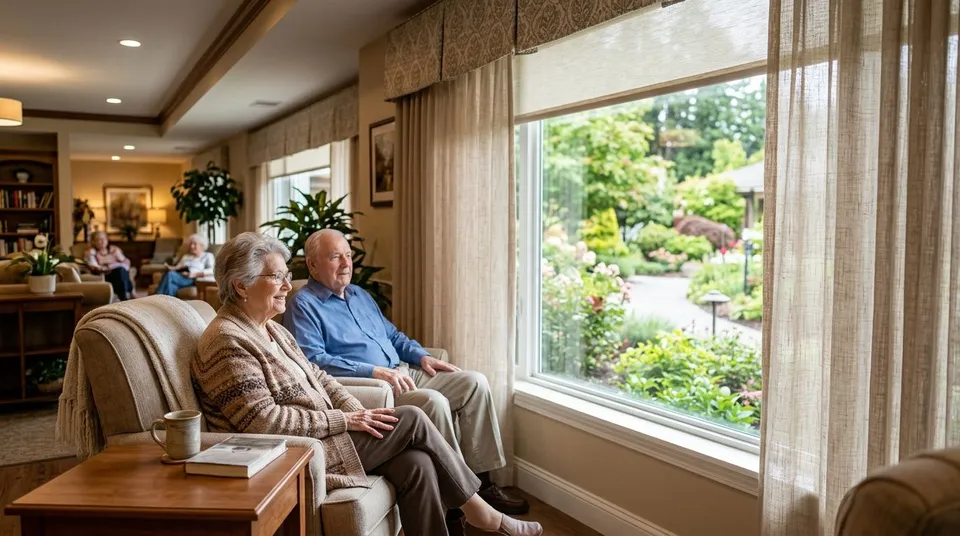
Window treatments for assisted living facilities are cordless, low-maintenance shades and drapery specified for resident safety, one-hand staff operation, and consistent light control across dozens of units at once. A homeowner picks a shade for one room. A facility director has to pick one that performs the same way in forty rooms, for residents with different vision, mobility, and memory needs.
- Cordless lift systems are the non-negotiable baseline for window treatments for assisted living facilities in 2026.
- Motorized and smart shades cut daily staff labor across wings with dozens of windows.
- Cellular shades suit resident bedrooms; wipe-clean roller shades suit common areas and dining rooms.
- Drapery works in formal common rooms but launders slower than a shade after daily cleaning rounds.
Why window treatments matter for assisted living facilities
Assisted living directors buy window treatments for reasons a single-family homeowner rarely weighs: strangulation risk, glare sensitivity, and a housekeeping crew cleaning between units every single day. The window covering industry's ANSI/WCMA A100.1 standard has required stock blinds and shades sold in the US to be cordless since December 2018, but custom-made units built for a specific facility fall outside that mandate unless the buyer writes cordless lift systems into the purchase order. Specifying window treatments for assisted living facilities in 2026 means treating that line item as mandatory, not assumed.
That gap matters more here than almost anywhere else. Residents with limited mobility or memory impairment are exactly the population a dangling cord puts at risk. Light control carries its own weight too: bedrooms need real blackout for residents on medication schedules or with sundowning symptoms, while dining rooms and activity spaces need glare control without going dark during the day.
A building that treats every window the same, one shade style top to bottom, ends up over-lighting half its rooms and under-lighting the other half. Reviewing aging-in-place window treatments is a reasonable starting point since assisted living shares most of the same operability and safety logic, just applied at building scale instead of one home.
How to choose window treatments for assisted living facilities
Eliminate cords from every resident-facing window
- Specify cordless lift systems on all custom blinds and shades, even though facility-grade custom units are technically exempt from the federal cordless mandate
- Retrofit older buildings with cordless lift kits before replacing entire shades
- Avoid continuous-loop cord systems in hallways and common rooms where residents wander
- Flag any shade with an exposed pull cord during the annual safety walk-through
Match light control to what each room actually does
- Blackout or heavy light-filtering shades in resident bedrooms for medication schedules and sundowning symptoms
- Light-filtering or sheer shades in dining rooms and activity spaces so daytime hours stay bright without glare
- Dual, day and night shades in common rooms that switch between quiet afternoons and bright group activities
- Skylight shades in vaulted common areas to cut overhead glare without losing natural light entirely
Choose fabric and material for daily cleaning, not looks
- Vinyl-faced or PVC-coated roller shades wipe down in seconds between rounds
- Skip heavily pleated fabric roman shades in high-traffic common areas since folds trap dust and slow down housekeeping
- Reserve fabric-heavy drapery for formal dining rooms and lobbies, not resident bedrooms or bathrooms
- Confirm any fabric on order meets the facility's fire-retardancy requirements before it ships
Simplify operation for staff and residents with limited dexterity
The same logic behind ADA-friendly blinds applies at facility scale: fewer moving parts residents have to fight with, and no fine-motor task required to make a room dark or bright.
- Move common-area shades to motorized operation so one staff member can raise or lower an entire wing on a schedule
- Add smart shades on a timer for bedrooms tied to a consistent wake and sleep routine
- Skip manual wand or chain-loop controls for residents with arthritis or reduced grip strength
- Use battery-powered motorized units in older buildings where rewiring every window isn't practical
Control glare and heat in shared spaces
- Outdoor or solar shades on south- and west-facing common room windows to cut afternoon heat gain
- Pair a light-filtering shade with a sheer layer in sunrooms so residents can sit near the glass without squinting
- Check west-facing dining rooms first since they usually get the most complaints during long summer evenings
Standardize product lines across the building
- Pick one or two shade types per building so replacement parts and repairs stay simple for maintenance staff
- Keep the same mount type, inside or outside, for windows of the same size throughout a wing
- Log exact measurements per unit at installation so reorders after a resident move-out don't require remeasuring
Schedule installation around residents, not just the calendar
- Install during daytime hours with advance notice posted for residents in that wing
- Work room by room instead of pulling every window covering in a wing at once
- Coordinate access with facility maintenance staff rather than the front desk alone
Comparing window treatment options for assisted living facilities in 2026
| Option | Best For | Key Limitation |
|---|---|---|
| Roller shades | Common areas and dining rooms needing a wipe-clean surface | Manual chain versions still need a cord unless upgraded to cordless or motorized |
| Cellular shades | Resident bedrooms where insulation and quiet operation matter | Fabric pockets collect dust faster than a flat roller shade |
| Zebra shades | Activity rooms that switch between full light and full privacy | More moving parts than a single shade means more to maintain |
| Motorized or smart shades | Entire wings where staff need to raise or lower dozens of windows on one schedule | Battery or wiring upkeep adds a maintenance step housekeeping doesn't have with manual shades |
| Drapery, rod or track | Formal common rooms and dining rooms needing a softer look | Heavy fabric panels are slower to launder and harder to wipe down than a shade |
The verdict for most buildings: motorized roller or cellular shades in resident bedrooms, cordless roller shades in common areas, and drapery reserved for formal lobbies only.
Common mistakes assisted living facilities make with window treatments
- Installing manual cord-operated blinds in resident bedrooms because they're the cheapest stock option, adding cord risk exactly where residents spend the most unsupervised time.
- Choosing one shade style for the entire building, so common rooms end up too dark for daytime activities or bedrooms too bright for residents on a set medication schedule.
- Picking heavy drapery for every common area. It reads formal, but it takes far longer to launder than a shade once housekeeping is on a strict rotation.
- Skipping motorized shades in common areas to save cost, which quietly costs more in staff time spent manually adjusting dozens of windows every day.
- Using patterned or high-contrast fabric in memory care hallways, which can read as a physical obstacle to residents with dementia and cause hesitation or falls.
Get a facility-wide consultation
Free in-home measurement and quote for every window in your building.
FAQ
What's the best window treatment for assisted living facility bedrooms?
Cordless or motorized cellular and roller shades with blackout or heavy light-filtering fabric work best in resident bedrooms in 2026. They control light for medication schedules and sundowning symptoms without leaving a cord within reach.
Are corded blinds legal in assisted living facilities?
Corded blinds aren't illegal in a custom-built facility order, but they carry real strangulation risk for residents with limited mobility or memory impairment. Custom window coverings are exempt from the federal cordless mandate that covers stock consumer blinds, so a facility has to specify cordless in writing.
How much light control do memory care rooms need?
Memory care bedrooms generally need near-full blackout capability to support consistent sleep and reduce sundowning symptoms. Common areas in the same wing need the opposite: bright, glare-controlled light during the day.
Should common areas get motorized or manual shades?
Common areas with more than a handful of windows benefit from motorized or smart shades because one staff member can adjust an entire room on a schedule instead of walking window to window. Manual shades still work for smaller rooms with one or two windows.
What fabric holds up best to daily cleaning in a facility?
Vinyl-faced or PVC-coated roller shade fabric wipes clean in seconds and holds up to daily housekeeping better than pleated fabric shades. Heavily pleated roman shades trap dust in the folds and take longer to clean between rounds.
Can you retrofit cordless lifts on existing blinds?
Cordless lift kits can retrofit many existing blinds without a full replacement, which is a faster and cheaper fix for a building working through a safety walk-through checklist. Full shade replacement is usually only needed once the existing hardware is worn out.
Is drapery a good fit for assisted living common areas?
Drapery works well in formal lobbies and dining rooms where the look matters, but it's a poor fit for daily-use common areas because heavy fabric panels are slower to launder than a shade. Reserve drapery for spaces cleaned on a lighter schedule.
Do outdoor shades work for facility patios and courtyards?
Outdoor roller shades work well on facility patios and courtyards to cut afternoon glare and heat for residents sitting outside. They're a common addition to south- and west-facing common areas that get complaints about sun in the late afternoon.
One last thing
Most facility directors assume cordless comes standard once they order custom shades. It doesn't. Custom-made window coverings, the kind almost every assisted living building needs because institutional window openings rarely match stock sizes, are specifically carved out of the federal cordless mandate. If cordless isn't written into the purchase order line by line, a supplier can ship a corded lift and still be in compliance with the letter of the regulation. Heading into 2026, that's the single line item worth double-checking before any order goes to production, and it's worth confirming outside-mount hardware where window frames have shifted slightly after decades of building settling, since outside mount tolerates an out-of-square frame better than inside mount.