
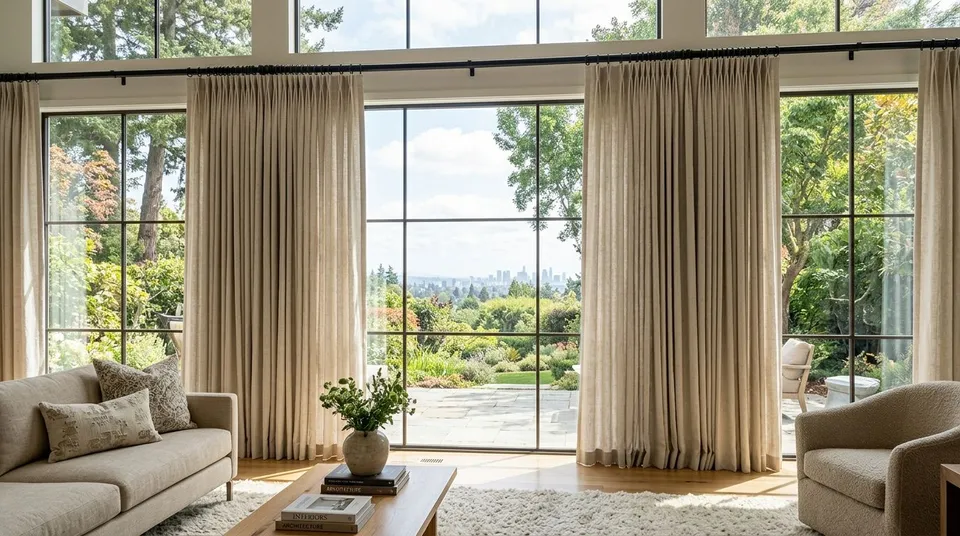
Traverse rod drapery for large window walls is drapery hung on a cord-and-carrier track built to span wide runs of glass without sagging, bowing, or dragging at the center. Large window walls (great rooms, walls of sliders, floor-to-ceiling glass) need hardware rated for the width and weight of multi-panel drapery, not a decorative rod stretched past its limit.
- Traverse rod drapery for large windows needs a track rated for the full span, not a single decorative rod bridged across brackets.
- Cord-operated traverse rods stay budget-friendly; motorized traverse rods solve the pull-cord problem on runs over 10-12 feet.
- Rainier Blinds measures and installs drapery hardware and panels for Greater Seattle Area homes with large window walls in 2026.
- Fabric weight and lining matter more on large spans, where unlined panels sag and show every seam.
- Pair traverse rod drapery with cellular or roller shades underneath for privacy without closing the whole wall off.
Why traverse rod drapery matters for large window walls
A single rod bracketed at 8-foot intervals will bow under the weight of floor-length panels once the span passes about 10 feet. Traverse rods distribute that weight along an internal track, which is why they show up on great room walls, walls of French doors, and floor-to-ceiling window walls where a decorative rod alone can't carry the load.
Homeowners searching for traverse rod drapery for large windows in 2026 are usually replacing a rod that's already sagging, or they're covering new construction glass that came without any drapery hardware at all. Either way, the fix is the same: match the track to the span, then match the fabric to the track.
Measure your window wall before you shop for hardware
Get the exact width and height first. Guessing on a wide span is the single most common reason traverse rods arrive short, sag, or won't stack cleanly to the side.
- Measure wall-to-wall width, not just glass width, if you want panels to stack off the glass entirely
- Measure floor-to-ceiling height at both ends of the window wall (many walls aren't perfectly level)
- Note any obstructions: outlets, HVAC vents, or trim that will interfere with bracket placement
- Record stacking space needed on each side, typically one third of the panel width per side
- Check ceiling height if you're mounting close to the ceiling for a taller visual line
Choose the right rod type for the span
Not every traverse rod is built the same, and the wrong type on a wide wall is how you end up with a rod that bows within a year.
- One-way traverse rods stack panels to one side, useful when the window wall sits beside a wall you can stack against
- Two-way (center-draw) traverse rods split panels to both sides, the standard choice for a symmetrical window wall
- Drapery track systems (ceiling-mounted, no visible rod) work best when you want the fabric to be the only visible element
- Motorized traverse rods replace the pull cord with a remote, app, or wall switch, which matters once a rod crosses 10 to 12 feet and cord tension becomes unreliable
- Confirm the rod's rated span before buying; a rod rated for 8 feet will sag well before the 12-foot mark on a heavy fabric
This is the point where the manual-versus-motorized decision actually matters. On anything under about 8 feet, a cord-operated traverse rod is fine and costs less to set up. Past that width, especially with lined or interlined panels, the cord starts to bind and the pull becomes uneven from one side to the other. Rainier Blinds measures the span and tells you plainly whether your window wall is a manual-rod job or a motorized one.
Pick fabric weight and lining for the span you have
Fabric choice changes more on a large window wall than on a standard window because gravity and light exposure both work harder over more square footage.
- Lined panels hold their shape across a wide traverse and resist sun fade better than unlined fabric
- Interlined panels add a layer between face fabric and lining for rooms that need better light blocking or a heavier drape
- Lightweight sheers work for filtering light across a window wall but won't carry a traverse the way a lined drapery does
- Blackout linings matter for west-facing window walls or home theaters where full light control is the goal
- Match the fabric's fullness ratio (typically 2x to 2.5x the rod width) so the panel doesn't look stretched thin once it's hung
For help narrowing fabric choices for a specific room, how to choose drapery fabric for custom window treatments covers weight, weave, and light-blocking tradeoffs in more detail.
Decide on manual, motorized, or smart operation
Operation tier is a separate decision from rod type, and it's where cost and convenience trade off most directly.
- Manual traverse rods use a pull cord or wand, the lowest-cost option for spans under 8-10 feet
- Motorized traverse rods run on a remote or wall switch, removing the cord-tension problem on wide spans
- Smart traverse rods connect to a hub or app for scheduling and voice control, useful in great rooms used daily at different times of day
- Battery-powered motors avoid a new electrical run; hardwired motors suit new construction where wiring is already planned
- Confirm which operation tier the room actually needs before paying for smart features a great room won't use daily
Rainier Blinds installs traverse rod drapery across all three operation tiers for Greater Seattle Area homes, and the crew that measures your window wall is the same crew that comes back to install it, not a subcontractor.
Plan fullness and stacking space so panels don't block glass
A panel that's too flat looks thin against a wide window wall, and a panel with nowhere to stack ends up covering glass you wanted open.
- Budget stacking space equal to roughly one third of the panel width on each side
- Choose 2x to 2.5x fullness for a tailored look that still moves smoothly on the track
- Mount the rod 4 to 6 inches above the window frame and extend it 4 to 6 inches past each side for a cleaner stack
- Consider a center-draw traverse if the window wall has a focal point (fireplace, view) you don't want a one-way stack to cover
- Leave clearance for any furniture or trim the panel will pass in front of when fully open
Layer drapery with shades for daily privacy control
Drapery alone on a window wall means opening the whole thing for daylight or closing the whole thing for privacy. Most large window walls in 2026 pair traverse rod drapery with a shade underneath for daily light control, saving the drapery for evening privacy or full blackout.
- Cellular or roller shades mounted inside the window frame handle daily privacy without touching the drapery
- Zebra shades give adjustable light filtering behind drapery that stays purely decorative
- Motorized shades paired with a motorized traverse rod let both layers run on the same remote or app
- Keep the shade's mount clearance in mind when the traverse rod sits close to the frame
For a deeper look at combining the two, motorized shades for large picture windows walks through pairing options for wide glass.
Get your window wall measured
Free in-home consultation, real pricing on the spot.
Install and maintain the hardware correctly
A correctly measured traverse rod still needs correct mounting, or the whole plan falls apart at the bracket.
- Anchor brackets into studs or use rated hollow-wall anchors on wide spans; drywall alone won't hold a lined panel long-term
- Check the rod's level across the full span before hanging panels, not just at the ends
- Test the cord or motor with panels attached before calling the install finished
- Vacuum tracks and wipe carrier hooks twice a year to keep the glide smooth
- Re-check bracket tension annually on spans over 12 feet, where hardware sees the most load
Comparison: drapery hardware options for large window walls
| Option | Best for | Key limitation |
|---|---|---|
| Manual traverse rod | Spans under 8-10 feet, lower-cost setups | Cord tension gets unreliable past 10-12 feet |
| Motorized traverse rod | Wide spans, daily-use great rooms | Needs power source or reliable battery charging routine |
| Ceiling-mounted track system | Rooms where a visible rod isn't wanted | Requires ceiling access and level mounting across the full run |
| Decorative rod (non-traverse) | Standard single windows, not window walls | Bows and sags once bridged across a wide span |
| Shades alone, no drapery | Daily privacy without fabric maintenance | No soft light-filtering layer or full blackout option |
Common mistakes on large window wall drapery
- Buying a decorative rod for a traverse-rod job. A rod rated for a standard window will bow within months once bridged across 10+ feet of glass.
- Skipping the lining on a wide span. Unlined fabric sags and shows every seam once it's stretched across a full window wall.
- Underestimating stacking space. Panels with nowhere to stack end up covering the exact glass the homeowner wanted left open.
- Choosing manual operation on a 14-foot span. Cord tension becomes uneven long before the panel reaches full width.
- Mounting into drywall alone. Wide-span hardware carrying lined panels needs stud anchors or rated hardware, not just drywall anchors.
Past about 10 feet of span, a cord-operated traverse rod is fighting physics, not just fabric weight.
FAQ
What is traverse rod drapery for large windows?
Traverse rod drapery for large windows is drapery hung on a cord-or-motor-operated track built to carry panels across wide spans without the rod bowing at the center. It's the standard hardware choice for great rooms, window walls, and multi-panel sliding door setups.
How wide can a traverse rod span before it sags?
A single decorative rod typically bows past 8-10 feet under the weight of lined drapery. A properly rated traverse rod distributes weight along an internal track and holds a level line across much wider spans.
Is motorized traverse rod drapery worth it for large windows?
Motorized traverse rods solve the uneven cord-pull problem that shows up on spans over 10-12 feet. On narrower windows, a manual pull cord works fine and costs less to set up.
Should I use lined or unlined drapery on a window wall?
Lined drapery holds its shape across a wide traverse and resists sun fade, which matters more on a window wall than on a single standard window. Unlined fabric tends to sag and show seams once stretched across a wide span.
Can I combine shades and drapery on the same window wall?
Yes, pairing a cellular, roller, or zebra shade underneath traverse rod drapery gives daily privacy control without opening the full drapery panel. This layered setup is common on large window walls in 2026 because it separates daily light control from evening privacy.
How much stacking space does traverse rod drapery need?
Budget roughly one third of the panel width on each side for the drapery to stack clear of the glass. Skipping this measurement is the most common reason panels end up covering the window they were meant to open.
Does Rainier Blinds install traverse rod drapery in the Greater Seattle Area?
Rainier Blinds measures and installs custom drapery, including traverse rod setups, for homeowners across Auburn, Bellevue, Tacoma, and the surrounding Greater Seattle Area. The same crew that measures the window wall handles the install.
What's the difference between a traverse rod and a drapery track system?
A traverse rod is a visible rod with an internal track for the carriers, while a drapery track system mounts to the ceiling with no visible rod at all. Track systems suit rooms where the homeowner wants the fabric to be the only visible element.
One last thing
The detail most homeowners miss on a window wall isn't the fabric, it's the bracket spacing. A traverse rod rated for a 14-foot span still needs intermediate support brackets roughly every 4 to 6 feet across that run, not just end brackets, or the middle of the track will sag under load within the first year regardless of how good the rod itself is rated to be.