
Our available controls: Rainier Blinds offers Roman and woven wood shades with motorized operation only. Available controls and power options for other products are confirmed at your consultation.
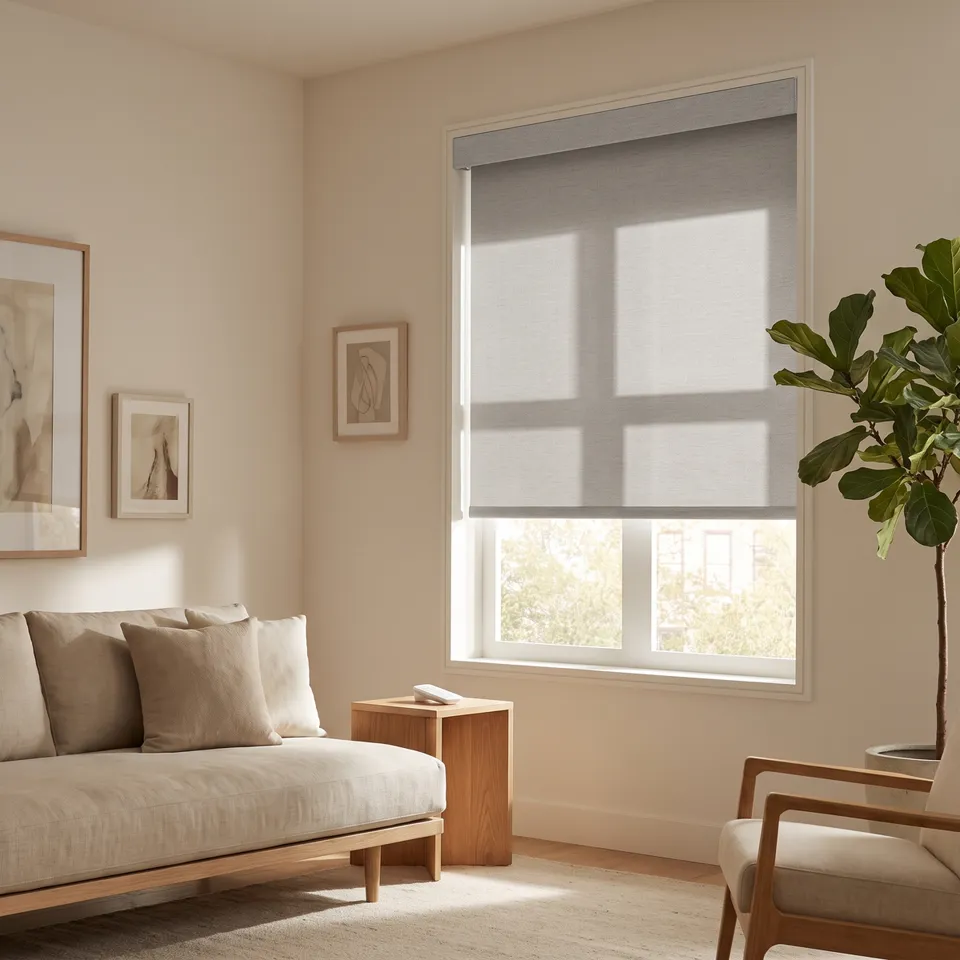
Motorized shades are the fix for Auburn, WA windows that manual shades handle badly: tall great-room glass in Lakeland Hills two-stories, stairwell windows nobody wants to ladder up to, sliders behind sofas, and bedrooms where the 5:15 AM June sunrise ends any hope of sleeping in. Push a button, tap a phone, or set a schedule and the shade moves itself. This 2026 guide covers which motor type fits which Auburn home, which shade styles work best motorized, what the install actually involves on out-of-square frames, and how a local measure-and-install crew keeps the whole setup working after the truck leaves.
TL;DR
- Motorized shades Auburn WA homes buy in 2026 win on tall windows, hard-to-reach glass, and scheduled light control.
- Battery motors retrofit into existing windows; hardwired motors suit remodels and new construction.
- Blackout cellular or roller fabric for bedrooms, light-filtering for living rooms. Motorized or not.
- Rainier Blinds measures windows, has shades custom-made to your exact measurements from a supplier, and installs with our own crew.
Why this matters
Auburn's housing mix produces the exact windows that motorization was built for. Lakeland Hills and Lea Hill two-stories carry great-room windows that run 14 to 20 feet up a stairwell wall. No manual shade gets operated daily at that height without a telescoping wand nobody keeps track of. Older ramblers off West Hill have windows placed behind sectionals and entertainment centers. Townhomes near the transit corridor face arterials where the shade needs to drop at dusk whether anyone is home or not.
The second reason is scheduling. Pacific Northwest summer sunrises land before 5:30 AM. A motorized blackout shade scheduled to close at 9 PM and stay closed until 7 AM solves the June dawn problem permanently, no morning dash down the hall in pajamas. The same schedule logic handles after-dark street privacy on first-floor front windows: the shade drops at sunset automatically, every day, regardless of who remembers.
The third reason is the honest one about manual shades: they stop being used. A shade behind the sofa that takes a wrestling match to lower stays down for months. A shade operated by remote gets used every day. In 2026, motorization has crossed from gadget to baseline on tall windows. The motors are quiet, battery packs last a season per charge, and the price gap versus manual has narrowed enough that it usually loses to one ladder accident.
What motorization does not change is the fabric decision. A motorized shade with the wrong opacity is still the wrong shade. It just moves itself into the wrong position. Blackout where you sleep, light-filtering where you live, sunscreen where you look out. The motor handles convenience; the fabric handles the actual job.
Who this is for
Auburn and South King County homeowners with windows that are tall, high, or behind furniture; shift workers and parents who need blackout on a schedule; anyone building or remodeling in Lakeland Hills, Lea Hill, or West Hill who can run wiring during construction; and anyone who has stopped using manual shades because reaching them is a chore.
It is also for buyers comparing online motorized kits and wondering what a local measure-and-install adds. Answer: the power-type decision, the casing depth check, and the motor limit calibration happen on site, with the crew that will service the shades if a motor misbehaves in year three.
It is not for renters wanting a no-drill temporary panel, and it is not a primer on products outside the shade and drapery range Rainier Blinds measures and installs.
What to look for in motorized shades for Auburn homes
Power type: battery, plug-in, hardwired
This is the first decision and it splits cleanly:
- Battery-powered shades can reduce the need for new wiring at an existing window. Confirm fit, load, power, charging equipment, and safe access for the selected Rainier shade. Recharge intervals depend on the selected motor, battery, shade size, use, and conditions. We confirm the charging method and access before ordering.
- Plug-in motors: mains power through a cord to a nearby outlet. No battery maintenance, but the outlet has to be reachable and the cord visible or concealed. Fine for outlets behind furniture; a no-go on picture windows with no outlet.
- Hardwired motors: low-voltage wiring run to each window, cleanest look, no charging ever. Requires an electrician or an open wall, which makes it the right call during new construction or a remodel and wrong for almost everything else.
Compare power options for the actual shade and room. Existing construction, wiring routes, shade load, and safe charging access all matter; neither battery nor hardwired power is automatically right for every project.
Shade style: which fabrics make sense motorized
The motor does not care what fabric rides the tube, but the room does:
- Blackout cellular: the insulated pick for bedrooms and media rooms; double-cell fabric plus a motorized schedule is the strongest dark-sleep setup in the catalog.
- Motorized roller: the slim, modern pick for great rooms and offices; light-filtering or sunscreen fabric for glare control on west-facing glass.
- Motorized zebra: dual bands let one shade move from sheer daylight to solid privacy on a schedule; the pick for street-facing living rooms.
- Roman and woven wood styles: motorization earns its keep where the shade is large and heavy; the fabric stacks ride a motorized tube the same as flat fabric.
One fabric opacity house-wide is the same mistake motorized or not. The motor multiplies convenience, not light control.
Noise and speed
Residential motors in 2026 run quiet, a soft whir at conversational level. Noise matters most in bedrooms and nurseries, where a shade that wakes the sleeper it just blacked out defeats the purpose. Ask for the quiet-grade motor on bedrooms and in-law suites; the standard motor is fine for great rooms and offices. Travel speed is mostly a non-issue on standard windows but matters on very tall glass, where a slow motor takes a while to travel and a faster one keeps daily use snappy.
Control: remote, wall switch, phone, voice
Choose the controls you want during the consultation: a compatible remote, wall control, or smart-home setup. App scheduling, voice control, and away-from-home use depend on the selected motor, controller, platform, and network. Our automation service is for Rainier-supplied shades; future upgrades are assessed for the exact equipment.
Mount depth and out-of-square frames
Battery motors add depth to the headrail. More than a manual cordless shade needs. Shallow casings on older Auburn frames sometimes reject the motor inside an inside mount, which pushes the decision to an outside mount on the trim. Settled frames are rarely square: width gets taken at top, middle, and bottom and the tightest number wins, or the shade binds on every cycle. Motor travel limits also get set at install, where the shade stops at the top and the bottom, and that calibration needs a level opening, which is exactly what the measure visit confirms.
Warranty and service
A motorized shade is a 10-to-15-year product with a motor that may need service sooner. Ask three things: fabric fade coverage, motor warranty length, and who actually performs service. A local crew that measured and installed the shades is accountable for the follow-up visit; a national hotline is not. Batteries are consumable. Ask what a replacement pack costs before ordering twelve of them.
Top picks for Auburn and South King County
The bedroom pick: motorized blackout cellular
The dark-sleep pick. Double-cell blackout fabric stops the June sunrise; the motor's schedule handles it before anyone is awake. Buy for primary bedrooms, nurseries, and shift-work bedrooms. Battery motor on existing windows, hardwired if the walls are already open. Custom-made to the tightest of three width measurements, not a stock chart.
The great-room pick: motorized light-filtering roller
The tall-window pick. Two-story glass in Lakeland Hills and Lea Hill great rooms gets daily use only when operating it costs nothing. Light-filtering fabric cuts the west-afternoon glare without darkening the room. Buy for stairwell walls, vaulted living rooms, and any window above reach. Skip motorization on standard-height windows where a cordless shade does the same job for less.
The street-front pick: scheduled privacy shades
The after-dark pick. First-floor windows along arterials and close lots in Auburn, Kent, and Federal Way need privacy at dusk, not at bedtime. A scheduled drop at sunset handles it. Motorized zebra or cellular both work. Consider on first-floor street-facing windows; upstairs windows rarely need the automation.
The hard-to-reach pick: motorized skylight and high windows
The reach pick. Skylights and vaulted-ceiling windows are the case where motorization is not an upgrade. It is the only practical control. Motorized skylight shades with blackout or light-filtering fabric cut the summer heat gain on overhead glass that manual hardware simply cannot reach. Buy on skylights and any window above stair height.
The smart-home pick: hub-connected shades
Compatible smart controls can add routines or voice operation. Confirm the exact equipment required by your preferred platform; compare those features with a simpler remote setup before deciding.
The skip: self-measure motorized kits online
A motor adds failure modes a manual shade does not have, wrong travel limits, a headrail too deep for the casing, a battery pack that dies in year two with no local service. Fixed chart widths plus a phone-app measurement on out-of-square Auburn frames compounds the risk. In 2026 the price gap between online kits and locally measured-and-installed motorized shades is often smaller than one remake plus one service call. Skip for custom openings.
What to avoid
Do not choose battery or wired power solely because the home is existing or new. Confirm the product's power requirements, available wiring routes, maintenance access, and electrical scope before ordering.
Motorizing the wrong fabric. The motor moves the shade; it does not fix the fabric. Blackout where you sleep, light-filtering where you live. A scheduled wrong shade is still the wrong shade.
Skipping the depth check. Battery motors and cassettes need more headrail depth than manual hardware. Shallow casing on older frames may force an outside mount, decided on the measure visit, not after the order arrives.
Ignoring travel limits. A motor that slams its top limit or stops short of the sill every cycle is an install-day calibration issue, not a defect. Confirm limits are set before the crew leaves, and confirm who to call when one drifts in year three.
Verdict comparison
| Option | Best for | Key spec | Verdict |
|---|---|---|---|
| Motorized blackout cellular | Bedrooms on a schedule | Blackout fabric with compatible scheduling | Buy |
| Motorized light-filtering roller | Great rooms, tall glass | Charging requirements vary | Buy |
| Scheduled street-front shades | First-floor fronts | Sunset auto-drop | Consider |
| Motorized skylight shades | Skylights, vaulted glass | Plan controls and maintenance access | Buy |
| Hub-integrated shades | Existing smart homes | Confirm supported smart features | Consider |
| Self-measure kits online | Out-of-square frames | No local service | Skip |
How local measure and install works
We bring fabric samples to your home and help you choose the weave, texture, and finish in your own light. Your shades are custom-made to your measurements, and our local crew handles measuring and installation.
- Consult and measure: on-site, room by room, noting power type per window, casing depth, and obstacles (furniture, cranks, deep trim).
- Measured quote: real pricing per window for motor type, fabric, and control setup. No showroom visit required.
- Production and installation timing depend on the selected fabric, hardware, supplier availability, and project scope. We confirm the current estimate for your order before you plan around a completion date.
- Installation: our team checks mounting and operation, sets motor travel limits where applicable, and shows you the controls. The number and timing of visits depend on the project.
That process is built for South King County window stock that does not match catalog widths. Coverage details sit on the Auburn service area page. For the manual counterpart on the same windows, see our cellular shades Auburn WA guide, and for the angled-glass version of the same problem, our skylight shades Auburn WA guide.
FAQ
What are the best motorized shades for Auburn WA homes in 2026?
How much do motorized shades cost in Auburn, WA?
Are battery-powered motorized shades reliable?
Can motorized shades be added to existing windows?
Do motorized shades work with Alexa or Google Home?
How long do batteries last in motorized shades?
Will motorized shades fit my out-of-square windows?
Does Rainier Blinds make the shades in-house?
One last thing
The detail most Auburn homeowners miss in 2026 is grouping. A motorized shade bought per window gets a remote per window, and twelve remotes are how motorized shades end up used manually, badly. Shades are grouped by room or by sun exposure: one command drops the whole west-facing wall at sunset, one raises the kitchen bank at 7 AM. Grouping and schedules are set at install, and they are what turn a motorized shade from a gadget into infrastructure.
Ask for grouping and schedules during the measure visit. Between grouping, the sunset schedule, and blackout fabric on bedrooms, motorized shades solve the June-dawn problem and the after-dark privacy problem in the same order, but only if both decisions are made on order day.