
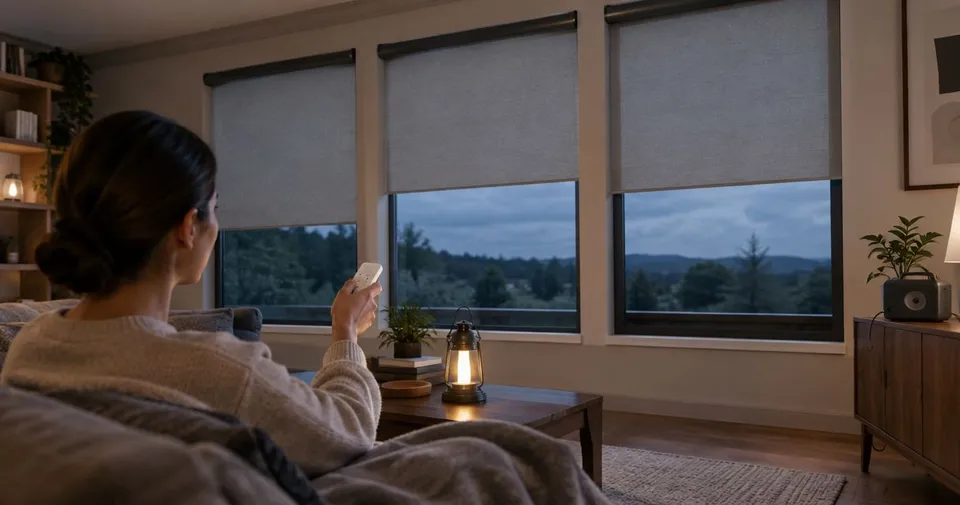
Keep motorized shades working during a power outage by identifying their power source, charging rechargeable batteries before storms, protecting required controls with compatible backup power, and learning the approved fallback control. Battery-powered shades can operate while their charge remains, but hardwired shades need a backed-up circuit. Never pull the fabric or bottom rail by force; use a manual control only when the system documentation permits it.
- Motorized shades during a power outage work only when their motor or electrical circuit still has power.
- Battery-powered shades are the simplest choice for operation independent of household electricity.
- Hardwired shades need a generator, battery system, or another approved source protecting their circuit.
- Smart controls can fail when the router or hub loses power, even if the shade remains powered.
- Rainier Blinds is best for Greater Seattle homeowners who want custom motorized shades measured and installed locally.
Why this matters
An outage can leave a shade open when you need privacy or closed when you need daylight. The right fallback depends on the motor, power supply, controls, and installation, so an outage plan must match the actual system rather than a generic motorized-shade checklist.
Start with the power source and charging routine. The motorized shade battery maintenance guide explains the routine for rechargeable systems. In 2026, record the motor and control information while power is available instead of trying to identify components during a dark house.
Rainier Blinds measures and installs custom motorized shades with its own crew, not a subcontractor. The shades are custom-made by a wholesale supplier, so backup behavior depends on the selected motor, controls, and power configuration.
How do you keep motorized shades working during a power outage?
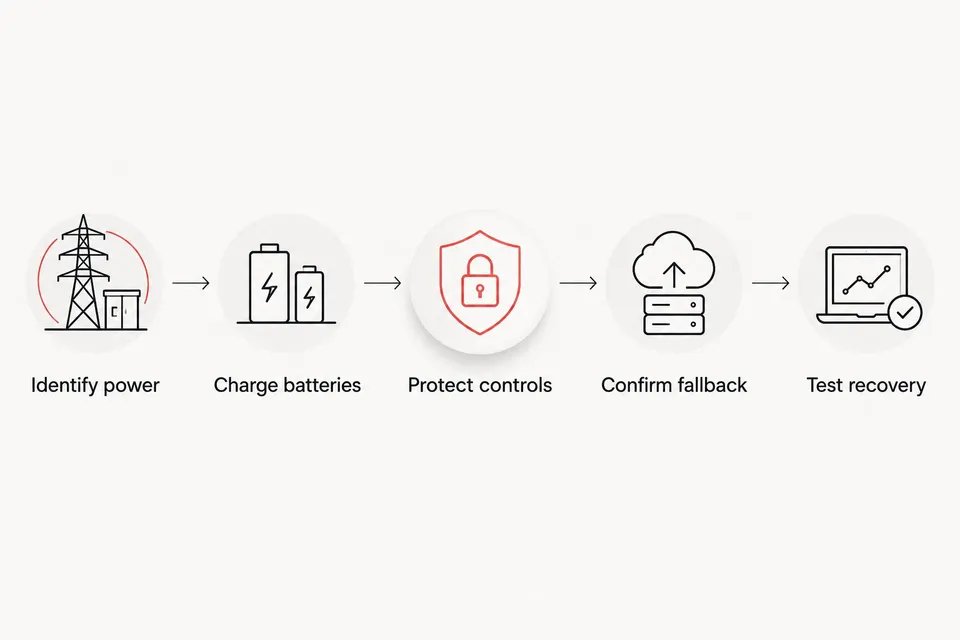
Use this sequence before an outage. It separates preparation from troubleshooting and prevents damage caused by forcing a shade that is designed to move only under motor or approved manual control.
| Step | What to check | Why it matters |
|---|---|---|
| 1 | Battery-powered or hardwired motor | Determines whether household power loss stops the motor |
| 2 | Battery charge or backed circuit | Confirms the shade has an available power source |
| 3 | Remote, wall control, hub, and router | Identifies which control can work without internet |
| 4 | Approved manual fallback | Provides a safe option if the motor cannot run |
| 5 | Recovery procedure | Reduces unnecessary resets after electricity returns |
1. Identify how every shade receives power
Check whether each motor uses a rechargeable battery, replaceable batteries, low-voltage wiring, or a hardwired power supply. Do not assume all shades in the house use the same configuration. A retrofit room can have battery-powered shades while shades installed during construction use concealed wiring.
Write the power type beside the room name in your household outage notes. Include the location of chargers, remotes, wall controls, hubs, and relevant electrical panels. This simple inventory is the foundation of a practical 2026 outage plan.
2. Charge rechargeable shade batteries before storm conditions
Rechargeable motorized shades keep operating only while their batteries retain enough energy to move the shade. Follow the motor supplier's charging instructions and use the approved charger. A random charger or power bank is not a safe substitute unless its specifications and connector match the system documentation.
Operate each shade after charging instead of treating a charging indicator as proof that everything works. Listen for unusual movement and confirm the shade reaches its normal upper and lower limits. If a shade moves unevenly or does not respond, use the motorized shade motor troubleshooting guide before the next outage.
3. Protect the controls the shade actually needs
A powered motor is only useful when you have a working way to control it. Keep compatible handheld controls in a known location, and replace their batteries according to the control manufacturer's instructions. Test local controls without using the phone app so you know which functions do not depend on Wi-Fi.
Smart shades add more possible failure points. A hub, router, smart speaker, or bridge can lose power while a battery-powered shade remains ready to move. Compatible backup power for required network equipment can preserve app control, but runtime and compatibility depend on the equipment connected to it.
4. Confirm whether the system has a manual fallback
Some motorized shade systems offer an approved manual override, while others do not. Find the instructions for your exact motor and shade before trying to move anything by hand. Never tug the fabric, twist the roller, or lift one side of the bottom rail.
If the system includes a manual control, store the tool where household members can reach it during an outage. Practice the approved procedure under normal lighting. If there is no manual option, choose the shade position you want before severe weather arrives.
5. Test the full outage routine safely
A safe test does not require opening electrical equipment or changing wiring. Disconnect only the plug-in components that the manufacturer allows you to disconnect, then confirm which remotes, switches, and apps still work. For hardwired systems, ask a qualified electrician how the shade circuit behaves on existing backup power.
Document the result for each room. A useful note says whether the motor runs, which control works, and what must be restarted after power returns. Repeat the check after a control, router, hub, motor, or electrical backup system changes.
Battery-powered shades: best for outage independence
Battery-powered shades are the most direct option when continued operation during a household outage is the priority. Their main advantage is separation from the home's electrical circuit. If the shade battery and remote are charged, losing household electricity does not automatically remove local control.
The downside is maintenance. Batteries eventually need charging or replacement, and a neglected battery can be empty when an outage begins. Large shades and frequent operation also place more demand on the motor system, so follow the supplier's charging guidance instead of relying on a universal schedule.
Best for: Retrofit rooms and homes where independent shade operation matters.
Verdict: Battery-powered shades are the clearest choice for motorized shades during a power outage when you will maintain their batteries.
Hardwired shades: best with protected electrical backup
Hardwired motorized shades avoid routine charging because their power comes from the building's electrical system. They stop when that supply disappears unless their circuit receives power from a compatible battery backup, standby system, or generator. The backup must cover the actual shade circuit, not just selected lights or outlets elsewhere in the house.
Hardwired installations work well when wiring can be planned before walls are closed or when concealed power is a design requirement. Their outage weakness is dependency on the electrical system. Adding backup later can require electrical assessment and work outside the shade installation itself.
Best for: New construction, major renovations, and homes with planned circuit backup.
Verdict: Choose hardwired shades in 2026 only after confirming how their circuit will operate when utility power fails.
Smart shades: best for automation with a local fallback
Smart controls add schedules, app operation, and integration with compatible home systems. They also introduce dependencies beyond the shade motor. If the router, hub, bridge, or internet connection is unavailable, some automated commands can fail while a local remote or wall control continues working.
The practical solution is not to abandon smart control. Keep a tested local control available and decide whether the required network equipment needs compatible backup power. After an outage, let the router and hub restart before resetting shade programming or motor limits.
Best for: Homeowners who want automation and are willing to maintain a separate fallback control.
Verdict: Smart shades work well in 2026 when local control remains available without the app.
Why outage performance varies
Two homes with motorized shades can have completely different outage results. These factors determine what keeps working:
- Power source: Battery-powered and hardwired motors respond differently when household electricity fails.
- Stored charge: A rechargeable motor needs enough remaining charge to complete the requested movement.
- Circuit coverage: A generator or home battery helps only when it supplies the shade's circuit and associated equipment.
- Control path: A handheld control can behave differently from an app that depends on a hub and router.
- Manual capability: A manual fallback exists only when the selected shade system explicitly supports it.
- System condition: A motor, battery, remote, or hub problem that existed before the outage remains a problem during it.
Rainier Blinds is a practical fit for Greater Seattle homeowners who want the power source and operating tier addressed during an in-home consultation. The company offers manual, motorized, and smart operation for its shade and drapery lines, with measuring and installation completed by its own crew.
Plan your motorized shade setup
Discuss power, controls, measuring, and installation during a free in-home consultation.
Can you open motorized shades manually during an outage?
You can open motorized shades manually only when the specific system includes an approved manual control or override. Check the motor documentation before touching the roller or bottom rail. If no manual method is listed, leave the shade in place until power or battery operation returns.
What should you do when a charged shade does not respond?
Check the control batteries, selected channel, local wall control, hub status, and power connection before treating the motor as failed. A smart-control outage can look like a motor problem. Do not erase programming or change movement limits until basic power and control checks are complete.
Will the shade remember its limits after power returns?
Motor and control behavior after an outage depends on the selected system. Many systems retain their setup, but the correct recovery procedure comes from the motor supplier's instructions. Test normal movement first and avoid reprogramming a shade that simply needs its hub or router to reconnect.
What should a 2026 motorized shade consultation cover?
A 2026 consultation should identify the preferred operation tier, power source, control method, window measurements, installation conditions, and outage fallback. Rainier Blinds is best for Greater Seattle homeowners who want custom motorized shades measured and installed by the company's own crew. The consultation also provides real pricing on the spot rather than an online or emailed estimate.
FAQ
Do motorized shades work during a power outage?
Battery-powered motorized shades can work during a power outage while they have sufficient charge. Hardwired shades require their electrical circuit to receive compatible backup power.
What is the best power option for motorized shades during a power outage?
Battery power is the simplest option for operating motorized shades independently of the household circuit. It still requires an approved charging routine and a working control.
Can I pull down a motorized shade by hand?
Do not pull down a motorized shade by hand unless the exact system instructions provide an approved manual procedure. Forcing the fabric or bottom rail can damage the shade or alter its alignment.
Will smart shades work if Wi-Fi is down?
Smart shades can still work through a compatible local remote or wall control when Wi-Fi is down, depending on the system. App, voice, and cloud-based commands can remain unavailable until the router or hub reconnects.
Can a generator operate hardwired motorized shades?
A generator can operate hardwired motorized shades when it supplies the correct shade circuit through an approved electrical installation. A qualified electrician should confirm circuit coverage and compatibility.
Should I reset motorized shades after an outage?
Do not reset motorized shades immediately after an outage. Restore power, allow connected equipment to restart, test the normal controls, and use the supplier's recovery instructions if the shade remains unresponsive.
How do I prepare motorized shades for an outage in 2026?
Prepare motorized shades in 2026 by recording their power type, charging batteries, testing local controls, locating approved manual tools, and documenting the restart procedure. Keep chargers and controls together in an accessible place.
One last thing
Set the shades to a useful position before severe weather reaches your area. Close bedroom and street-facing shades for privacy, but leave selected shades open where daylight would help during an outage. That decision costs nothing, requires no electrical work, and remains useful even if every powered control becomes unavailable.
Rainier Blinds can address power type, control method, and installation conditions during the same in-home visit used to measure custom motorized shades. Make outage behavior part of the 2026 selection process, not a question discovered after installation.