
Our available controls: Rainier Blinds offers Roman and woven wood shades with motorized operation only. Available controls and power options for other products are confirmed at your consultation.
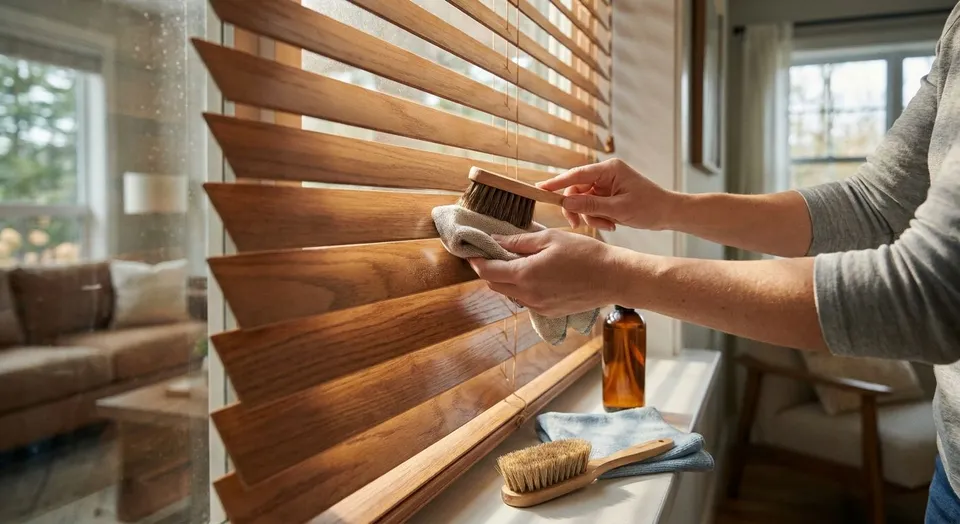
Start with the real-wood blind manufacturer’s instructions for its finish and hardware. A dry, gentle dusting method may be appropriate, but do not assume water or household cleaner is permitted. Rainier Blinds does not sell or install real wood blinds; contact the original supplier for care or repair guidance.
- Real wood blinds get a weekly microfiber dusting and a monthly barely damp wipe, never a soak.
- Standing water, steam, and ammonia cleaners crack or discolor a wood finish fast.
- Rainier Blinds skips real wood, faux wood, and aluminum blinds and installs custom shades instead.
- Woven wood roman shades and cellular shades copy the wood look with far less 2026 maintenance.
Why this matters
Wood and its finish can be affected by moisture, sunlight, and cleaning products. Follow the exact product’s care instructions and address persistent condensation; a generic climate description does not predict when a finish will fail.
Rainier Blinds measures and installs custom shades and drapery across Bellevue, Tacoma, Seattle, and Auburn, but the company does not carry real wood, faux wood, or aluminum blinds. That means the steps below are a straight answer to the search question, not a pitch for a product on the truck. If you own wood blinds already, the routine works. If you're shopping for a replacement in 2026, the second half of this page covers what to look at instead.
How do you clean wood blinds?
- Close the slats fully and dust with a microfiber duster or a vacuum's soft brush attachment, working top to bottom on one side, then flipping the tilt wand to catch the other side.
- Wipe each slat with a barely damp microfiber cloth once a month, drying immediately with a second dry cloth so no moisture sits on the grain.
- Spot clean stains with a wood safe furniture cleaner, testing an inch on the back of one slat before treating the whole blind.
- Use only the cleaning and maintenance methods approved for the exact fabric, finish, and hardware. Avoid water, steam, chemicals, or lubricant unless the manufacturer permits them. Stop using a damaged or binding treatment and contact its supplier.
- Vacuum the headrail and bottom rail track once a month. Dust builds up there first and falls back onto clean slats within days if it's ignored.
That five step routine handles a standard wood blind. Blinds with a distressed or whitewashed finish need a lighter touch on step 3, since the wood safe cleaner can pull pigment off an unsealed surface faster than off a solid stain.
Why wood blinds need more upkeep than shades
- Horizontal slats collect dust on a flat surface, unlike a rolled or folded fabric shade that hides most of its surface area when closed.
- Real wood swells and cracks with humidity swings, something roller and cellular shades never do since they're built from synthetic or coated fabric.
- Painted and stained finishes fade unevenly on the sun facing side of each slat, creating a two tone look that cleaning can't reverse.
- Cords and tilt mechanisms wear out faster on wood blinds because the slats weigh more than fabric or vinyl alternatives pulling on the same hardware.
- Individual slats need replacing one at a time when they crack, and matching an aged finish gets harder every year the blinds stay in the window.
Real wood vs the shades Rainier Blinds installs
| Option | Cleaning routine | Humidity risk | Rainier Blinds installs it? |
|---|---|---|---|
| Real wood blinds | Weekly dust, monthly damp wipe | High, can warp or crack | No |
| Woven wood roman shades | Occasional vacuum brush pass | Low to moderate | Yes |
| Cellular shades | Occasional vacuum or compressed air | Very low | Yes |
Woven wood roman shades give the same natural texture as real wood blinds with a fraction of the maintenance, and cellular shades need almost none at all. If fabric is more your style than woven wood, the routine is different again, see how to clean fabric roller shades for that specific method.
The right brush matters as much as the schedule
A stiff nylon brush scratches a wood finish the same way the wrong tool scratches an outdoor surface. Soft bristles lift dust without digging into the grain, and that logic doesn't stop at the window. Eco-friendly cleaning brushes built for patio furniture and outdoor decking use the same soft bristle approach to pull dirt off a finish without scoring it. If wood blinds sit near a slider that opens onto a deck, matching brush stiffness to each material, wood inside and weatherproof surfaces outside, keeps both looking right through 2026 instead of one dragging the other down.
Common questions about cleaning and replacing wood blinds
How often should you dust wood blinds?
Dust wood blinds once a week with a microfiber tool or a vacuum brush attachment. Skipping past two weeks lets dust bond to the finish, and it takes more scrubbing to remove without scratching the slat afterward.
Can you clean wood blinds with water?
Use only the cleaning and maintenance methods approved for the exact fabric, finish, and hardware. Avoid water, steam, chemicals, or lubricant unless the manufacturer permits them. Stop using a damaged or binding treatment and contact its supplier.
What ruins wood blinds the fastest?
Use only the cleaning and maintenance methods approved for the exact fabric, finish, and hardware. Avoid water, steam, chemicals, or lubricant unless the manufacturer permits them. Stop using a damaged or binding treatment and contact its supplier.
What's a lower maintenance alternative to wood blinds?
Woven wood roman shades and cellular shades are the lower maintenance alternative to wood blinds, since neither reacts to humidity the way solid wood does. Rainier Blinds measures and installs both across the Greater Seattle Area, including woven wood shades in Auburn and cellular shades in Auburn as direct swaps for a maintenance heavy set of wood blinds.
FAQ
What's the best way to clean wood blinds?
The best way to clean wood blinds is a weekly microfiber dusting paired with a monthly barely damp cloth wipe, never a soak. Skip ammonia cleaners since they strip the finish.
Is it okay to vacuum wood blinds?
Yes, vacuuming wood blinds with a soft brush attachment is fine and recommended once a week. Keep the vacuum on a low setting so the brush doesn't scratch the finish.
How do you get dust out of wood blind slats without scratching them?
A microfiber duster or vacuum brush attachment lifts dust off wood blind slats without scratching, since neither tool has a hard edge. Wipe in the direction of the grain, not across it.
Can wood blinds be repainted or restained once they fade?
Wood blinds can be repainted or restained slat by slat, but matching an aged finish gets harder every year the blinds are in place. Replacement is usually simpler once fading shows up unevenly across multiple slats.
Does Rainier Blinds install real wood blinds?
No, Rainier Blinds does not install real wood, faux wood, or aluminum blinds. The company measures and installs custom shades and drapery, including woven wood roman shades that mimic the wood look.
What's a low maintenance alternative to wood blinds in 2026?
Woven wood roman shades and cellular shades are the two lowest maintenance alternatives to wood blinds in 2026, since neither warps with humidity changes. Both operate differently than a slat blind, so measuring for the swap works best in person.
How often should wood blinds be deep cleaned?
Wood blinds need a deep, barely damp wipe once a month, on top of weekly dusting. Deep cleaning more often than that adds more moisture exposure than solid wood can handle.
Can you use furniture polish on wood blinds?
Furniture polish isn't recommended on wood blinds because most polishes leave an oily residue that attracts more dust to the slat. A dry microfiber cloth or a wood safe cleaner made for blinds works better.
One last thing
Sunlight can change the appearance of wood and fabric over time. Check the selected product’s exposure and care requirements; no generic shade or cleaning routine guarantees that a finish will not fade.
Related guides
In-home consultations are free within 60 driving miles of Auburn. Farther projects are considered individually; any consultation fee is quoted before booking and credited toward your order.