
Our available controls: Rainier Blinds offers Roman and woven wood shades with motorized operation only. Available controls and power options for other products are confirmed at your consultation.
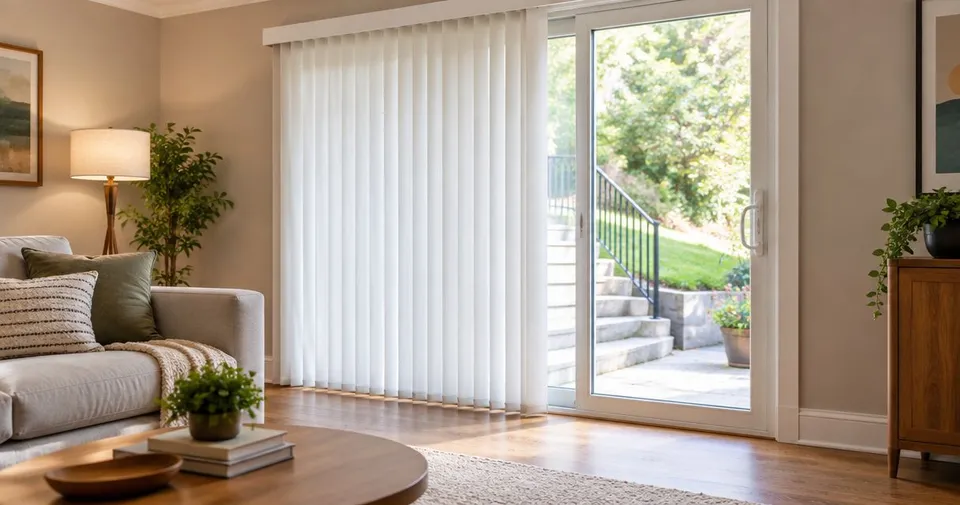
A walkout basement door needs a window covering that clears the door handle, retracts flat against the frame, and survives below grade humidity, which rules out standard slat blinds before you even look at fabric. Drapery on a track is the first pick for a sliding walkout door, because it pulls fully to one side and never has to be raised to walk through; vertical cellular and zebra shades are the next best answer for the same reason, stacking sideways instead of hanging loose slats across a door people open every day. The detail most homeowners miss: if the basement door doubles as a fire exit, the shade hardware cannot eat into the code-required clear width, and that changes which mount type actually works.
- Drapery on a track is the first pick for a sliding walkout door, with vertical cellular shades the strongest shade-side alternative.
- Outside mount clears the frame's swing radius; inside mount saves trim but can eat into egress clearance.
- Moisture-resistant fabric matters below grade, especially in older South King County basements.
- Cordless or motorized lift keeps floor-to-ceiling basement door shades safe around kids and pets.
- A walkout door used as a fire exit needs to keep its code-required clear width, not just look good closed.
Why this matters
A walkout basement door is not a standard window. It is taller, wider, gets walked through daily, and sits in the part of the house most likely to run damp. Pick a covering built for a regular window and you get slats that catch on the handle, fabric that sags on a 6-foot span, or a hem that swells the first wet winter.
Rainier Blinds measures and installs custom shades for homeowners across the Greater Seattle Area, including basements in Auburn, Kent, and Tacoma where walkout doors are common in daylight and garden-level layouts. The fix is not a bigger blind. It is the right shade type paired with the right mount.
How do you choose blinds for a walkout basement door?
Start by ruling out horizontal slat blinds entirely. They hang loose across a wide door, catch wind when the door opens, and the cords become a hazard on a door kids and pets pass through daily. The shade types below are what actually work on a walkout basement door.
| Shade type | Best for | Pros | Cons | Verdict |
|---|---|---|---|---|
| Drapery panels on a track | Sliding walkout doors used every day | Pulls fully clear of the opening, nothing to raise on the way through, softens a wide slab of glass | Needs wall space beside the door for the stack, the hem has to clear the floor and the track | Buy, the default for a slider |
| Vertical cellular shades | Sliding or French doors where drapery does not suit the room | Stacks flat to the side, adds insulation against basement cold | Fabric folds show dust in bright light | Buy |
| Zebra shades | Doors opened often during the day | Sheer stripe lets in light without losing the view, opaque stripe closes for privacy at night | Banding can hang loose on doors taller than 8 feet without extra support | Buy for daily use |
| Roller shades | Simple, low-profile coverage | Cleanest look, easiest to wipe down | No insulation value, a single flat drop can sag on very wide doors | Hold, works as a secondary layer |
The pattern across every row: whatever you choose has to move sideways out of the door's path rather than up and down. A covering that has to be raised every time someone walks through is the one people stop using by the second week.
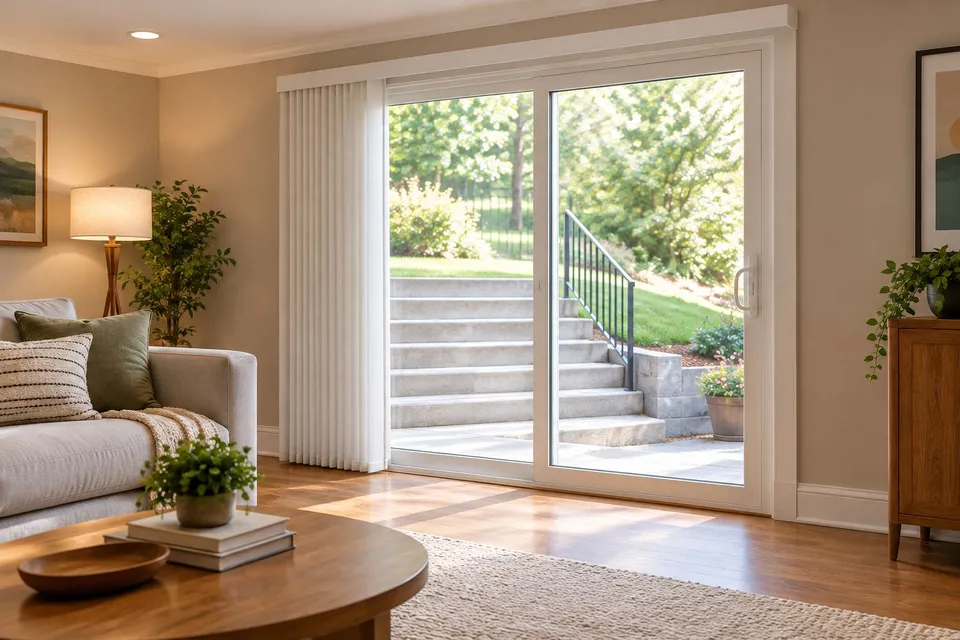
Manual, motorized, or smart lift for a basement door
Basement doors get more daily traffic than a bedroom window, and that traffic changes which operation tier makes sense.
- Manual works fine if the door is used a few times a day and the shade sits within easy reach.
- Motorized earns its place on doors taller than a standard window, where a cord or wand across a wide span is awkward to operate one-handed while carrying groceries or laundry through the door.
- Smart control adds scheduling, useful if the basement doubles as a rental unit, an ADU, or a space where you want the shade closed before anyone gets home.
The operation tier does not change which fabric or shade type is right. It changes how often you will actually use the shade correctly, which matters more on a door than on a window nobody touches.
Mount type decides whether the shade clears the door hardware
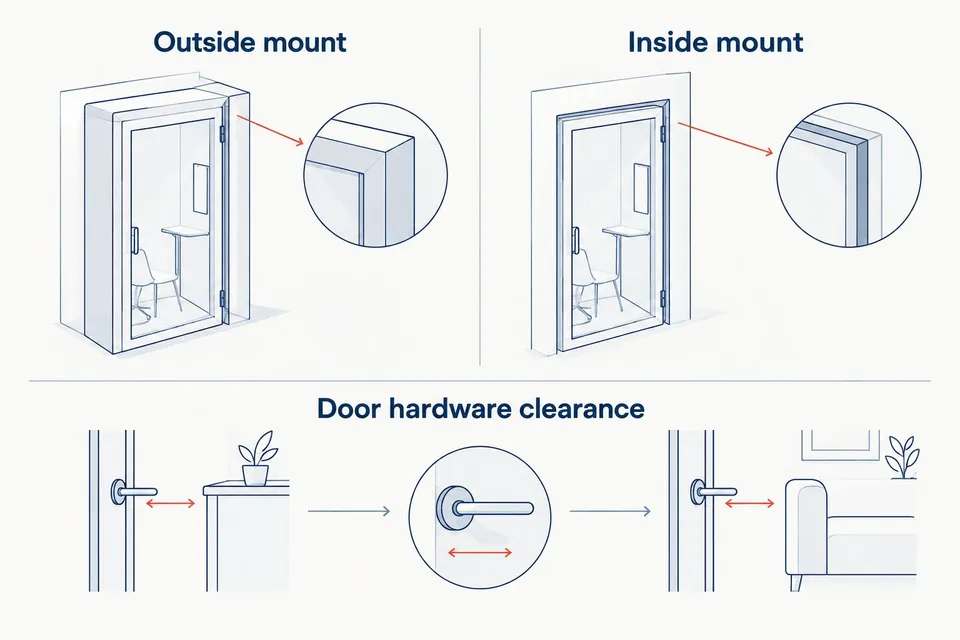
Outside mount hides the door frame's imperfections and gives the shade more room to stack, but it needs enough wall space beside the door to accept the headrail and side channels. Inside mount tucks the shade into the frame and keeps trim visible, but on a walkout door that space often overlaps with the handle, the deadbolt, or the swing radius of a French door.
Check the mount type against the door hardware before ordering, not after. A shade mounted a half inch too far into the frame will catch the deadbolt every time someone locks the door.
Egress code clearance affects how you mount the shade
If the walkout basement door serves as a fire exit for a finished basement bedroom or living space, the International Residential Code (IRC R311.2) requires the egress door to keep a minimum clear width of 32 inches. Shade hardware, a headrail bracket, or a stack of fabric that intrudes into that clear width is a code problem, not just a design one.
This is where an outside mount with slim brackets usually wins over a bulky inside-mount headrail. Confirm egress compliance for the specific door before finalizing hardware placement, especially in a basement that was finished after the home was built.
“If the shade can't stack flat off to the side, it will end up in the way of the one door people actually use to get out.”
Why the right choice varies for a basement walkout door
- Door width and height. Most walkout basement sliding doors run 6 to 8 feet wide and 6 feet 8 inches to 8 feet tall, wider and taller than a typical window, which pushes toward a shade type that stacks cleanly rather than one built for a small opening.
- Egress status. A basement door serving as a fire exit has hardware clearance rules a purely decorative window does not.
- Humidity. The EPA recommends keeping indoor relative humidity between 30% and 50% to limit mold growth, and an unfinished or poorly ventilated basement can run higher than that, which pushes toward moisture-tolerant fabric over natural woven wood.
- Foot traffic. A door used daily needs a shade that operates smoothly every time, not one that needs coaxing on a track.
- Light control. South and west facing walkout doors get direct sun for hours; zebra shades give you a middle setting between fully open and fully closed that a plain roller shade skips.
- Hardware interference. Deadbolts, handle sets, and French door astragals all compete with shade brackets for the same few inches of frame.
Get the mount type right the first time
A free in-home consultation measures the door and hardware before anything is ordered.
Is a walkout basement door better with a sliding shade or a French door shade?
A sliding walkout door needs a covering that moves entirely to one side so the door still slides freely, which is why drapery on a track is the usual recommendation; a French walkout door needs a shade split at the center hinge or two narrower shades, one per panel, so each door swings independently. Mixing the two approaches is the most common installation mistake on this type of door. If the door is French style, the fabric and hardware questions differ enough that it is worth reading the dedicated French door guide before ordering.
Can you use blackout fabric on a basement walkout door?
Blackout fabric works on a basement walkout door, but full blackout at floor level often reads darker than expected once daylight from the yard is fully blocked. Light-filtering fabric is the more common pick for a door people use during the day, reserving true blackout for basement bedrooms without a second window.
Do basement walkout doors need different shades than daylight basement windows?
Basement walkout doors need shades built for a wider, taller opening with hardware clearance in mind, while daylight basement windows are closer to standard window sizing. If the same basement has both, the door and the windows may end up on different shade types for garden-level and daylight basement windows even in the same room.
FAQ
What's the best shade for a walkout basement door?
Drapery on a track is the best fit for most sliding walkout basement doors in 2026 because it pulls entirely to one side and never has to be raised to walk through. Vertical cellular shades are the strongest shade-side alternative, and zebra shades suit doors used heavily during the day for their middle light setting.
Is a motorized shade worth it on a basement door?
A motorized shade is worth it on any basement door taller than a standard window or used several times a day, since operating a cord across a wide span one-handed is awkward. Manual lift is fine on smaller, less-trafficked walkout doors.
Can regular blinds go on a basement walkout door?
Standard horizontal slat blinds are not a good fit for a basement walkout door because the slats hang loose across a wide opening and catch on the handle when the door opens. Drapery on a track, or a shade type that stacks to the side, handles a door far better than blinds built for a stationary window.
Do I need moisture-resistant fabric for a basement door shade?
Moisture-resistant fabric matters for a basement door shade whenever the basement runs above the EPA's recommended 30% to 50% indoor humidity range. Below-grade rooms without a dehumidifier are the most common case where this applies.
How does egress code affect blinds for a basement walkout door?
Egress code requires a basement walkout door used as a fire exit to keep a minimum 32 inch clear width under IRC R311.2, and shade hardware cannot intrude into that space. An outside mount with slim brackets usually keeps the door code compliant.
What mount type works best for a basement door?
Outside mount works best for most basement walkout doors because it gives the shade room to stack fully off the frame, clearing handles and deadbolts. Inside mount can work on doors with generous frame depth and no hardware conflicts.
Are zebra shades good for basement doors used every day?
Zebra shades are a strong choice for basement doors used every day because the sheer and opaque stripes let you adjust light and privacy without fully raising or lowering the shade each time. That flexibility matters more on a door than on a window that stays closed most of the day.
Should a French walkout basement door use one shade or two?
A French walkout basement door typically needs two narrower shades, one per door panel, so each side can still swing open independently. A single wide shade across both panels blocks one door from opening without disturbing the other.
One last thing
The detail that trips up most DIY installs on a walkout basement door is not the shade fabric, it is the bracket depth relative to the door handle. Measure the distance from the glass to the outer edge of the handle before choosing outside versus inside mount, because a bracket that looks fine on paper can still catch the handle in daily use once the shade is hung. Rainier Blinds measures that clearance as part of the standard consultation, since it is the single most common reason a basement door shade gets returned or reordered.