
Our available controls: Rainier Blinds offers Roman and woven wood shades with motorized operation only. All other shade styles are available with manual, motorized, or smart control. Your consultation confirms the controls and power options for your product.
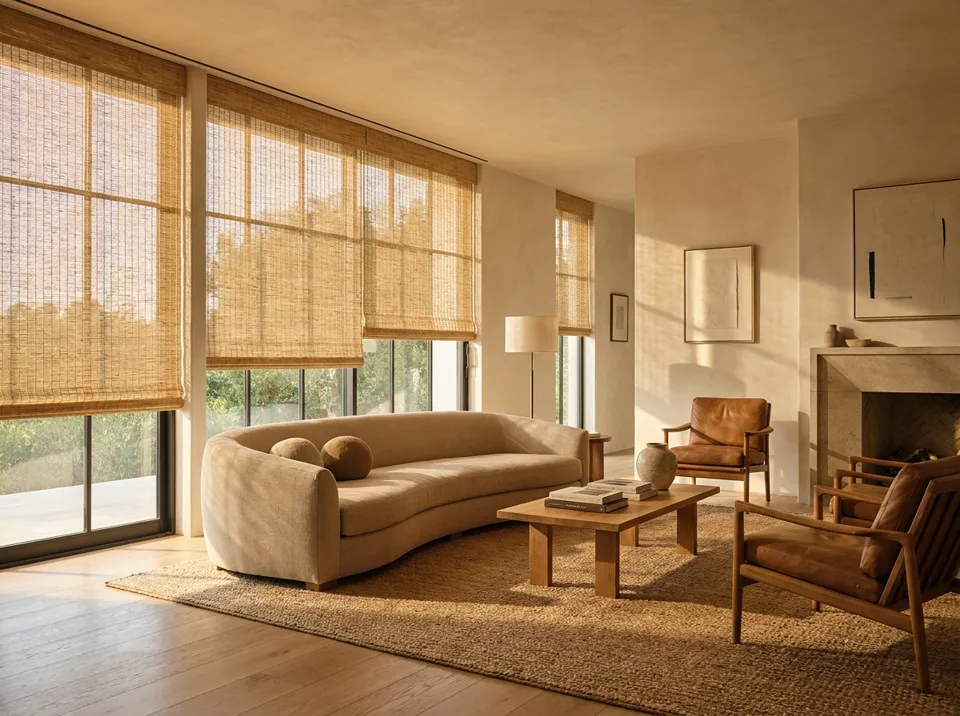
Custom shades are cut and built to your exact window, which is the only fix that works on Auburn homes where stock store sizes leave light gaps, fight the frame, or leave odd-shaped glass bare. This 2026 guide ranks the five shade styles that handle nearly every window in Auburn, WA homes — roller, cellular, zebra, woven wood, and roman — by room, fabric, and daily use, then walks through how custom shades from a local measure-and-install crew go from first consult to hanging on the wall.
TL;DR
- Roller shades win most Auburn rooms: sunscreen, light-filtering, or blackout in one clean panel.
- Double-cell cellular shades cut winter heat loss and summer glare the most.
- Zebra shades give day-and-night control on one window without layering two products.
- Woven wood and roman shades add texture where the fabric look matters.
- Rainier Blinds measures free, quotes on the spot, and installs with our own crew.
Why this matters
Auburn's housing stock defeats off-the-shelf window treatments. Lakeland Hills and West Auburn two-story builds carry tall great-room windows that no retail width covers. Lea Hill ramblers from the 1980s and 90s have wide picture windows built before anyone standardized sizes. West Hill mid-century homes have bedroom glass cut to inch-off dimensions from another era. Stock programs ship in a handful of set widths — 23, 31, 35, 43 inches — and Auburn windows do not respect those numbers.
The result is familiar: a window dressed in a shade that is either an inch too narrow with a bright stripe down one side, or mounted outside the frame on a chunky filler board. In a region where summer sun sits low and hits west-facing rooms hard from mid-afternoon, an inch of gap is an inch of glare straight onto the TV and the hardwood floor.
Custom shades solve it by starting from your window, not a size chart. The tradeoff is that you have to choose a style, a fabric, and an operation before anything gets ordered — and that choice is easier when the five real options are laid out side by side.
Who this is for
This guide is for Auburn and South King County homeowners — Lakeland Hills, Lea Hill, West Hill, Downtown, and the surrounding neighborhoods — who want shades that fit, darken, insulate, and hold up, without driving to a big-box aisle to settle for close enough. It also fits buyers finishing new construction, replacing failed DIY installs, and anyone comparing a local crew against online retailers. Full coverage details sit on the Auburn service area page.
What to look for in custom shades
Exact measurement, mount first
Every custom shade starts with two decisions before fabric: inside mount or outside mount, and the depth the frame can take. An inside mount sits inside the window casing for a clean, built-in look; an outside mount covers the trim and hides imperfections on older frames. Get the mount wrong and nothing else matters — a shade built for inside mount will not hang outside the frame. A professional measure records width at three points, height at three points, squareness, and depth in one visit, which is why guessing from a tape measure you borrowed once is the most common way custom orders go wrong.
Fabric and opacity
Shade fabric comes in three working levels. Sunscreen fabric runs 1-5% openness: tighter weaves cut more glare and block up to 99% of UV, more open weaves hold more of the view. Light-filtering fabric softens daylight to a glow while keeping privacy after dark. Blackout turns a room genuinely dark, which in Auburn means sleeping through a summer sunrise that lands before 5:30 AM around the June solstice. Pick the level per room, not per house — bedrooms and media rooms take blackout, living spaces take sunscreen or light-filtering.
Operation and safety
Cordless lift is the default in homes with kids and pets — no dangling cords, no tangles. Continuous-loop chains suit tall or heavy shades where you need precise stops. Motorized lift runs on a remote or a phone app and earns its cost on high, wide, or hard-to-reach windows, and on schedules you want automated. Decide operation per window: a motor on a kitchen window you raise twice a day by hand is money spent on nothing.
Who actually builds it
Know what you are buying before you compare quotes. Your shades are custom-made to your measurements by an established wholesale supplier, and a local crew handles the measuring and installation in person. That model is what lets a local company quote real pricing on the spot and stand behind the fit — because the same people who measured the window are the ones who hang the shade.
The 5 best custom shades for Auburn homes
1. Custom roller shades — best overall
The workhorse pick. A roller shade is one clean panel of fabric on a tube, and every fabric level comes in the same format: sunscreen for street-facing living rooms, light-filtering for kitchens, blackout for bedrooms. It mounts tight, disappears when raised, and suits nearly every window shape Auburn homes have. The tradeoffs are real but narrow: no insulation value in the fabric, and a minimal look that reads plain if texture matters to you. Buy for the majority of rooms — this is the shade to default to.
2. Double-cell cellular shades — best for insulation
The comfort pick. Cellular fabric builds air pockets into the shade itself, which slow heat loss through glass in winter and hold summer sun out in the afternoon. On north-facing rooms, bedrooms above garages, and any window that runs cold in January, double-cell cellular is the style that changes how the room feels, not just how it looks. Cons: the honeycomb texture is visible up close, and cellular stacks taller at the top of the window than a roller does. Buy for bedrooms and cold-room windows; skip it where a minimal look is the priority.
3. Zebra shades — best day-and-night control
The flexible pick. A zebra shade alternates sheer and opaque bands on one roller: align the bands and light passes through, offset them and the room closes to privacy, all without raising the shade. One window gets sunscreen-bright daytime and privacy at night from a single product — no layering a solar shade behind a blackout panel. Cons: the banded look is distinct, so it defines the room's style, and true blackout needs a room-darkening liner added, because the sheer bands never fully disappear. Buy for living rooms, home offices, and any window where you shift between open and private several times a day.
4. Woven wood shades — best natural texture
The warm pick. Woven wood shades are built from natural grasses, bamboo, and reeds, and they bring a depth of texture no flat fabric matches — the reason they anchor so many Pacific Northwest interiors. Add a privacy or blackout liner and they work in bedrooms, not just living spaces. Cons: natural materials vary slightly in tone between production runs, and the weave lets halos of light through unless it is lined. Consider for great rooms, dining rooms, and homes leaning craftsman or organic-modern.
5. Custom roman shades — best soft-fabric look
The dressed-up pick. A roman shade stacks into soft folds as it rises, giving a window the tailored look of fabric with the operation of a shade. In linen or a textured weave it finishes a dining room or primary bedroom better than any flat panel. Cons: it stacks taller than every option above, it costs more per window, and the folds collect dust in kitchens. Consider for formal rooms where the window is part of the decor.
Comparison at a glance
| Shade | Best for | Fabric range | Verdict |
|---|---|---|---|
| Custom roller | Most rooms, clean lines | Sunscreen, light-filtering, blackout | Buy |
| Double-cell cellular | Cold rooms, insulation, bedrooms | Light-filtering, blackout | Buy |
| Zebra | All-day light flexibility | Sheer bands, room-darkening liner | Buy |
| Woven wood | Natural texture, great rooms | Unlined, privacy liner, blackout liner | Consider |
| Roman | Tailored fabric look | Any drapery fabric | Consider |
What to avoid
Measuring once, from memory
A custom shade is built to the numbers you send. Width at one point on a settled frame is how half-inch gaps happen. Every measurement — width, height, depth, squareness — gets taken at the window, per opening, before anything is ordered.
"Custom" sizes at the big box
Some retail programs market themselves as custom but still cut from fixed size grids, with trim-to-fit compromises at the rail. If the order does not start with a person standing at your window, it is not custom in the way that fixes light gaps.
Corded lifts around kids and pets
Long cords tangle, fray, and hang at exactly the height small hands reach. On any window in a family room, nursery, or pet zone, cordless or motorized is the correct hardware — full stop.
Blackout in every room
Blackout is a tool for bedrooms and media rooms. Put it on a living room and you get a cave that needs lamps at noon. Match the opacity to the room.
How local measure and install works
We bring fabric samples to your home and help you choose the weave, opacity, and finish in your own light. Your shades are custom-made to your measurements, and our own crew — not a subcontractor — handles the install.
- Consult: tell us the rooms and the problems — glare, heat, privacy, bare transoms — and we map a product to each window.
- Measure: every window is measured on site, mount depth confirmed, obstacles like cranks and trim logged before ordering.
- Quote on the spot: real pricing before we leave, on every window in the project. Standard rectangular windows start from $275, backed by a warranty of up to 5 years depending on package.
- Custom-made and installed: shades arrive typically 2-4 weeks after measurements are confirmed; one visit hangs them, with motors paired and limits set before the crew leaves.
FAQ
How much do custom shades cost in Auburn, WA?
What are the best custom shades for Auburn homes in 2026?
Are custom shades worth it compared to store-bought?
How long do custom shades take to get?
Can custom shades be motorized?
What type of shade blocks the most heat and cold?
Do you install shades outside Auburn city limits?
What is the difference between roller shades and zebra shades?
One last thing
The detail that separates a real custom fit from a catalog order: mount depth. A window that looks deep enough for an inside mount often is not once the shade's headrail, brackets, and fabric roll are counted — and the fix at order time is free, while the fix after delivery is a remake. A measure that records depth and squareness per window is what makes the shade look built-in rather than hung-on.
Book the free in-home quote and decide in your own light — fabric samples against your wall say more than any product page.