
Our available controls: Rainier Blinds offers Roman and woven wood shades with motorized operation only. Available controls and power options for other products are confirmed at your consultation.
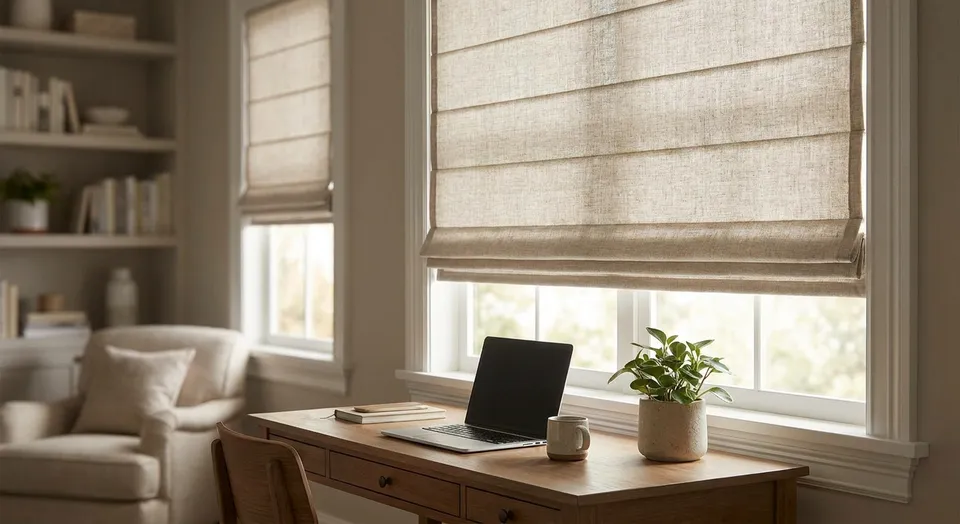
Roman shades in a home office need to do one job the rest of the house doesn't ask for: keep you looking sharp on a video call without turning the room into a cave by 2 p.m. Here's how to pick the fabric, control type, and mount that actually work for that.
- Motorized light-filtering Roman shades are the safe pick for roman shades home office setups in 2026, Buy.
- Compatible smart controls can add scheduling to motorized Roman shades; confirm the equipment and pricing during consultation.
- Blackout-lined roman shades kill glare behind you on camera but darken the room by midday, Consider.
- Skip sheer or busy-pattern roman shades in a home office. They add glare and moiré on webcams, Skip.
- Top-down-bottom-up roman shades balance desk light and privacy better than any other style, Buy.
Why this matters
A home office window behaves differently than a living room window. It's on camera for hours, it's lit by a screen as much as by the sun, and it's often the one room where a homeowner cares more about function than decor.
Get the light control wrong and every video call in 2026 has you squinting or backlit into a silhouette. Get the cord setup wrong and you're reaching past a keyboard to yank a chain mid-meeting. Roman shades solve both problems better than blinds or roller shades when the style and control type match the room.
Who this is for
This guide is for remote and hybrid workers running calls from a spare bedroom, converted den, or built-in nook in a Seattle-area home, Bellevue, Tacoma, Renton, Auburn, anywhere in the Greater Seattle Area where the window gets direct morning or afternoon sun. If you're outfitting a home office and want a window treatment that looks intentional rather than makeshift, Rainier Blinds measures and installs custom roman shades across the region with its own crew, not a subcontractor.
It's also for anyone who's tried a cheap fabric roman shade from a big-box store and found out the hard way that it either lets too much glare through or blacks out the room entirely.
What to look for in roman shades for a home office
Light control without visor glare
A home office window needs a fabric that cuts direct glare without forcing you to turn on every lamp in the room to see your screen. Light-filtering fabrics soften direct sun into a diffuse glow instead of a hard beam across your monitor.
This matters more in a home office than almost any other room because the glare hits your camera and your eyes at the same time, all day, not just in the evening.
Cord safety and operation type
Rainier Blinds offers Roman shades with motorized operation only. We confirm the motor, power option, and compatible controls for your windows during the consultation. Follow the product safety instructions and keep climbable furniture away from windows.
Motorized Roman shades can make a window behind a desk easier to adjust. Compatibility, hub requirements, and available controls depend on the selected motor and your home setup. We confirm those details before ordering.
Privacy without daytime darkness
A home office window facing a street or a neighbor's yard needs privacy during work hours, but full blackout during the day just means more lamps and a worse video feed. Top-down-bottom-up roman shades let you drop the top 12 to 18 inches for privacy while keeping the bottom section open for desk-level light.
That's a different priority than a bedroom, where full blackout at night is the whole point.
Camera-friendly fabric and pattern
Busy prints and high-contrast patterns can create a moiré effect on a webcam feed, that shimmering, vibrating look you've probably seen on someone else's call. A solid or subtly textured fabric reads clean on camera in a way a bold stripe or floral never will.
This is a small detail that gets overlooked until the first Zoom call where the shade behind you is doing more work than your face.
Fit for tall or casement windows
Home offices are often converted bedrooms or dens with taller, narrower windows than a formal living room. Roman shades stack to roughly 4 to 6 inches at the header when fully raised, which matters if the window sits close to a ceiling or a built-in shelf.
Outside mount roman shades cover more of the wall around the window and cut edge-glare that inside mount can leave exposed.
Top picks for a home office
The safe pick: motorized light-filtering Roman shade
One spec that matters: light-filtering fabric softens direct sun into diffuse light instead of a hard glare line across your desk.
This is the default choice for most home offices in 2026 because it handles the two things that matter most, glare control and cord safety. The quote confirms the selected fabric, motor, and controls. It works in rooms with moderate direct sun, east- or west-facing windows especially.
Verdict: Buy.
The tech pick: motorized roman shade with app control
One spec that matters: app or remote-scheduled operation means the shade can lower automatically before your first call of the day.
If your desk sits far from the window or you're on back-to-back calls all morning, not having to get up to adjust the shade is worth the extra cost. Rainier Blinds' motorized shades guide for Kent-area homes walks through how motorization works room by room, which applies just as well to a home office setup.
Verdict: Consider.
The practical pick: blackout-lined roman shade
A blackout liner reduces transmitted light, but mounting gaps and other windows can still affect camera glare. Test the room’s lighting arrangement with the intended shade position.
This works best for a home office that doubles as a spare bedroom, or for anyone recording video content where a hard glare source behind them is a dealbreaker. The tradeoff is a noticeably darker room by midday unless you pair it with good task lighting.
Verdict: Consider.
The privacy pick: top-down-bottom-up roman shade
One spec that matters: independent top and bottom sections mean you can drop the top 12 to 18 inches for street-facing privacy while leaving the bottom open for desk light.
This is the pick for a ground-floor home office or one facing a sidewalk, driveway, or neighbor's window. It's the only style on this list that solves privacy and daylight as two separate problems instead of one blunt setting.
Verdict: Buy.
The one to skip: sheer or lightly filtering roman shade
One spec that matters: sheer fabrics let through most direct light, doing almost nothing for camera glare.
These look good in a living room where soft light is the goal, but in a home office they solve none of the problems that matter, no glare control, no privacy, no camera benefit.
Verdict: Skip.
Get a quote for home office roman shades
In-home measurement across the Greater Seattle Area.
What to avoid
- Fully manual continuous-cord roman shades in a shared home office. Between kids, pets, and rolling desk chairs, a loose cord chain is the first thing that gets tangled or pulled loose.
- Busy patterns or high-contrast stripes. They look fine in person but create moiré shimmer on a webcam feed that's distracting for anyone on the other end of the call.
- Cheap fabric romans with no liner. They fade faster in direct sun and do nothing for glare control, which defeats the purpose of putting a roman shade in an office in the first place. For a broader look at how roman shades stack up against other styles, the roller shades vs cellular shades comparison for South King County covers where each style makes more sense than a roman shade.
Verdict comparison
| Style | Light control | Cord safety | Privacy while working | Verdict |
|---|---|---|---|---|
| Light-filtering Roman | Moderate glare cut | Motorized | Good, soft glow | Buy |
| Motorized with app control | Full control on schedule | Cordless, no cords at all | Good | Consider |
| Blackout-lined | Full glare block | Motorized | Full block, darker room | Consider |
| Top-down-bottom-up | Adjustable by section | Motorized | Best balance of light and privacy | Buy |
| Sheer or light fabric | Minimal | Motorized | Poor for camera glare | Skip |
FAQ
What's the best roman shade for a home office in 2026?
A motorized, light-filtering Roman shade can soften glare while keeping the room bright. Rainier Roman shades are motorized only; choose the fabric and lining for the light at your desk.
Are motorized roman shades worth it for a home office?
Motorized roman shades are worth it if your desk sits far from the window or you're on calls all morning and don't want to get up to adjust the shade. Rainier Roman shades use motorized operation only. We confirm compatible controls and power for the selected product.
Do roman shades block glare on video calls?
Light-filtering and blackout-lined roman shades both block direct glare behind you on camera, while sheer fabrics do not. The fabric weight and liner, not the roman shade style itself, determine how much glare gets through.
Is cordless or motorized safer for a home office with kids and pets?
Rainier Blinds offers Roman shades with motorized operation only. We confirm the motor, power option, and compatible controls for your windows during the consultation. Motorization avoids an exposed operating pull cord, but product safety instructions still apply.
How much light do blackout-lined roman shades block?
A blackout liner blocks essentially all direct light coming through the window, which is why the room gets noticeably darker by midday. It's the right tradeoff if window glare on camera is a bigger problem than room brightness.
What fabric pattern works best behind a webcam?
Solid or subtly textured fabrics read cleanest on a webcam feed. Busy prints and high-contrast stripes can create a shimmering moiré effect that's distracting on camera.
Should I use inside mount or outside mount for a home office window?
Outside mount covers more of the wall around the window and cuts more edge-glare, which helps on camera. Inside mount gives a cleaner, built-in look if the window frame is deep enough to support it.
Are roman shades better than cellular shades for a home office?
Roman shades give a cleaner, more tailored look and stack smaller at the header, while cellular shades edge out roman shades on insulation. For a home office where glare control and appearance on camera matter most, roman shades are the stronger pick.
One last thing
Most homeowners default to inside mount because it looks built-in, but outside mount roman shades cover more of the window frame and cut the edge-glare that sneaks in around an inside-mounted shade, worth the extra fabric if your desk faces the window directly.
Related guides
In-home consultations are free within 60 driving miles of Auburn. Farther projects are considered individually; any consultation fee is quoted before booking and credited toward your order.