
Our available controls: Rainier Blinds offers Roman and woven wood shades with motorized operation only. Available controls and power options for other products are confirmed at your consultation.
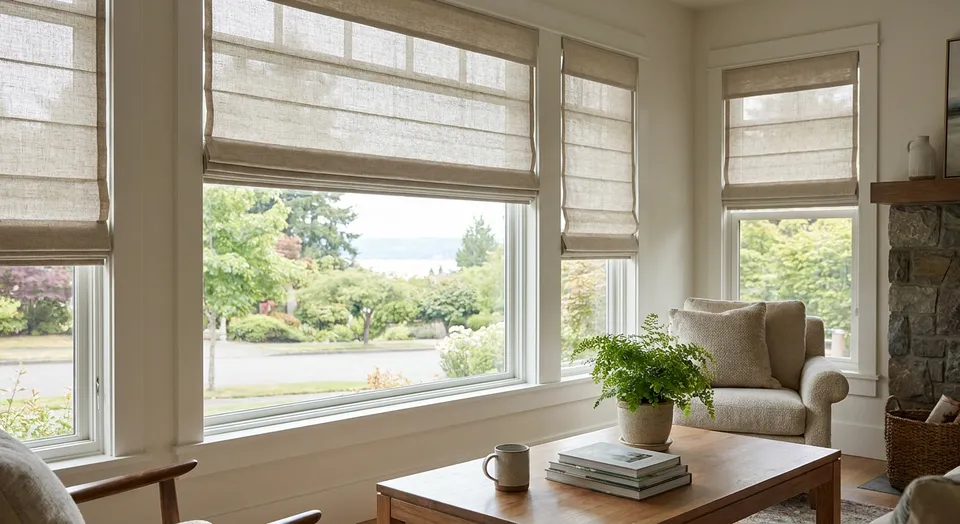
University Place homeowners deal with big view windows facing Puget Sound, older craftsman ramblers with odd window sizes, and salt air that ages cheap vinyl fast, custom blinds for University Place, WA need to handle all three.
- Cellular shades win for University Place view homes that face west-facing glare off the Sound. Buy them for living rooms.
- Motorized shades are the right call for tall or hard-to-reach windows common in split-level homes here.
- Big-box blinds bought off the shelf rarely fit Pierce County's older double-hung windows. Measure custom or skip it.
- Roller shades stay the safe, budget pick for bedrooms and kids' rooms in 2026.
- Custom blinds university place wa buyers should prioritize local install crews over online kits for anything over 40 inches wide.
Why this matters
University Place sits close enough to the water that afternoon glare off Puget Sound is a real problem, not a decorating preference. Homes here also skew older, craftsman ramblers and split-levels from the 60s and 70s with window openings that don't match modern stock sizes.
That combination means a lot of homeowners buy blinds twice: once from a big-box store or an online kit, then again from someone who actually measures the window. Rainier Blinds measures and installs with its own crew across the Greater Seattle Area, which is the difference that matters when a window is 3/8 inch off standard.
Who this is for
This guide is for University Place homeowners replacing dated mini-blinds or bare windows in a house built before 1990, especially anyone with west- or water-facing rooms that get hit with direct glare in the late afternoon. It's also for anyone comparing an online blind kit against a local install and wondering if the price gap is worth the risk.
What to look for in custom blinds for University Place homes
Glare control for water-facing rooms
A living room facing Puget Sound gets low, direct afternoon sun for months at a time, and standard slat blinds don't cut it without leaving gaps. Cellular and honeycomb shades trap that light in a pocketed cell structure, which cuts glare without blacking out the view entirely.
Fit for non-standard window openings
Homes built in University Place before the 1990s commonly have window openings that run a half-inch or more off modern factory sizes. A roller shades vs cellular shades comparison only matters once the shade actually fits the frame, stock sizes from a big-box store routinely miss by enough to leave light gaps on both sides.
Motorization for tall or awkward windows
Split-level homes put windows over stairwells, above kitchen sinks, or twelve feet up a vaulted living room wall, all spots where a pull cord is either useless or dangerous. Motorized shades solve that with a remote or wall switch, and 2026 pricing on battery-powered motors has come down enough that it's no longer a luxury add-on for a single hard-to-reach window.
Local measuring and install support
A local measuring visit can identify out-of-square openings, mounting constraints, and suitable products before ordering. Any preparation or correction needed is discussed as part of the project scope.
Child and pet safety
Cordless and motorized options remove looped cords entirely, which matters in any University Place household with kids or pets under school age. Cellular shades and roller shades both come in cordless versions as a baseline in 2026, not a premium upgrade.
Warranty and repair access
A blind that jams six months in is only a minor problem if someone local can fix it fast. A warranty backed by a company with no physical presence in the region means shipping a broken headrail back and forth for weeks.
Top picks for University Place homes
Cellular (honeycomb) shades. The glare fix. Cell depths run from 3/8 inch to 3/4 inch, and the deeper cell rates higher for insulation in a house with older single-pane windows. Buy for any water-facing living room or bedroom dealing with afternoon glare.
Roller shades, the safe, everyday pick. A single flat fabric panel with no slats to dust, available in blackout or light-filtering weaves. Buy for bedrooms, kids' rooms, and any room where budget matters more than a design statement.
Motorized shades, the wildcard for hard-to-reach windows. Remote or app control eliminates the pull cord problem on stairwell windows and vaulted living rooms. Check the motorized shades guide before ordering, motor battery life and mounting depth vary enough between brands that this isn't a one-size decision. Consider if you have at least one window over 8 feet off the floor; skip it for standard bedroom windows where a cord works fine.
Zebra shades. The light-control layering option. Alternating sheer and solid fabric bands let you dial light in increments instead of an all-or-nothing pull. Consider for home offices and dining rooms where you need to adjust light through the day without full blackout.
Drapery. The finishing layer. Paired over roller or cellular shades, drapery adds a soft-close look and an extra layer of insulation for west-facing rooms. Full custom window treatments that combine drapery with shades run more than shades alone, so consider it for living rooms and primary bedrooms rather than every window in the house.
What to avoid
- Stock big-box blinds on non-standard windows. They look fine boxed on a shelf but leave a half-inch gap on either side once installed in an older University Place frame. That gap is where the glare gets back in.
- Online kits shipped without a local measure. A kit priced lower on paper often ends up costing more once a homeowner pays separately for a fix when the mount doesn't sit flush.
- Corded blinds in a house with young kids or pets. Cordless versions exist at the same basic tier in 2026, there's no reason to install a corded set in a family home anymore.
Get real pricing for your windows
A measure and quote from a local crew, not a stock size guess.
Verdict comparison
| Option | Best for | Verdict |
|---|---|---|
| Cellular shades | Water-facing glare, older single-pane windows | Buy |
| Roller shades | Bedrooms, budget rooms | Buy |
| Motorized shades | Tall or stairwell windows | Consider |
| Zebra shades | Home offices, dining rooms | Consider |
| Drapery layer | Living rooms, primary bedrooms | Consider |
FAQ
What's the best custom blinds option for University Place, WA homes?
Cellular shades handle glare from Puget Sound-facing windows better than standard blinds because their honeycomb cells trap light instead of just angling slats. Roller shades are the better pick for bedrooms and lower-glare rooms where budget matters more.
Are motorized shades worth it for a University Place home?
Motorized shades are worth it for windows over 8 feet high or above stairwells where a pull cord isn't practical. For standard bedroom or kitchen windows, a manual cordless shade does the job at a lower cost in 2026.
Do big-box store blinds fit older University Place homes?
Big-box blinds are cut to standard factory sizes, and many University Place homes built before 1990 have window openings a half-inch or more off that standard. A custom measure avoids the gaps that let light and glare back in.
How much does it cost to have blinds professionally measured and installed?
Pricing depends on the number of windows, shade type, and whether motorization is added, and it varies enough between homes that an on-site quote is the only accurate number. Ask for pricing for your selected products rather than an online estimate that assumes standard window sizes.
Are cordless blinds safe for homes with kids or pets?
Cordless controls avoid exposed operating pull cords. Follow the product safety instructions and keep beds, furniture, and other climbing objects away from windows. Confirm which controls are available on the selected shade; Rainier Roman and woven wood products are motorized only.
What's the difference between roller shades and cellular shades?
Roller shades are a single flat fabric panel best for straightforward light control at a lower cost, while cellular shades use pocketed cells that add insulation and cut glare more effectively. Water-facing rooms in University Place generally do better with cellular shades.
Can I add motorization to shades later instead of at install?
Our automation service is for Rainier-supplied shades. We confirm whether the exact product supports the requested controls; we do not promise motor or cordless conversions for customer-owned shades.
One last thing
The window most University Place homeowners skip is the smallest one. A bathroom or stairwell window they figure isn't worth custom sizing. That's usually the exact window with the worst fit problem, since small odd-sized openings get the least attention from stock manufacturers in the first place.