
Our available controls: Rainier Blinds offers Roman and woven wood shades with motorized operation only. Available controls and power options for other products are confirmed at your consultation.
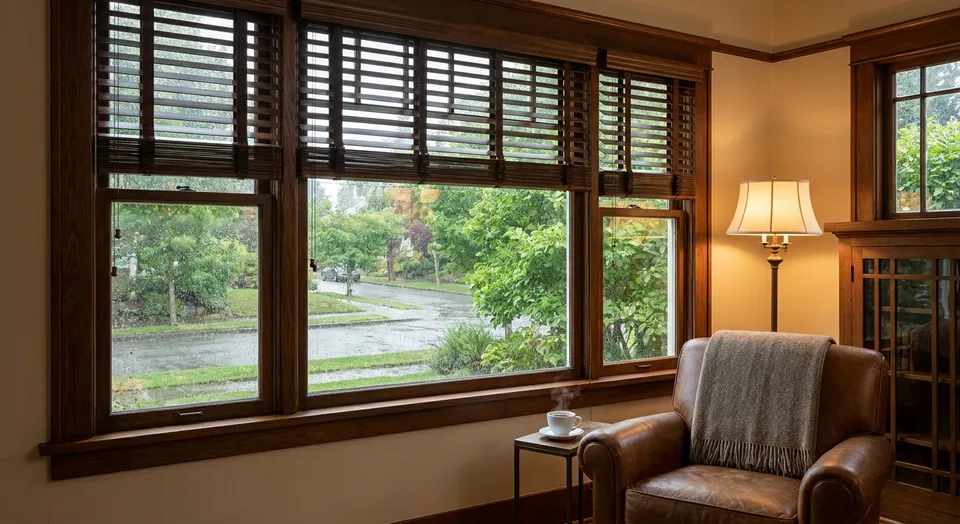
Seattle's historic homes, Craftsman bungalows in Wallingford, Victorians in Capitol Hill, Tudor Revivals in Mount Baker, have window openings that predate every standard blind size sold today, and that single fact drives most of the decisions in this guide.
- Cellular shades win for historic Seattle windows with narrow jamb depth. Buy them for cordless lift and tighter light control.
- Woven wood shades match original trim tones better than plastic or vinyl alternatives. Consider them for street-facing rooms.
- Skip stock vinyl mini blinds on pre-1940 sash windows; they warp and rarely fit true-to-size openings.
- Battery-powered motorized roller shades avoid cutting new wiring into original plaster, a solid pick for upper-floor windows.
- Custom shades for historic homes Seattle buyers need almost always require field measurement, not catalog sizing.
Why This Matters
A lot of historic homes in Seattle lose their character to window treatments that were never built for them. Vinyl mini blinds bought off a big-box shelf get forced into openings that are a half-inch out of square, and the mullion pattern on a 1912 Craftsman sash disappears behind a shade that was sized for a 2010 tract house. Getting this right protects both the look of the house and its resale value, and it starts with knowing what to measure before you buy anything.
Rainier Blinds measures and installs custom shades and drapery across the Greater Seattle Area, including homes built well before modern window standards existed.
Who This Guide Is For
This guide is written for owners of pre-1950 homes in Seattle proper and the surrounding neighborhoods, Craftsman bungalows, Victorians, Tudor Revivals, and Foursquares with original wood sash windows, plaster walls, and trim profiles that no longer match anything sold in a standard catalog. If your windows are out of square by more than a quarter inch, or your jamb depth is under 2 inches, this is your buyer profile.
What to Look For in Custom Blinds for Historic Homes
Jamb Depth and Mount Type
Most pre-1940 Seattle homes have jamb depths under 2 inches, which rules out a lot of inside-mount cellular and roller products designed for modern 3.5-inch-deep frames. An outside mount solves the depth problem but changes how the window reads from the street, so this decision has to happen before you finalize anything.
Material Match to Original Trim
Fir, oak, and cedar trim ages to a specific tone that plastic and vinyl blinds rarely replicate. Woven wood shades in a matched tone hold their value in a resale conversation far better than a plastic slat that photographs fine but looks wrong in person after a year of Seattle light.
Light Control on Divided-Light Windows
Divided-light and true-divided sash windows have visible mullions that a poorly chosen shade will hide entirely, killing the architectural detail you're paying to preserve. Roller shades vs. cellular shades each solve this differently, cellular shades stack tighter and preserve more of the visible mullion when raised.
Motorization Without Touching Original Wood
Any motorized system that requires cutting a channel into original wood trim or fishing wire through plaster is a bigger project than most homeowners want. Battery-powered lift systems avoid that entirely and can be installed on original sash windows in under an hour per window.
UV and Heat Protection for Original Finishes
Original fir floors and wood trim fade and dry out under direct sun exposure faster than modern engineered materials. A cellular shade with a tighter honeycomb typically cuts more heat transfer through a single-pane historic sash than a basic roller shade, which matters most on south- and west-facing rooms.
Top Picks for Seattle's Historic Homes
Cellular shades, the light-control workhorse. Cordless lift, tight honeycomb construction, and a stack height that clears narrow jamb depth without an outside mount in most cases. This is the pick for original sash windows with under 2 inches of depth. Buy.
Woven wood shades, the historic match. Available in natural weaves and tones that track close to original fir or oak trim, unlike plastic alternatives that read flat under direct light. Best for street-facing rooms where the interior view from outside matters to the block's character. Buy.
Roman shades, outside mount, the soft-look pick. An outside mount hides frame irregularities common in 100-plus-year-old openings, and the fabric fold softens a room without competing with ornate trim. Best in formal rooms, dining rooms, front parlors, where a slatted look feels too utilitarian. Consider.
Battery-powered roller shades may reduce the need for new wiring in a historic room. Confirm the specific headrail, sash clearance, mounting permissions, power, and controls before selecting a product.
Exterior/outdoor shades on street-facing facades. The one to skip. Many Seattle historic overlay districts restrict exterior-visible changes without a landmarks review, and an exterior shade mounted to original siding or trim can trigger that review even when the product itself is reversible. Skip for street-facing installs until you've confirmed the property's designation status.
What to Avoid
- Stock vinyl mini blinds. They're sized for modern openings and rarely fit a historic sash without visible gaps at the jamb.
- Adhesive or tension-mount shades on plaster. Plaster walls in pre-1950 Seattle homes crack under tension hardware that's rated for drywall.
- Full rewired motorization without a landmarks check. Cutting channels into original trim for hardwired motors is a bigger commitment than most owners realize once the wall is opened up.
Verdict Comparison Table
| Criteria | Cellular Shades | Woven Wood Shades | Roman Shades | Motorized Roller |
|---|---|---|---|---|
| Fits under 2" jamb depth | Yes | Sometimes | Outside mount only | Yes |
| Matches original trim tone | Neutral | Best match | Good | Neutral |
| Preserves visible mullions | Best | Good | Fair | Good |
| Install without new wiring | Yes | Yes | Yes | Yes (battery) |
| Verdict | Buy | Buy | Consider | Consider |
FAQ
What's the best window treatment for a historic home in Seattle?
Cellular shades are the best default for pre-1940 Seattle homes because they fit narrow jamb depths and preserve visible window mullions when raised. Woven wood shades are the better pick when trim tone matching matters more than stack height.
Are custom blinds worth it for an older home versus stock sizes?
Yes, because most historic Seattle window openings are out of square by more than the tolerance stock blinds are cut to, which shows as visible gaps at the jamb. Custom measurement solves that fit problem directly.
Can you motorize blinds in a historic home without rewiring the walls?
Battery-powered motorized lifts avoid cutting into original plaster or trim entirely, and they install on existing sash windows in about an hour per window in most 2026 installs. Hardwired systems require more invasive work and a closer look at any landmarks restrictions first.
Do historic districts in Seattle restrict window treatments?
Interior window treatments are generally unrestricted, but exterior-visible changes on designated historic properties can require a landmarks review before installation. Check the property's designation status before mounting anything visible from the street.
What's the difference between roller shades and cellular shades for old windows?
Cellular shades stack tighter and insulate better against heat transfer through single-pane historic glass, while roller shades mount flatter and work well on wider, more modern openings. Narrow jamb depth on pre-1940 sash windows usually favors cellular.
How much depth do you need for inside-mount blinds on old windows?
Most inside-mount products need at least 2 to 2.5 inches of jamb depth, which many pre-1940 Seattle sash windows don't have. An outside mount solves the depth issue when the jamb is too shallow.
Do woven wood shades fade or warp in Seattle's climate?
Woven wood shades hold up well in Seattle's moderate, low-humidity-swing climate compared to coastal or desert markets, though direct west-facing sun exposure will still dry and lighten the finish over years. Adding a light cellular layer behind them helps slow that fading.
Should I get outside mount or inside mount for a historic window?
Outside mount is the safer default for historic windows because it hides an out-of-square frame and doesn't depend on shallow jamb depth. Inside mount looks cleaner when the frame and trim are in good original condition and depth allows it.
One Last Thing
The detail most homeowners miss in 2026 is that a single historic house can need three different mount types across its windows, inside mount in a squared-up bay window, outside mount on an original sash that's shifted a quarter inch over a century, and battery motorized on a stairwell window nobody wants to reach with a pole. Measuring room by room instead of settling on one product for the whole house is what actually protects both the trim and the budget.