
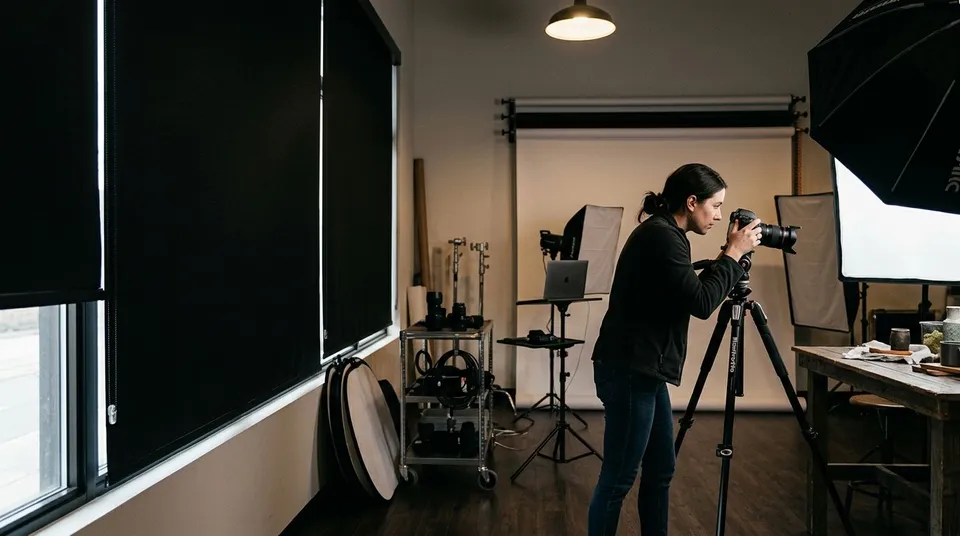
Blackout shades for photography studios need to block essentially all ambient light so a shoot's exposure and color temperature stay consistent from the first frame to the last, and the shade has to disappear from camera view the moment it isn't doing that job. A home nursery or bedroom can tolerate a thin line of light around the edges. A working studio cannot, because that line shows up as a flare or a warm cast on every take shot near it.
- Blackout shades for photography studios work best with side channels that seal light leaks along the window frame.
- Rainier Blinds installs blackout roller and cellular shades with sealed side tracks across the Seattle area in 2026.
- Motorized blackout shades let a studio reset lighting between shoots without an assistant walking to a wall switch.
- Skip standard room-darkening fabric. Studios need a true blackout liner rated for near-zero light transmission.
Why this matters
A photography studio isn't judging a shade on comfort or decor, it's judging a shade on whether a monitor stays dark during a 30-second exposure test. Standard room-darkening fabric, the kind sold for bedrooms, still passes a visible glow at the fabric surface and around the frame edges. That glow reads as inconsistent exposure between shots taken five minutes apart as the sun moves outside.
Rainier Blinds measures and installs custom blackout shades for homes and small business spaces across Auburn, Bellevue, Tacoma, and the wider Seattle area, and studio conversions inside a garage, a spare bedroom, or a rented commercial unit all run into the same problem: the window was never built for controlled light. Fixing that means choosing the right fabric rating, the right mount, and the right side seal, not just ordering the darkest fabric on a swatch card.
Why blackout shades matter for photography studios
A studio window behaves differently depending on the time of day and the direction it faces, and a shade that looks fully closed at 10am can leak a visible strip of afternoon sun by 3pm as the sun angle shifts. Standard blinds with slats can't close that gap at all since even a fully rotated slat leaves microscopic light paths between each one, which is one reason blinds with movable slats don't work for this use case the way a continuous blackout shade does.
Studios shooting product photography or video content also need the shade to stay flat and light-tight when fully lowered for hours at a time, not just closed briefly like a bedroom shade at bedtime. That's a different demand than most residential buyers are shopping for, and it changes which fabric weight and mount type actually solve the problem.
Audit your studio's light leaks
Start with a walkthrough, not a fabric order. Most leak points are predictable once you know where to look.
- Walk the room at your brightest shoot time of day and mark every visible gap with tape
- Check window frames closely, older single-hung windows common in converted garages and rented lofts warp slightly and leave gaps a newer window wouldn't
- Turn the lights off, roll or record for 30 seconds, and review the footage for leak points a naked eye misses
- Log east-facing and west-facing windows separately since the leak location changes as the sun moves through the day
Choose the right opacity rating
Not every fabric labeled blackout actually blocks light the same way, and this is where most studio buyers get burned.
- Room-darkening fabric blocks most but not all light and still shows a soft glow at the fabric surface and edges
- True blackout fabric blocks light transmission close to 100% and shows no glow on camera even at a long exposure
- Ask to hold a fabric sample up to a bright window before ordering, not a swatch under indoor lighting, since indoor light hides the difference
- Match liner weight to window size, a larger pane needs heavier blackout backing to stay flat and light-tight under its own weight
For a deeper walkthrough on picking between opacity levels, see choosing shade opacity for privacy versus natural light control.
Pick a mount and side channel that seals the frame
This is where the fabric choice stops mattering if the mount leaks around it.
- Inside mount hides the shade inside the window frame but leaves a small gap on wide, uneven, or bowed openings
- Outside mount with side channels covers frame edge to edge and closes the light gap an inside mount can't
- A crew that measures each window individually can fit side channels tight enough to eliminate the strips of light that leak around a standard blackout roller shade
- For rented studio space, ask about mounting options that don't require drilling into shared or leased walls
Decide between manual, motorized, and smart operation
Operation type changes how fast you can reset a room between shoots, which matters more in a working studio than a bedroom.
- Manual shades cost less to install and work fine for a studio with one fixed shooting window
- Motorized shades reset a room's lighting in seconds between setups without an assistant walking across the room
- Smart shades group into scenes, so one tap drops every shade in a multi-window studio at once
- Battery-powered motorized units skip the wiring work a hardwired motor needs, useful in a rented or converted space
A similar setup, tuned for creative work instead of retail shoots, shows up in home recording studios, where the same motorized reset logic applies to sound isolation instead of light isolation.
Get a studio window measured right
Free in-home consultation, real pricing on the spot, own crew handles the install.
Layer shades with blackout drapery for zero-light scenes
Some video and long-exposure work needs a second layer beyond even a sealed roller shade.
- Add a drapery panel over the shade track to catch any sliver of light a single shade might miss
- Choose a drapery lining rated for blackout, not just a heavy decorative fabric that only dims light
- Mount the drapery rod wider than the window so the panel closes past the frame, not just across it
- Reserve this layered approach for rooms doing long-exposure or night-simulation shoots, it's overkill for a standard product photography setup
Plan for quick light resets between shoots
- Group shades on one remote or app scene so a full studio blackout drops in a single tap
- Test the reset time before a paid shoot, a well-installed motorized shade closes a large window in well under a minute
- Keep a manual backup plan for any zone near an outlet that could lose power mid-session
- Label each shade zone by wall or backdrop so an assistant can adjust one window without hunting for the right remote
Maintain consistent color temperature across sessions
- Pair blackout shades with the same color-temperature lighting setup on every shoot day
- Check the studio at a consistent time of day if you're using shades to dim rather than fully block outdoor light
- Avoid off-white or cream blackout fabric near the shooting area, it can cast a warm tint onto light-colored backdrops
- Replace blackout fabric once it starts to yellow with age, since a faded liner changes how much light it actually reflects back into the room
Comparing blackout shade options for a photography studio
| Option | Best for | Key limitation | Verdict |
|---|---|---|---|
| Blackout roller shades with side channels | Studios needing full blackout at one fixed window | Fixed once installed, less flexible for multi-angle setups | Buy |
| Blackout cellular shades | Studios wanting insulation and light block in the same shade | Bulkier stack height on very tall windows | Consider |
| Motorized blackout roller shades | Studios resetting light between shoots on a schedule | Needs power or a charged battery, motor upkeep matters | Buy |
| Blackout drapery layered over a shade | Studios needing zero measurable leak for video work | Takes more wall space, needs a wider rod than the window | Consider |
Motorized blackout roller shades with sealed side channels are the strongest default for a working photography studio in 2026 because they close a full-size window fast, block light at the frame, and don't need someone walking the room between takes.
“The biggest light leak in a photography studio isn't the fabric, it's the half-inch gap on either side of an inside-mounted shade.”
Common mistakes photography studios make
- Ordering fabric marketed as blackout without checking the transmission rating, some room-darkening lines use the word loosely and still glow under studio lights
- Skipping side channels and assuming an inside mount is tight enough, gaps show up as line flares in wide-angle shots even when the fabric itself is fully opaque
- Choosing manual shades for a multi-window cyclorama wall, then losing shoot time raising and lowering each one by hand between setups
- Installing white or cream blackout fabric near a warm-toned backdrop and picking up bounced color the shade wasn't set up to block
- Mounting the shade box exposed in frame instead of recessed or hidden, which then shows up in wide shots and needs cropping out in post
A studio deciding between blackout and a screening-room-grade setup should compare notes with commercial screening and media rooms, since the light-control math is nearly identical even though the use case differs.
FAQ
What's the best blackout shade for a photography studio?
Motorized blackout roller shades with sealed side channels are the strongest default for a working studio in 2026 because they close fast and block light at the frame edge, not just at the fabric surface.
Do blackout shades really block 100% of light?
True blackout fabric blocks light transmission close to 100%, but the shade only performs that way if the mount and side channels are sealed too. A gap around an inside-mounted shade lets light through regardless of the fabric rating.
Are motorized blackout shades worth it for a studio?
Yes for any studio resetting lighting between multiple shoots in a day, since a motorized shade drops or raises in seconds without an assistant walking to a wall switch. A single fixed shooting window can get by on manual shades instead.
Can blackout shades replace blackout curtains in a studio?
For most fixed windows, yes, since a sealed blackout roller shade with side channels blocks light as well as heavy drapery. Layering drapery over the shade is only necessary for long-exposure or night-simulation shoots that need zero measurable leak.
How much light leaks around a standard blackout roller shade?
An inside-mounted shade without side channels typically leaves a visible gap along both edges of the frame, which is the most common leak point in a converted studio window. Outside mounting with sealed side channels closes that gap.
What's the difference between room-darkening and blackout shades?
Room-darkening fabric blocks most light but still shows a soft glow at the surface and edges, which reads as inconsistent exposure on camera. Blackout fabric is rated to block light transmission close to 100% and shows no glow under studio lighting.
Do blackout shades affect color temperature in photos?
Off-white or cream blackout fabric can bounce a warm tint onto a light backdrop near the window, so studios should stick to neutral or dark fabric colors near the shooting area. A faded or yellowing liner changes reflected light over time as well.
Can Rainier Blinds install blackout shades in a rented studio space?
Rainier Blinds measures and installs blackout shades using mounting options that don't require drilling into shared or leased walls, which matters for a rented commercial unit or a converted garage studio. A free in-home consultation covers which mount fits the specific lease terms.
One last thing
The fabric almost never causes the light leak. The gap around an inside-mounted shade does, and it's the single most common fix a studio skips because it looks like a cosmetic detail rather than a functional one. Switching to an outside mount with sealed side channels closes that gap without changing which fabric or which brand of shade sits behind it, and it's the cheapest upgrade available before anyone spends money on a heavier blackout liner that won't fix a gap the fabric was never the problem in the first place.