
Our available controls: Rainier Blinds offers Roman and woven wood shades with motorized operation only. Available controls and power options for other products are confirmed at your consultation.
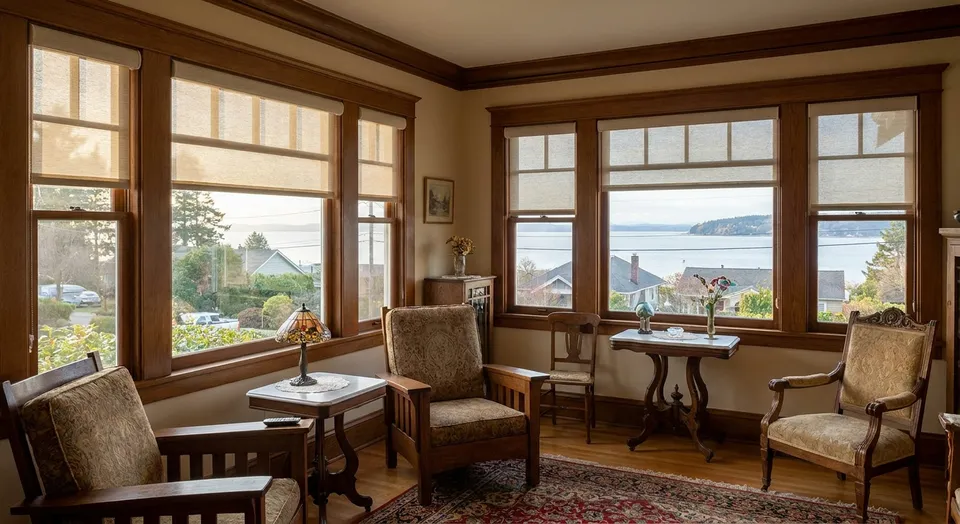
Steilacoom's historic homes come with tall double-hung windows, narrow original casings, and trim nobody wants drilled into for a bulky headrail. Motorized shades solve the reach problem on those upper sashes without wrecking the woodwork, and the 2026 lineup of low-profile motors makes that possible without visible wiring.
- Motorized cellular shades win for Steilacoom historic homes on insulation and low-profile mounting - Buy.
- Woven wood roman shades give the most period-correct look for Victorian and Craftsman windows - Buy.
- Skip motorized outdoor shades on original wood porches unless the mounting surface is confirmed sound - Consider.
- Battery-powered motors avoid cutting into 100-year-old window casings for wiring - the safer retrofit route in 2026.
Why this matters
Steilacoom is one of the oldest incorporated towns in Washington, and its historic district windows were built before anyone thought about remote controls or smart-home hubs. Original sashes are often 6 to 9 feet tall, single-pane, and set in trim that's 3/4 inch or less deep - too shallow for a lot of off-the-shelf motorized headrails sold at big-box stores.
The fix isn't finding a bigger bracket. It's picking a shade type built to mount shallow and a motor that doesn't need hardwired power run through original plaster walls. Rainier Blinds' motorized shades guide covers the mechanics of battery versus hardwired motors in more detail if you want the full breakdown before you commit.
Get this wrong and you're either drilling extra holes into casings that predate 1950, or you're stuck with a motor bulge that sticks out past the window frame. Get it right and the shade disappears into the window the way it should on a house this old.
How we ranked
Each pick below is evaluated against three things that matter specifically for Steilacoom's historic housing stock: mounting depth against narrow original casings, whether the fabric or material reads as period-appropriate rather than modern-office, and whether the motor option (battery, rechargeable, or hardwired) avoids invasive retrofit work. Product lines outside Rainier Blinds' offering - faux wood, real wood, aluminum, and venetian blinds - are excluded entirely; they aren't stocked or installed for this market and don't hold up on tall original sashes anyway. Rankings reflect installer-facing product knowledge from work across South King and Pierce County homes through 2026, not third-party lab testing.
The ranked list
1. Motorized Cellular Shades - the quiet insulator
Cellular shades trap air in honeycomb pockets, which matters more in a single-pane historic window than in a modern double-glazed one. On a drafty 1890s sash, that pocket does real work cutting the cold-glass chill in winter.
The headrail on most cellular shades in 2026 mounts in under 2 inches of depth, which clears narrow historic casings that would reject a bulkier roller or drapery track. Rainier Blinds' cellular shades line comes in light-filtering and blackout versions, both available motorized.
Verdict: Buy. This is the default recommendation for any Steilacoom historic home with original single-pane glass.
2. Motorized Woven Wood Roman Shades - the period-correct pick
Motorized woven wood shades can complement traditional trim and natural materials. Confirm the power option, visible hardware, fabric stack, and mounting method before ordering for an original window.
Rainier Blinds' custom roman shades guide covers the fabric and fold options that work best on farmhouse and Craftsman-style windows, which overlaps closely with Steilacoom's housing stock.
Verdict: Buy for front-facing rooms where the shade is part of the visible facade.
3. Motorized Roller Shades - the low-profile option
Roller shades mount the shallowest of any shade type on this list, often under 1.5 inches of headrail depth. That's the thinnest possible profile against a casing too narrow for anything bulkier.
The tradeoff is aesthetic: roller fabric leans modern, and on a strict Victorian restoration it can look out of place in a front parlor. It works better in back bedrooms, kitchens, and additions where period accuracy matters less.
Verdict: Consider for secondary rooms, Skip for the primary historic facade.
4. Motorized Zebra Shades - the light-control hybrid
Zebra shades alternate sheer and solid bands, letting you dial in light without fully closing the shade. On a house with mature trees and shifting seasonal light, that flexibility beats a fixed light-filtering or blackout fabric.
The look is contemporary, though, closer to what you'd see in a newer build than a 1900s cottage. Reserve these for sunrooms or additions rather than the original structure.
Verdict: Consider for non-historic additions.
5. Motorized Skylight Shades - the reach solved
Skylight motorization exists to solve one problem: you can't reach a shade mounted 12 feet up a sloped ceiling with a pole wand every morning. If a Steilacoom home has an added skylight (common in kitchen or bath additions, less common in original construction), motorization isn't a luxury upgrade - it's the only practical way to operate the shade at all.
Verdict: Buy if the home has a skylight; otherwise not applicable.
6. Motorized Outdoor Shades - the porch call
Steel wire and zipper-track outdoor shades work well on newer decks and patios, but original wood porch columns and railings on a historic home need the mounting surface checked before drilling. A century-old porch beam may not take standard outdoor-shade brackets without added blocking.
Verdict: Consider, contingent on a mounting-surface check by an installer before ordering.
Comparison table
| Pick | Mounting depth | Period fit | Motor retrofit | Verdict |
|---|---|---|---|---|
| Motorized cellular shades | Under 2 in | Neutral/good | Battery, no wiring | Buy |
| Motorized woven wood romans | 2-3 in | Best | Rechargeable | Buy |
| Motorized roller shades | Under 1.5 in | Modern | Battery | Consider |
| Motorized zebra shades | 2-3 in | Modern | Battery | Consider |
| Motorized skylight shades | N/A (ceiling mount) | N/A | Hardwired or battery | Buy if applicable |
| Motorized outdoor shades | N/A (exterior mount) | Depends on porch | Hardwired typical | Consider |
“If motorization is a retrofit, you shouldn't have to drill into a 100-year-old window casing to add it.”
Get a quote for historic window shades
In-home measuring for narrow original casings, no subcontractor crew.
Where to buy
- Skip the online configurator for historic windows. A casing measured wrong by 1/8 inch on a 100-year-old sash means a headrail that either won't seat or shows a gap.
- Ask who's doing the install. A crew that installs its own work day-to-day handles historic trim differently than a subcontractor doing volume installs for a big-box retailer.
- Get the motor type in writing before ordering. Battery and rechargeable motors avoid running new wiring through original walls; hardwired motors don't, and that distinction should be decided before the order goes in, not after.
FAQ
What's the best motorized shade for a historic Steilacoom home?
Motorized cellular shades are the best default for Steilacoom historic homes in 2026 because they mount in under 2 inches of depth and add insulation against single-pane original glass. Woven wood roman shades are the better pick when the room needs a period-correct look rather than maximum insulation.
Do motorized shades require rewiring an old house?
No, battery-powered and rechargeable motorized shades don't require rewiring in most cases. Hardwired motors do need an electrician, which is worth avoiding on original plaster walls unless the room is already being renovated.
Are motorized roller shades period-appropriate for a Victorian home?
Motorized roller shades read as modern rather than period-correct, so they fit better in kitchens, additions, or back bedrooms than a front parlor. For street-facing rooms on a historic facade, woven wood roman shades hold up better visually.
Can motorized shades fit narrow historic window casings?
Yes, most cellular and roller shade headrails in 2026 mount in under 2 inches of depth, which clears typical historic casings under 3/4 inch deep. Bulkier drapery hardware or wider motorized headrails may not fit without added blocking.
Is blackout or light-filtering better for historic bedrooms?
Blackout fabric is better for bedrooms facing east or west where morning or afternoon glare is strong, while light-filtering fabric works better in living rooms where you still want daylight. Both are available motorized on cellular and roller shade lines.
How much does motorized shade installation cost in Steilacoom?
Pricing depends on the number of windows, shade type, and motor option, and varies by installer. Getting an in-home measurement and quote is the only reliable way to price a specific historic window setup.
Do motorized outdoor shades work on historic porches?
They can, but the porch mounting surface needs to be checked first since original porch beams weren't built for standard outdoor-shade brackets. An installer should verify the beam or column before ordering.
What motor type is best for a historic home retrofit?
Battery power can avoid a new power cable at the window when the selected product supports it. Confirm the motor, approved charger or batteries, charging access, and any wired-power requirements before ordering. Battery life and charging time vary by model, shade size, and use. In a historic room, agree on permitted fixing locations and any preservation requirements first.
One last thing
The detail most homeowners miss on a Steilacoom historic remodel isn't the shade fabric - it's the casing depth. A shade that looks identical in a showroom can sit flush on one window and stick out half an inch on the next if the original trim wasn't milled to a consistent depth, which is common in houses built before standardized lumber sizing. Measure each window individually in 2026 rather than assuming one spec fits the whole house.