
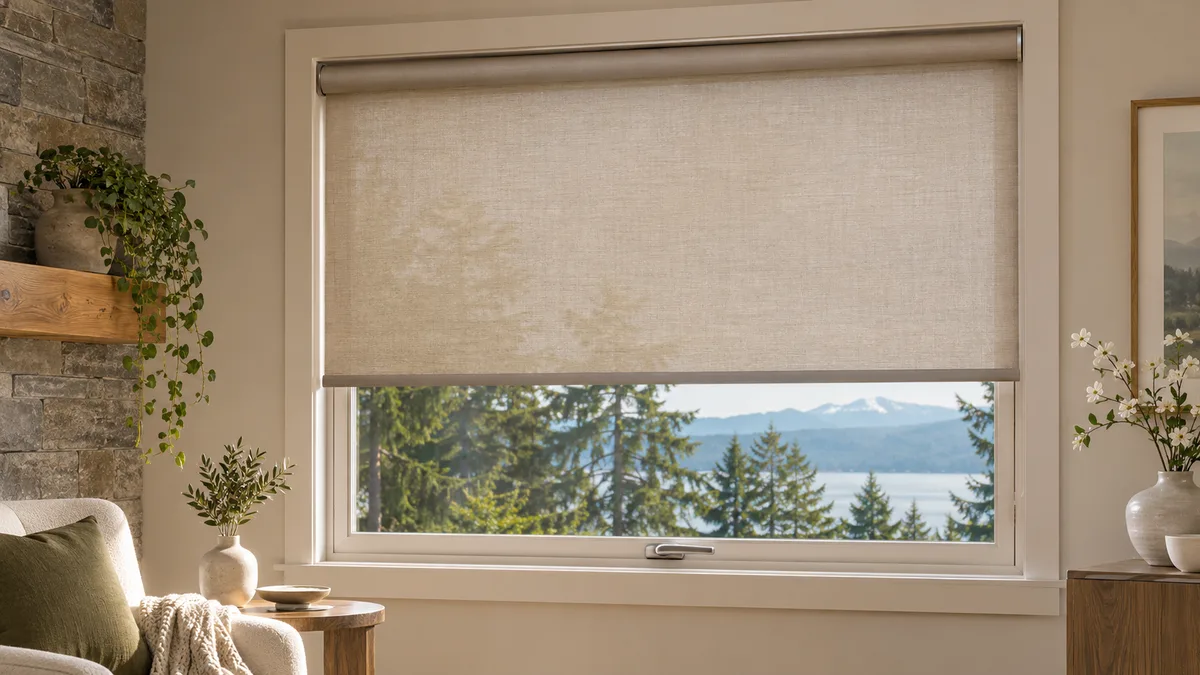
A roller shade can unwind from the back of its tube, closer to the window, or from the front, farther into the room. That small difference affects the space around handles, the appearance of the top roll, and the light you may notice around the fabric.
Start by checking how the shade will fit your window. Standard roll is a sensible starting point when the fabric clears the hardware. Reverse roll can be worth discussing when a handle needs more room or you prefer the fabric to fall in front of an exposed roller. Availability depends on the selected shade system.
Quick takeaways
- Standard roll drops the fabric behind the tube, toward the glass. Reverse roll drops it in front, toward the room.
- Compare handle clearance and edge coverage before choosing by appearance.
- Confirm roll direction together with the fabric, brackets, top treatment, and controls before ordering.
Understand where the fabric will hang
Picture the shade from the side. With standard roll, sometimes called regular roll, the fabric comes down on the window side of the tube. With reverse roll, it comes down on the room side. Hunter Douglas Hospitality illustrates both arrangements in its roller-shade specifications.
Roll direction is a separate choice from inside or outside mounting. Inside mount places the shade within the window opening. Outside mount places it beyond that opening, typically on the surrounding wall or trim. The combination that works depends on the product and available space.
At your consultation, ask where the fabric will sit, not only where the brackets will attach. A quick side-view sketch can make the difference clearer than a front-facing room photo.
Check handles and the full path of the shade
A projecting window crank or lock can sit in the path of a shade. Lutron's measuring guidance identifies reverse roll as one way to increase the space between the fabric and window hardware. Its dimensions and product restrictions apply to Lutron systems, so they should not be used as measurements for a Rainier shade.
Show the consultant how you open and lock the window. Check the handle in the positions you actually use, along with the path of the shade's bottom bar. A shade that clears a folded crank still needs a practical plan for reaching and operating it.
Ask whether the proposed layout lets you use both the window and shade comfortably. The answer may involve a different mounting position or product rather than a change in roll direction alone. Have the final arrangement measured for that particular opening.
Consider light at the edges
For a bedroom, review the complete light-control plan before deciding on reverse roll. Moving fabric farther toward the room changes its relationship to the opening. Lutron's corner-shade guidance notes that this projection can increase light bleed at outer edges, even when it helps a different gap at a corner. The result depends on the layout.
For your window, ask where light could enter at the sides and top. Look at the proposed coverage from the bed or sofa, including an angled view. Do not assume a particular roll direction will eliminate gaps.
Rainier's blackout roller shades use blackout fabric, but the finished light control depends on mounting and fit. Standard roll cannot make a light-filtering fabric opaque, and reverse roll cannot make an otherwise unsuitable layout work for a dark bedroom. Choose the fabric and installation together.
Compare the top of the shade
With an exposed roller, reverse roll lets the descending fabric sit in front of the tube. Standard roll leaves more of the wrapped roll visible from the room. If the fabric has a different backing color, ask what you will see when the shade is raised, partly lowered, and closed.
A cassette, fascia, or other top treatment can change the appearance again. Compare the complete assembly rather than deciding from a fabric swatch alone. Bali's roller-shade page shows reverse roll as a design option but excludes it with several of that brand's top treatments. This is a useful reminder that an attractive combination in a photo may not be offered in every system.
If several windows share one wall, review their top treatments and fabric positions together. For an adjoining dining area and living room, our guide to coordinating window treatments throughout the house can help you decide which visual details to keep consistent.
Confirm the configuration before you order
Reverse roll is not a universal option. The selected hardware, fabric, controls, and top treatment must be compatible. A different manufacturer's example explains the concept; it does not establish what Rainier can supply for your window.
Rainier offers light-filtering and blackout roller shades, with available control options confirmed at your visit. Ask which roll directions are supported for your exact selection. If your preferred arrangement is unavailable, compare the supported alternatives before finalizing the quote.
Record the agreed roll direction for each relevant window, along with the top treatment and fabric. Our custom shade quote checklist covers the other details to review before an order is placed.
Questions to bring to your consultation
- Where will the fabric hang relative to the glass, trim, and handle?
- Can I open and lock the window without catching the shade?
- What will the roll and fabric backing look like from the room?
- How will the proposed arrangement affect edge coverage?
- Is this roll direction compatible with my selected top treatment and controls?
- Will adjacent shades have a consistent finished appearance?
Frequently asked questions
Is reverse roll the same as reversing the motor
No. Roll direction describes where the fabric leaves the tube. Changing a motor setting is not a substitute for confirming the shade's physical configuration. Follow the instructions for the exact product and contact the installer before making changes.
Is reverse roll always better for window handles
It can create additional clearance, but it does not guarantee a workable fit. The mounting position, handle movement, bottom bar, and available product options still need to be checked.
Can I change the roll direction of an existing shade
Ask the installer to identify the shade and check the manufacturer's instructions first. Do not assume you can turn the assembly around or rewind the fabric. Whether a change is possible depends on the specific system.
Plan the fit in your home
Rainier Blinds brings fabric samples, measures your windows, and prepares a personalized quote for your selected treatments. Our own crew handles measuring and installation. We serve Auburn and communities across Greater Seattle and the South Sound.
Book an in-home consultation to compare suitable roller-shade configurations for your windows. Consultations are free within 60 driving miles of Auburn, WA, with no obligation to order. Farther-away projects are considered individually. Any travel or consultation fee is quoted before booking and credited toward your order if you proceed.